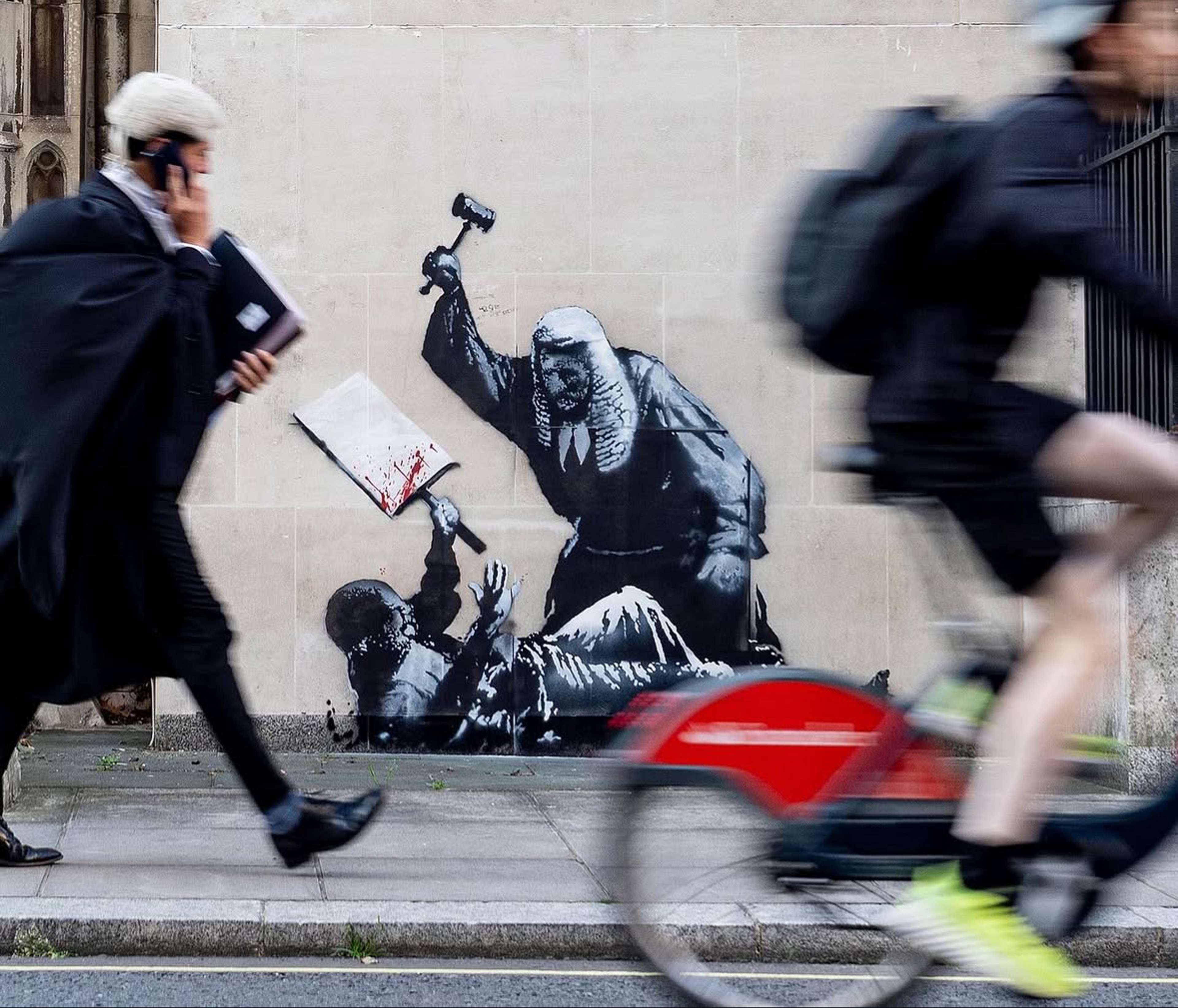


An Uncharacteristically Direct Caption
The mural was posted to Banksy’s Instagram on Monday 8th September with a caption that was unusually precise: “. Royal Courts of Justice, London”. The inclusion of the full institutional name – punctuated with a definitive full stop –is rare for an artist who typically avoids fixed meanings, let alone geotagged declarations. Here, the caption functions less as a title and more as a legal citation – deliberate, declarative, and difficult to ignore.
While the mural can be read broadly as a critique of judicial power, its placement invites sharper readings. The location a national symbol of legal authority – offers a compelling proximity to the Royal Courts’ rejection of an appeal by Palestine Action against its designation under UK legislation, and the reported arrest of over 900 pro-Palestinian protesters across the UK in the days prior. The work makes no explicit reference, but the overlap in timing, context, and institutional critique is profoundly poignant. It raises difficult, unresolved questions about how dissent is categorised, how protest is policed, and how systems of power determine which voices are heard – or silenced. The fact that the mural was quickly covered and corned off with metal barriers, without explanation, only intensifies the already palpable tension. In true Banksy fashion, the silence says as much as the statement.
Architecture as Message
What makes this work so potent is not just its imagery, but its site. By placing the mural directly onto the Royal Courts of Justice, Banksy turns one of Britain’s most imposing legal institutions into both subject and surface. The building’s gravitas – its authority, history, and architectural weight – isn’t just a backdrop; it’s part of the critique. The institution becomes complicit in the violence depicted, reinforcing the idea that systems meant to uphold justice can just as easily obscure or distort it. This reading is underscored by the surveillance camera positioned above the mural – installed to oversee public space, yet visibly turned away. It watches nothing, sees nothing, and in doing so, mirrors a system that looks without accountability. By the following day, the image had been pressure-washed from the wall – a response that almost speaks louder than the work itself. Its erasure completes the work’s argument, leaving censorship as the final statement.
As Banksy expert Jasper Tordoff puts it, “By choosing the Royal Courts of Justice, Banksy transforms a historic symbol of authority into a platform for debate. In classic Banksy form, he uses the building itself to sharpen the message, turning its weight and history into part of the artwork.” The result is a work where the setting is inseparable from the statement – where stone, stencil, and silence combine to expose a system that too often performs justice, rather than delivers it.
A Continuation of His Anti-Authority Series
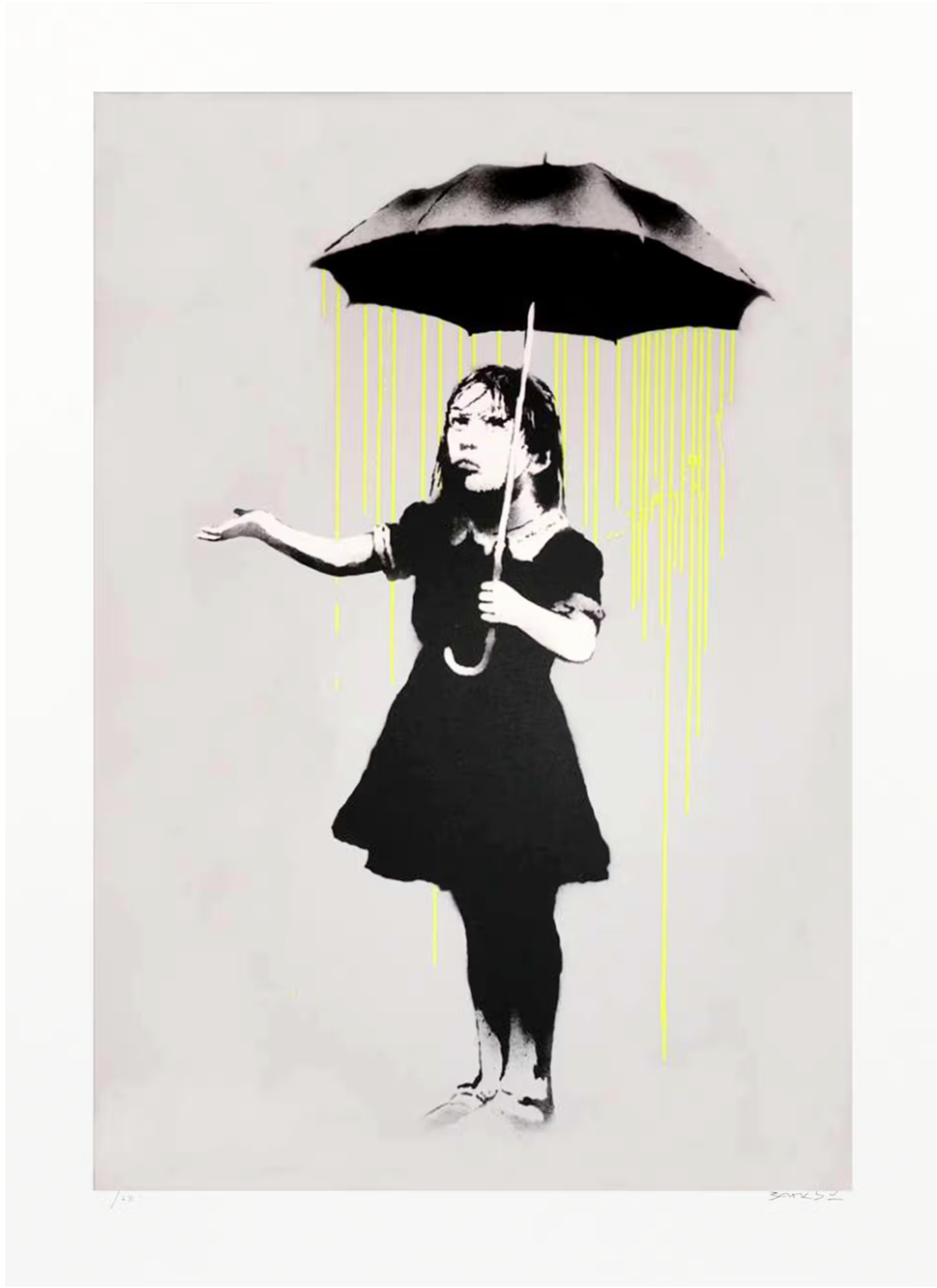
This latest mural extends a lineage of works in which Banksy confronts state authority not with abstraction, but with blunt, satirical violence. As with Rude Copper and Queen Victoria – two of his most recognisable and enduring print editions – figures of officialdom are stripped of dignity and reimagined as aggressors. The gavel, traditionally a symbol of legal order, becomes a weapon of force. The setting outside the Royal Courts intensifies the message: this isn’t parody at a distance – it’s a direct challenge to the optics and infrastructure of power.
That connection to Rude Copper and Queen Vic isn’t just visual – it’s material. These early anti-authority prints have long been touchstones for collectors precisely because they crystallise Banksy’s most confrontational themes in a form that circulates, trades, and remains relevant. In that sense, this mural doesn’t just revisit old ground – it reinforces the enduring appeal of politically charged works within the print market, where sharp messaging and institutional critique continue to resonate.
Strategic Timing Before the Autumn Auctions
Earlier this year, Banksy’s I Want To Be What You Saw In Me, Marseille offered a more introspective installation – quiet, poetic, and emotionally open. It marked a tonal shift that left some wondering whether his sharpest edges had softened. But this mural returns to the street with renewed force. It reasserts not just his political intent, but his ability to activate public space with urgent clarity – and to confront power not through symbolism alone, but through proximity, naming, and deliberate timing.
Its arrival – just ahead of the London autumn auctions – feels deliberate, marking a shift in tone and a clear return to confrontation.