Understanding Spanish Art Desires
Conducted in early 2025, the survey covered a wide range of identities, exploring how age, gender, and life experience shape artistic longing. In Spain, what emerges is the enduring power of homegrown masters: Velázquez, Sorolla, and Picasso collectively account for half of Spain’s Top 10. Their dominance speaks to a living national heritage, with artworks that trace Spain’s royal, cultural, and political history.
Patterns in the responses echo the global findings while retaining a distinctly Spanish voice. Works associated with intimacy and tenderness (Klimt’s The Kiss, Sorolla’s Madre) drew a higher share of female votes and stronger support from younger cohorts, who emphasised emotional resonance. By contrast, more monumental artworks (Michelangelo’s David, Picasso’s Guernica) tended to attract voters who stressed scale, technique and ethical force. Broadly, Millennials and Gen Z often chose works for how they feel in daily life, whereas Gen X more frequently framed their preferences in terms of canonical stature and cultural legacy.
Spanish respondents consistently chose artworks because of place. Sorolla’s canvases are praised for making Spanish light itself a subject; his beaches, patios, and interiors becoming repositories of shared memory. Velázquez functions similarly; Las Meninas is a mirror of Spain’s self-image of art, power, and spectatorship. With Guernica, many respondents link the painting’s history to broader questions about how nations safeguard difficult memories. In Spain, “ownership” is frequently reframed as stewardship, with several voters explicitly resisting the idea of private possession for certain works, insisting they remain in public museums.
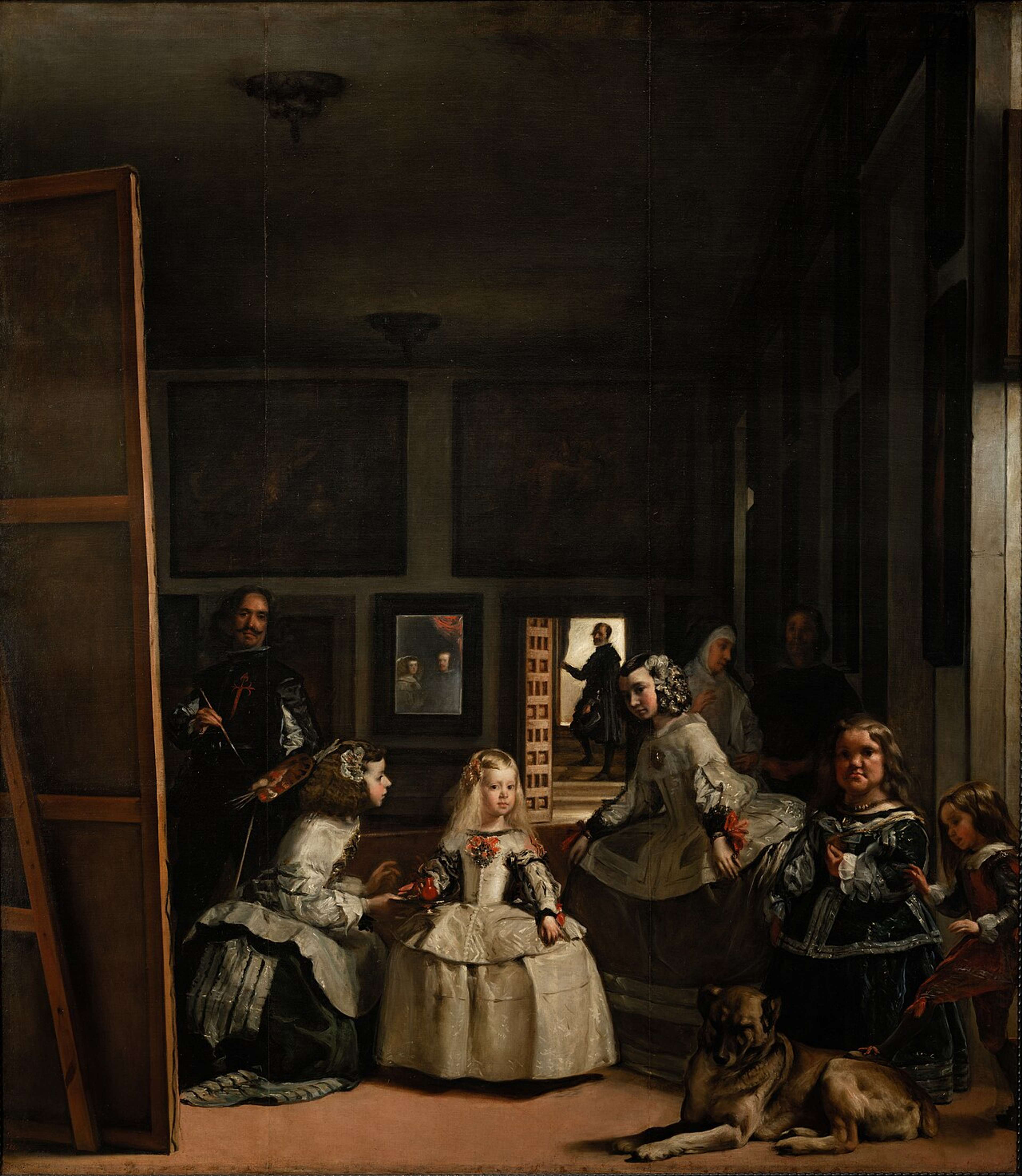
1. Las Meninas by Diego Velázquez
At the top of Spain’s list is Diego Velázquez’s Las Meninas (1656), one of the most celebrated paintings of the Spanish Golden Age and a work that has puzzled and fascinated viewers for centuries. Set in the Royal Alcázar of Madrid, the vast chamber shows the five-year-old Infanta Margarita Teresa surrounded by her attendants and a large mastiff. To one side, Velázquez paints himself at his easel, brush raised mid-stroke, while at the back a mirror reflects King Philip IV and Queen Mariana. Their spectral presence suggests they are both within and beyond the scene, standing where the viewers are, making us participants in the act of looking.
This seemingly spontaneous moment is in fact a carefully staged construction of perspective, geometry, and light. The open doorway at the rear draws the eye deep into the space, while the mirror pulls our attention back out, setting up an intriguing play between presence and absence. Even the minor figures add to the riddle: the chamberlain paused mid-step in the doorway, uncertain whether he is entering or leaving, the dwarfs whose inclusion reflects the court’s fascination with them, and the subtle red cross of Santiago on Velázquez’s chest, added years later at the king’s order. Las Meninas is often called “a painting about painting,” a meditation on illusion that has inspired artists from Manet to Picasso.
Spanish respondents overwhelmingly placed Las Meninas at the top of their list, recognising its status as a cornerstone of Spanish cultural identity and a painting that unites monarchy, artistic intellect, and shared patrimony. For Gen X respondents in particular, Velázquez remains the artist who “changed art.” Many spoke of its technical brilliance; the “air, the atmosphere, the space”, while others described the uncanny experience of standing before it as “the closest thing to time travel.” Several emphasised that it is “a piece of Spanish history.” This sense of collective ownership is so strong that many stated they would never keep it privately, even if they could, one claiming; “the amount of details linked between the history of Spain and the picture is huge.” Thus, Spain’s top pick of a homegrown masterpiece is an expression of identity, memory, and the conviction that art should transcend private possession.
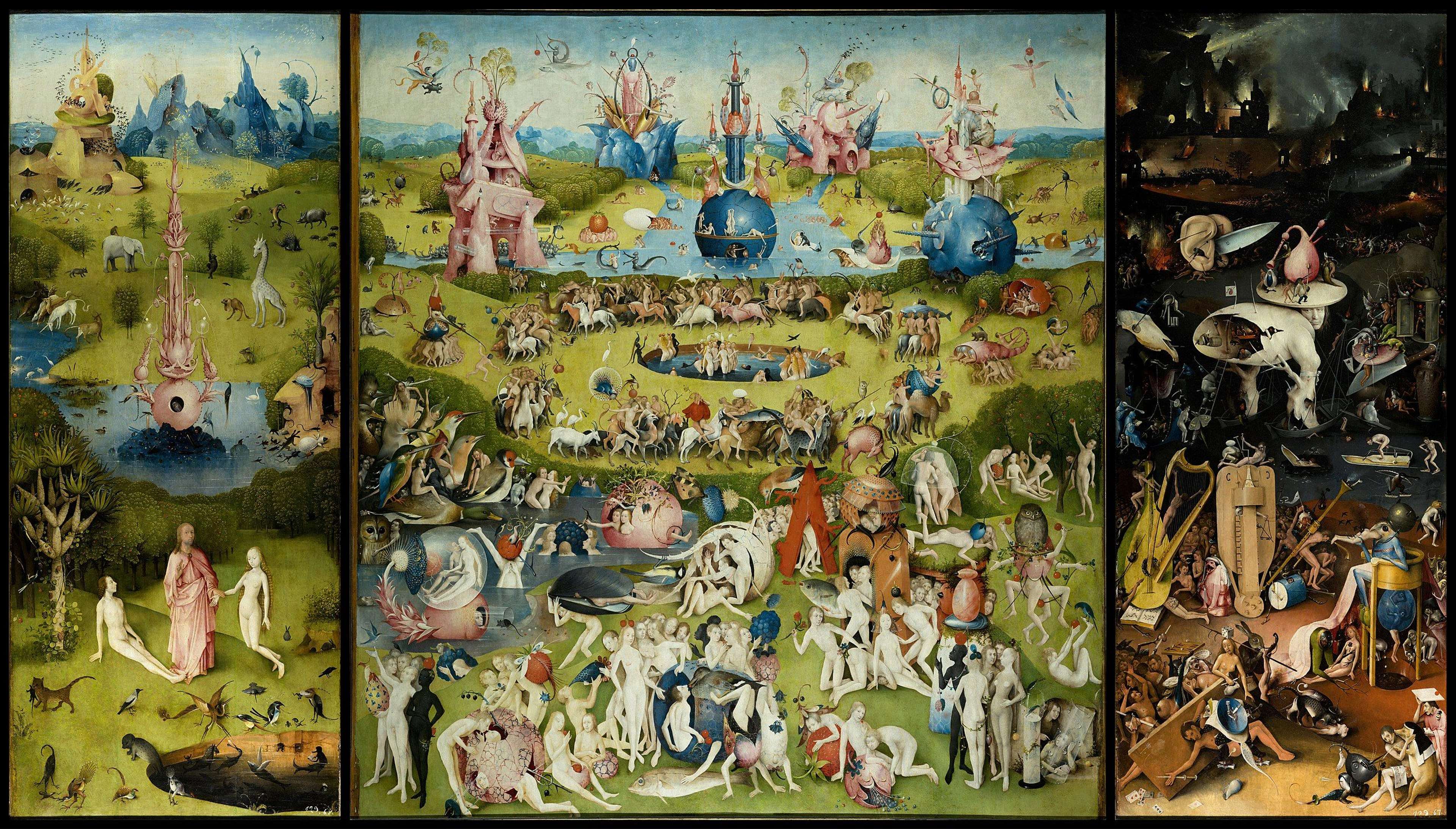
2. The Garden of Earthly Delights by Hieronymus Bosch
Taking second place is The Garden of Earthly Delights by Hieronymus Bosch, painted around 1490–1500. One of the most bewildering works of Western art, the left panel of the triptych presents a visionary Eden, with God introducing Eve to Adam, an motif associated with marriage and the divine command to “be fruitful and multiply.” What follows in the vast centre panel, however, is a deceptive paradise: a sprawling garden where nude men and women cavort among oversized fruit, strange animals, and fantastical architecture. The imagery amuses with its playfulness, but its meaning is darker - these delights are fleeting, fragile, and destined to collapse into sin. The right panel is the inevitable consequence: Hell, rendered as Bosch’s most terrifying vision of a carnival of punishment, where lust, greed, gluttony and pride all receive their gruesome due.
It is this collision of beauty and dread that continues to fascinate. Bosch fills his central panel with erotic charge: figures feasting on strawberries, riding on the backs of birds or unicorns, slipping into bubbles, shells, and blossoms. Yet his symbols speak to the brevity of such pleasures: cracked fountains and hollow fruits are subtle reminders of corruption beneath the surface. Even the continuous horizon line across all three panels insists that Eden, Earth, and Hell are bound by a single sinful thread. Scholars have debated Bosch’s intent for centuries, and the triptych’s panels continue to provoke endless conversation.
Spanish audiences respond to Bosch’s vision with an intense devotion. Chosen mainly by Millennials (60 %) and women (60 %), the triptych’s hallucinatory imagery seems to resonate with those drawn to ambiguity, symbolism, and layered storytelling. Many respondents stressed its inexhaustibility, one saying; “you could stare at it for hours and still find new things”, while others highlighted how “It portrays earth, life, death, metamorphosis, creatures and nature, but with a philosophical and religious component that catches the attention.” One respondent recalled seeing it as a child: “No matter how many times I look at it, it shows me a different story depending on the scene I focus on.” This blend of philosophical depth and kaleidoscopic variety reveals why this painting is so rooted in Spain’s artistic imagination.
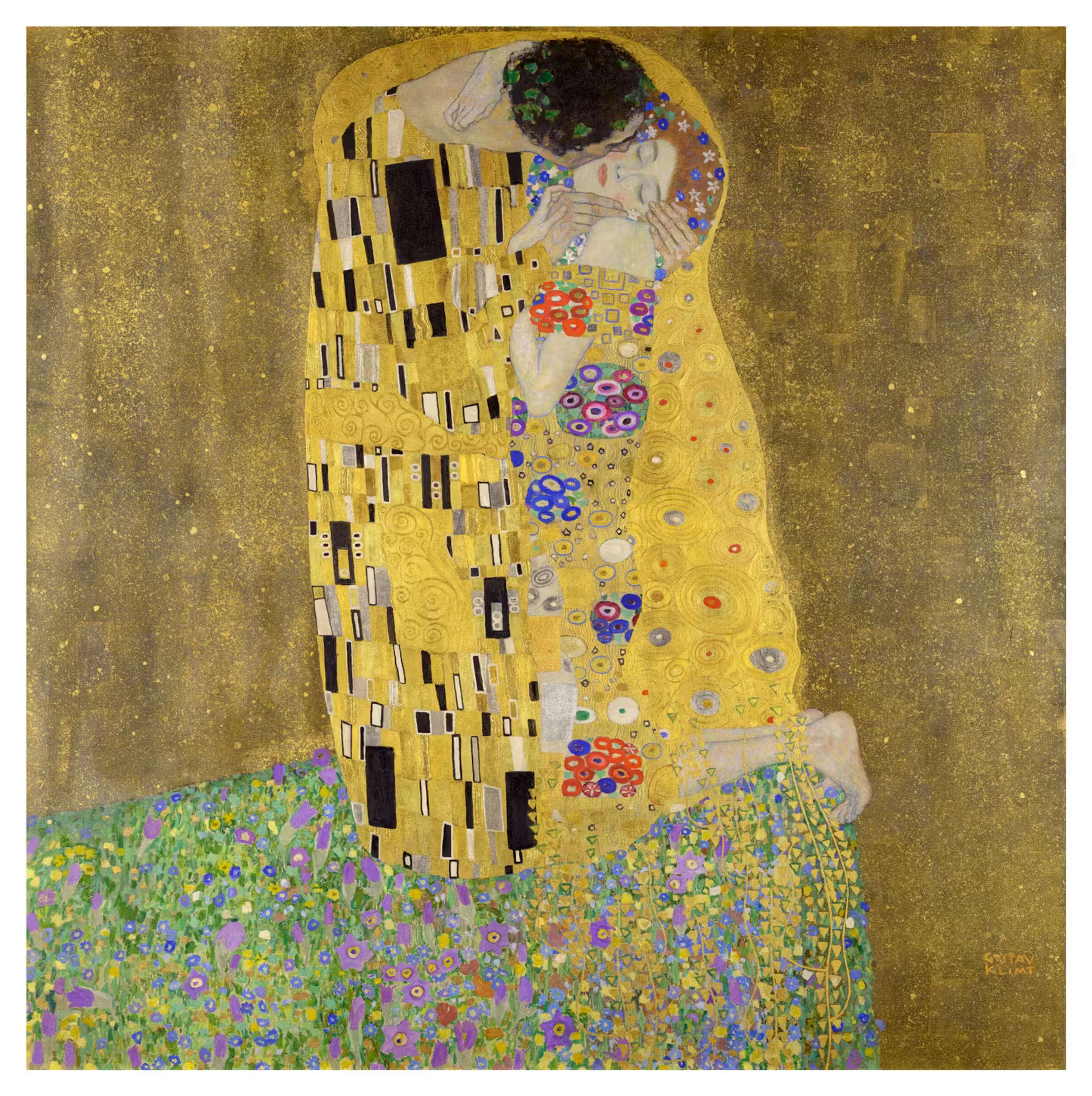
3. The Kiss by Gustav Klimt
In third place is Gustav Klimt’s The Kiss (1907–08), painted at a turning point in his career. Just a few years earlier, his ceiling murals for the University of Vienna had been condemned as obscene, damaging his reputation and prompting him to sever ties with the Vienna Secession, the movement he had helped to found. Yet from this personal and professional crisis emerged his most celebrated work. First unveiled at the Kunstschau exhibition of 1908, the painting was instantly recognised as a national treasure and the Austrian government purchased it on the first day it was exhibited.
The work captures a couple locked in an embrace, wrapped within a golden cloak that fuses their bodies into a single form. The man appears dominant, stooping over the woman’s bowed form, yet her exposed foot reveals she is kneeling, and were she to stand, she would rise above him. The effect destabilises traditional hierarchies of gender, transforming the scene into a vision of mutual reverence rather than possession. Her closed eyes and tilted head suggest a mixture of ecstasy, surrender, and serenity, while his hands cradle her face with tenderness. The couple stand on a bed of flowers that exists at the edge of an abyss, as though love is balanced between transcendence and disappearance.
For Spanish respondents, every admirer identified as female, one respondent recalling that seeing it in Vienna was “breathtaking and sparkling.” Another marvelled at its scale and splendour: “big, dreamy… a total masterpiece”, while others focused on its emotional charge: “it makes me feel like love is possible”. For those that chose it, The Kiss is the embodiment of intimacy and is repeatedly cited as a Spanish and global favourite.
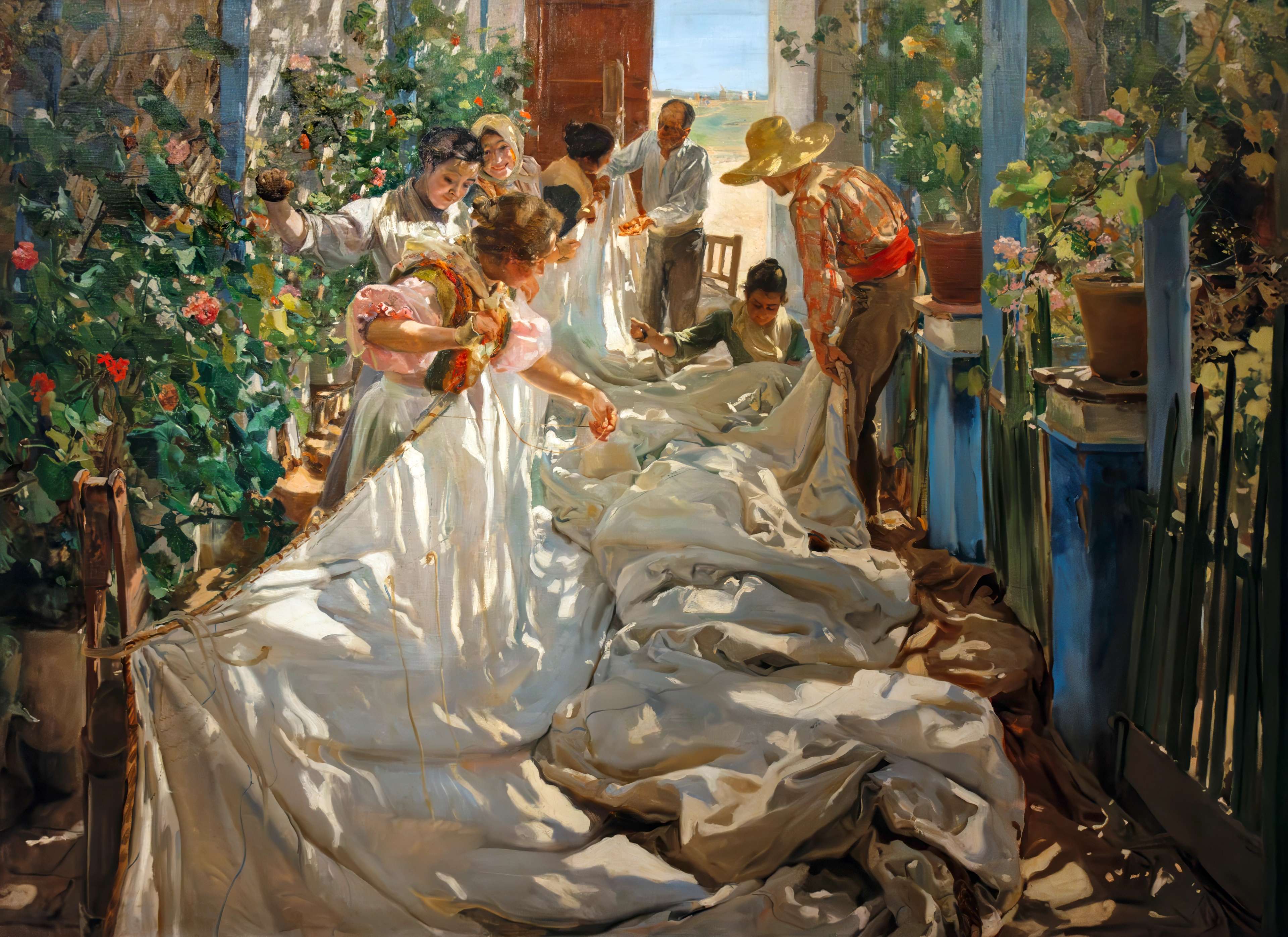
4. Cosiendo la Vela by Joaquín Sorolla
Ranking fourth is Joaquín Sorolla’s Cosiendo la Vela (Sewing the Sail), painted in 1896. The scene captures the Mediterranean in full blaze, made brilliant by Sorolla’s exquisite mastery of light. Five women and two men gather beneath a shaded patio, stitching together a vast sail. The setting is domestic yet beautiful; filtered sunlight dapples the white fabric, clothing and skin, and spills out towards an open doorway where the distant sea glows under the Valencian sun. Everywhere, colour pulses with vitality: greenery, flowering plants, and the sea transform an ordinary act of labour into a radiant act of community and place. Known as the “Master of Light,” Sorolla initially painted social realist scenes of hardship, but by the mid-1890s he had turned to the rhythms of everyday Mediterranean life, brightening his palette and chasing the fleeting sunshine.
The painting’s quiet grandeur rests in its whites: the sailcloth, garments, and reflected light are all subtly distinguished, yet equally luminous. Spanish respondents clearly felt this warmth. Half of voters were Millennials, and women made up two-thirds - many emphasising the emotional atmosphere as much as the technical brilliance. “The warmth and light of it” was a recurring sentiment, while another viewer described it as “full of joy and hope.” One respondent spoke of its immersive quality: “It’s as if I was there, with them”.
Like Velázquez, Sorolla is a Spanish artist, and his paintings have long been identified with a Spanish sense of place and identity. Whereas Velázquez depicted Spain in its courtly grandeur, Sorolla offered a vision of national life rooted in sunlight, sea air, and everyday labour. His canvases are filled with recognisable landscapes and traditions that belong to Spain itself. Choosing Sorolla is a celebration of a painter who elevated the ordinary, and who made Spain’s Mediterranean light an emblem of national pride.
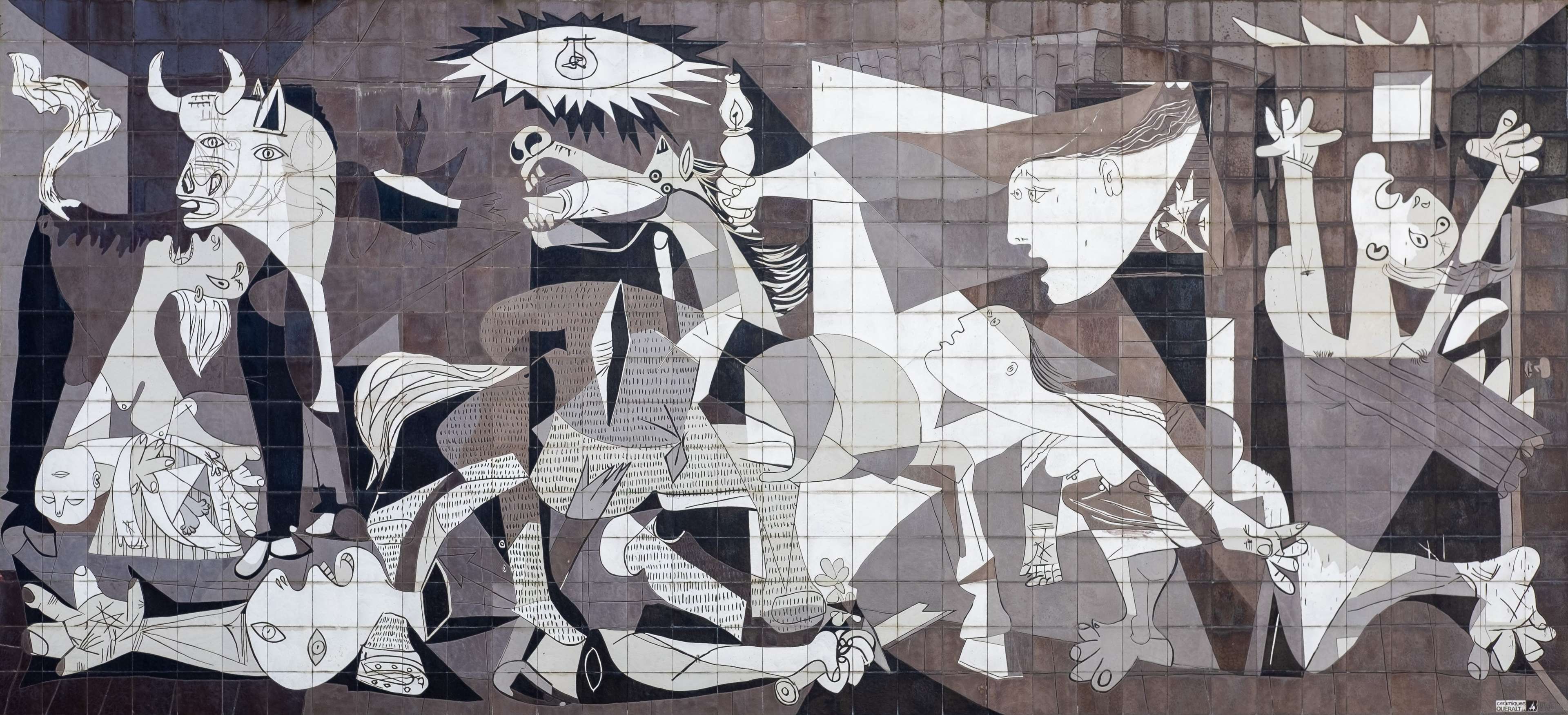
5. Guernica by Pablo Picasso
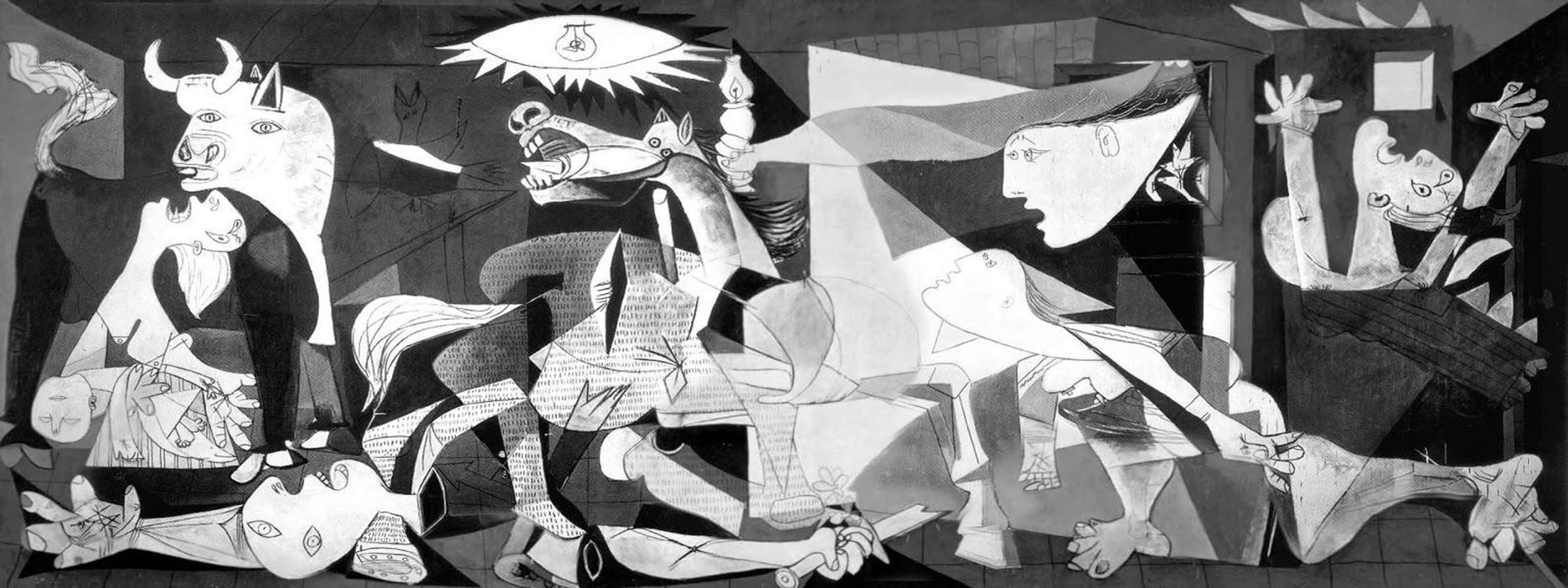
Few paintings carry as much status as Picasso’s Guernica, painted in 1937 in response to the Luftwaffe’s bombing of the Basque town during the Spanish Civil War. Standing as the artist’s most famous political statement, the canvas is 3.5 metres high and almost eight metres across, rendered in black, white, and grey. Bodies twist and collapse, a horse screams in agony, and a mother wails over her dead child, all while a bull looms implacably to one side, its meaning debated for decades. For some, the bull is a symbol of Fascism’s brutality, and devoid of romanticism, Guernica reads as a testimony to atrocity and grief.
When it was first shown at the Paris International Exhibition in 1937, Guernica attracted little notice. Yet its subsequent world tour gave the Spanish Civil War unprecedented visibility, and the painting grew into a universal symbol of protest. Picasso insisted it remain outside Spain until democracy was restored, and only in 1981, six years after Franco’s death, did it return, installed at the Museo Reina Sofía in Madrid.
Ranking fifth as Spain’s most popular artwork, Guernica’s history deepens its meaning as a Spanish national icon. In our survey, 80% of its admirers were women, with Millennials forming the largest share of voters. Some emphasised its personal meaning, one admirer saying; “Being Basque, it has a special meaning for me.” Others stressed its relevance in the present; “Its message feels more relevant than ever in today’s world.” Respondents praised its “chaotic but calculated” composition and the way it captures both “anguish and resilience.” Like Velázquez and Sorolla, Picasso anchors the Spanish list in homegrown voices, yet where Sorolla offers sunlight and community, Picasso’s artwork represents an emblem of Spanish resistance, pain, and endurance.
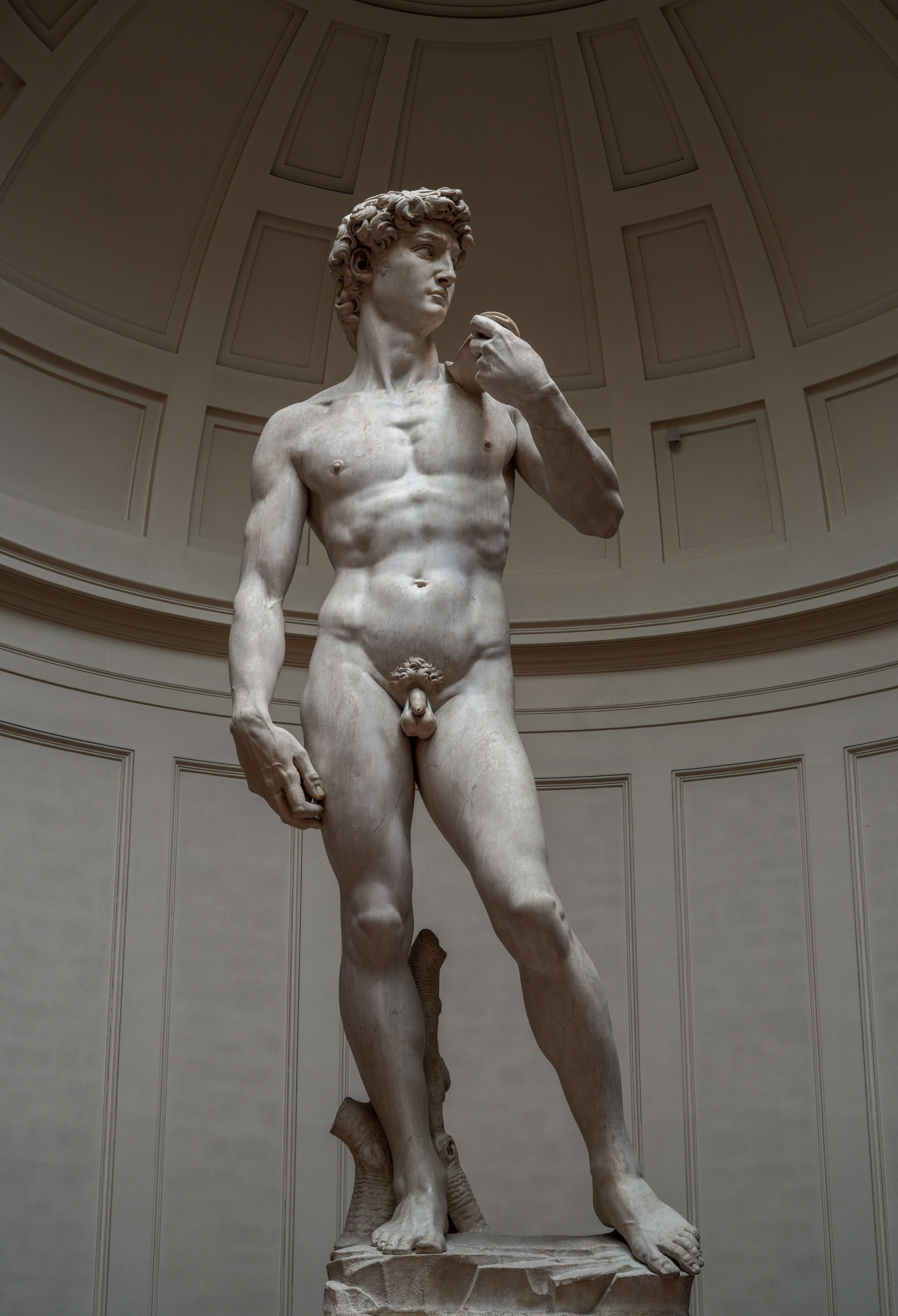
6. David by Michelangelo Buonarroti
Carved from a single, famously “ruined” block of Carrara marble that earlier sculptors had abandoned, Michelangelo’s David became Florence’s civic emblem. In January 1504 a committee of the city’s leading artists ruled that the finished statue should stand at the entrance to the Palazzo Vecchio as a symbol of Florentine strength and independence. Where Donatello, Ghiberti and Verrocchio had often shown the biblical hero after his victory, Michelangelo chose to depict the moment before David’s fight with Goliath. David stands alone, stone clenched in his right hand, sling resting lightly over his left shoulder. Tension is carried through the anatomy, where tendons rise, muscles tighten, and veins sit beneath the surface.
Among Spanish respondents, every voter was a woman, with Gen X making up 80% of admirers. “It’s stunning,” wrote one, while another said; “I love his eyes, how David is looking at Goliath, and I love the way Michelangelo treats human anatomy in all his work.” Many stressed the scale and presence: “I was overwhelmed when I saw it… the difference between the ‘real’ one and the replicas is undeniable.”
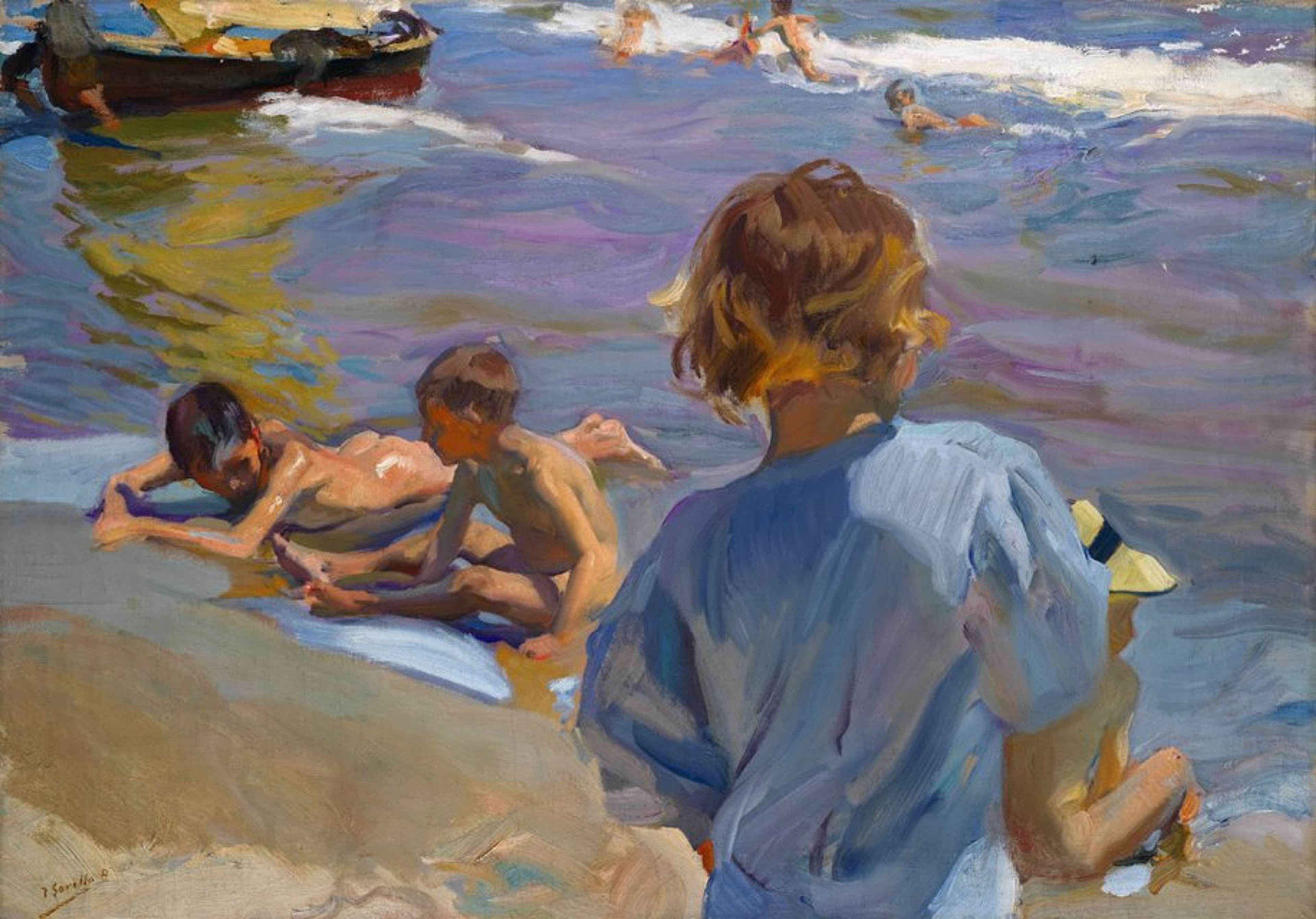
7. Niños en la Playa by Joaquín Sorolla
Taking seventh place is Sorolla 's sun-drenched Niños en la Playa, produced during a prolific spell in Valencia in the summer of 1909. In his painting, there is no horizon line, bringing the sand and water into the foreground so that light, skin and sea become the only subjects. Three nude boys lie where the tide turns: the nearest boy, fair-haired and dry, leans on a diagonal that pulls us into the picture; our eye follows his glance to the second, then comes to rest on the third. Their skin tones deepen from pale mauves to wet bronze, while beneath them, Sorolla records both reflection and shadow under the midday sun. Even the small hollow scoured by the undertow at a heel is observed, proof of Sorolla's capacity for minute detail.
Another homegrown artist, the popularity of Niños en la Playa speaks to national pride in Sorolla, whose beaches live in the country’s collective memory. All the Spanish voters for this work were women, praising its serenity and its joy; “so temporary and happy… the colours are so beautiful”. Choosing Sorolla celebrates another national artist who rendered daily Spanish life in an intimate yet shared vision of light and childhood.
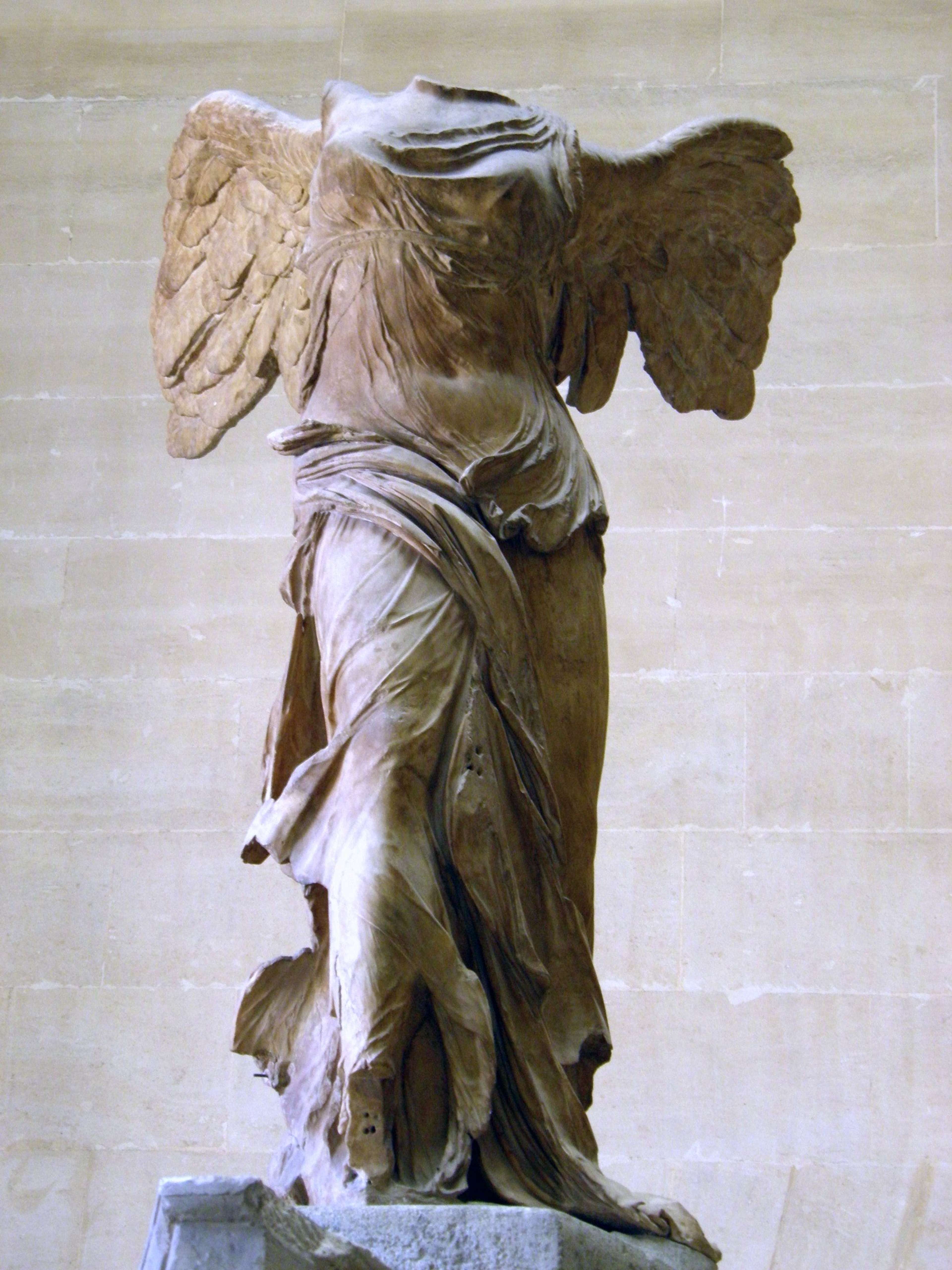
8. The Winged Victory of Samothrace
Carved around 190 BCE, the Winged Victory of Samothrace was conceived as a naval monument, poised on the prow of a marble ship within the sanctuary on Samothrace. Even headless and armless, the goddess looks airborne, her torso pitching forward, and the great wings sweeping behind as if she is about to launch. Her thin tunic clings to her body in folds, as if an invisible gust of wind is animating her. Seen today on the Louvre’s Daru staircase, she commands the space, proving that her fragmentation has not diminished her presence.
Ranking eighth for Spanish voters, the statue’s magnetism lies in its paradox of power and loss. Respondents praised her as “magnificent and colossal”, “absolutely magical,” and “majestic.” Every Spanish voter for this work was a woman, with Gen X leading (66.67%) and Gen Z close behind (33.33%). One admirer revealed; “ever since we studied her in school I’ve been obsessed”, while others praised her poise and implied motion. Viewers also responded to the goddesses' endurance, finding in her a metaphor for resilience.
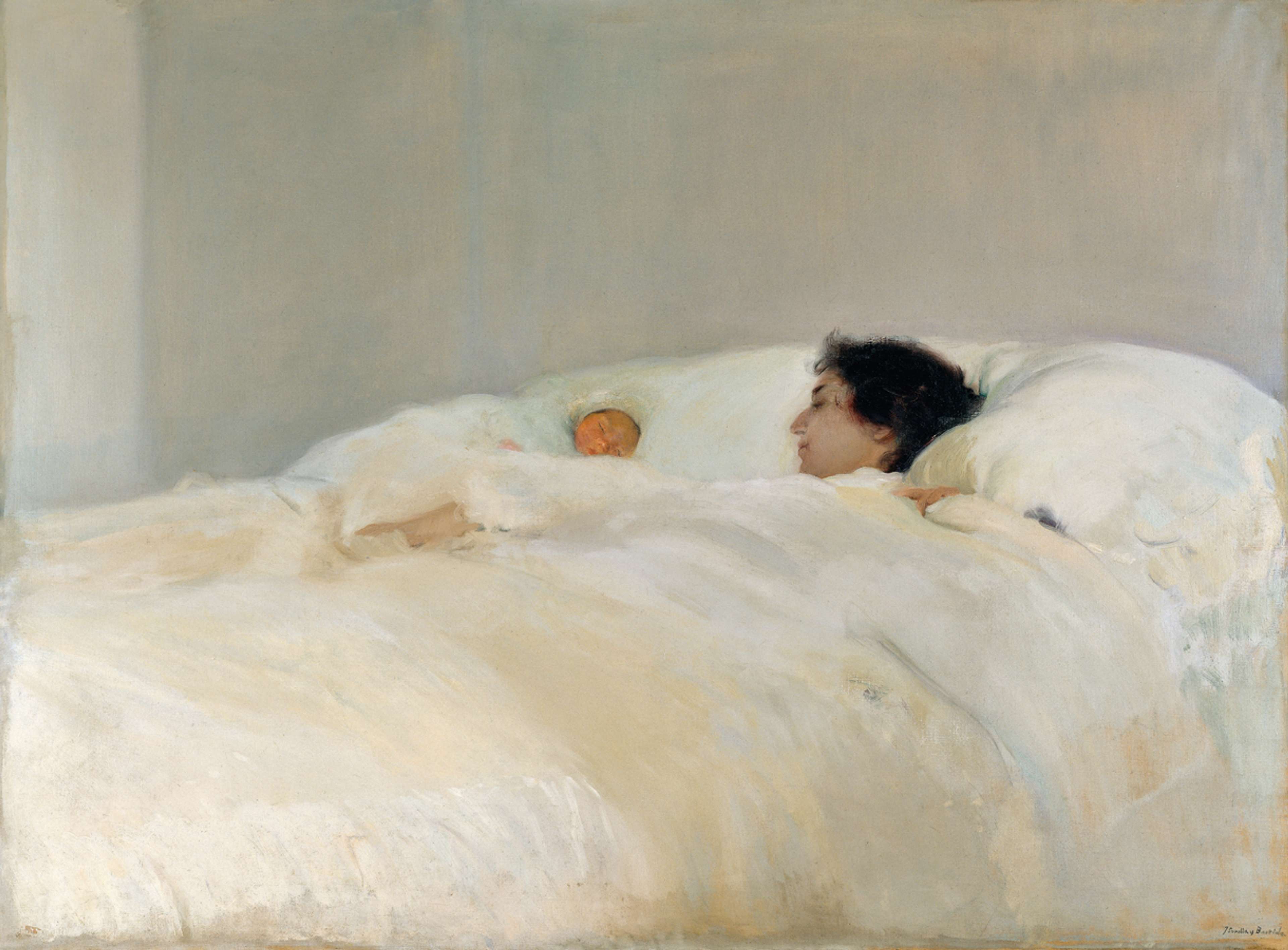
9. Madre by Joaquín Sorolla
Taking the penultimate space in Spain’s artwork ranking, Sorolla’s Madre turns a private family moment into a meditation on light and tenderness. Painted between 1895 and 1900 to mark the birth of Sorolla’s younger daughter, Elena, the painting depicts Sorolla’s wife, Clotilde, and the newborn resting face-to-face, their heads emerging from an endless sea of linen. Almost everything is white, yet nothing is the same shade of white, filtered daylight sliding across sheets and pillows. The husband and father’s gaze is folded into the emotion of the piece to create an intimate look at a pause between exhaustion and bliss.
Madre shows why Spaniards reach for Sorolla again and again; by showing everyday life and elevating domestic tenderness, he proves that Spanish light is not just a blazing beach glare but also the soft glow of a family room in Madrid. Choosing another artwork by Sorolla is a recognition intimacy is as central to Spanish identity as court and conflict.
Every Spanish voter for Madre was Gen Z, and two-thirds were women. One admirer noted, “almost everything is white but with so many different shades,” while another recalled seeing it in a museum and being struck by how directly it “showcases emotions.” For others, the painting unlocked personal memories of “summer naps with my mother near the beach” - highlighting Sorolla’s gift for translating shared memories.
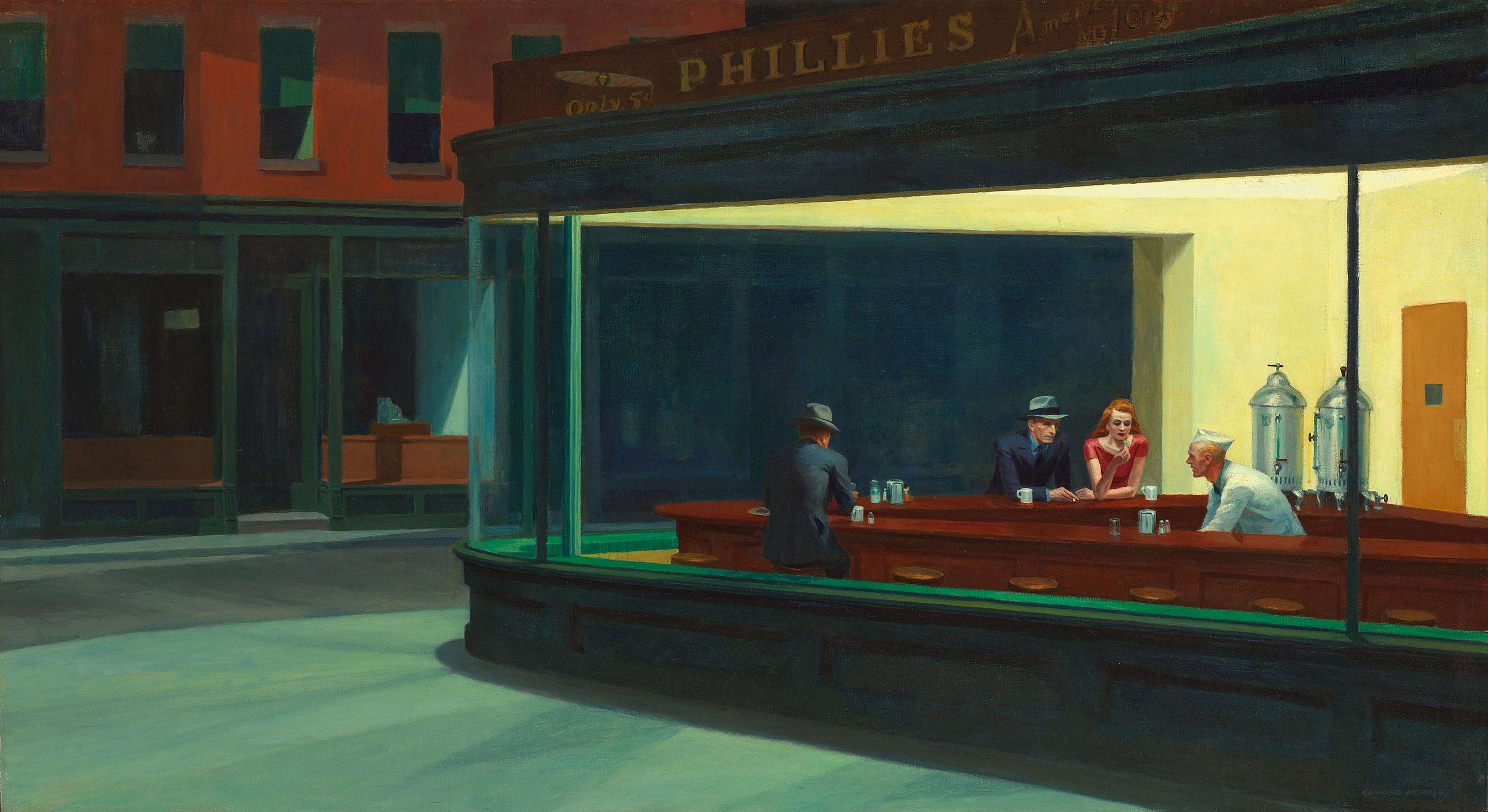
10. Nighthawks by Edward Hopper
Finally, in tenth place is Edward Hopper’s Nighthawks, painted in 1942 just weeks after Pearl Harbor. This painting has often been read as a narrative of wartime alienation due to its depiction of figures sealed behind glass, suspended in an uneasy hush. The acid greens and warm golds heighten the cinematic mood, while the absence of narrative explanation keeps the story open; leaving the viewer to wonder who these people are and what comes next.
Two-thirds of Spanish admirers of Nighthawks are men, one respondent sharing: “It makes me think. It creates a story about what could have happened before… or after”, while another shared; “this painting makes me feel a lot of emotions by only seeing it”. In a Top 10 dominated by Mediterranean light and Spanish scenes of community, Hopper’s nocturne is a noticeable counterpoint. Its cool geometry, modern lighting and glass barrier speak a universal language of solitude, offering community through the shared drama of being alone.
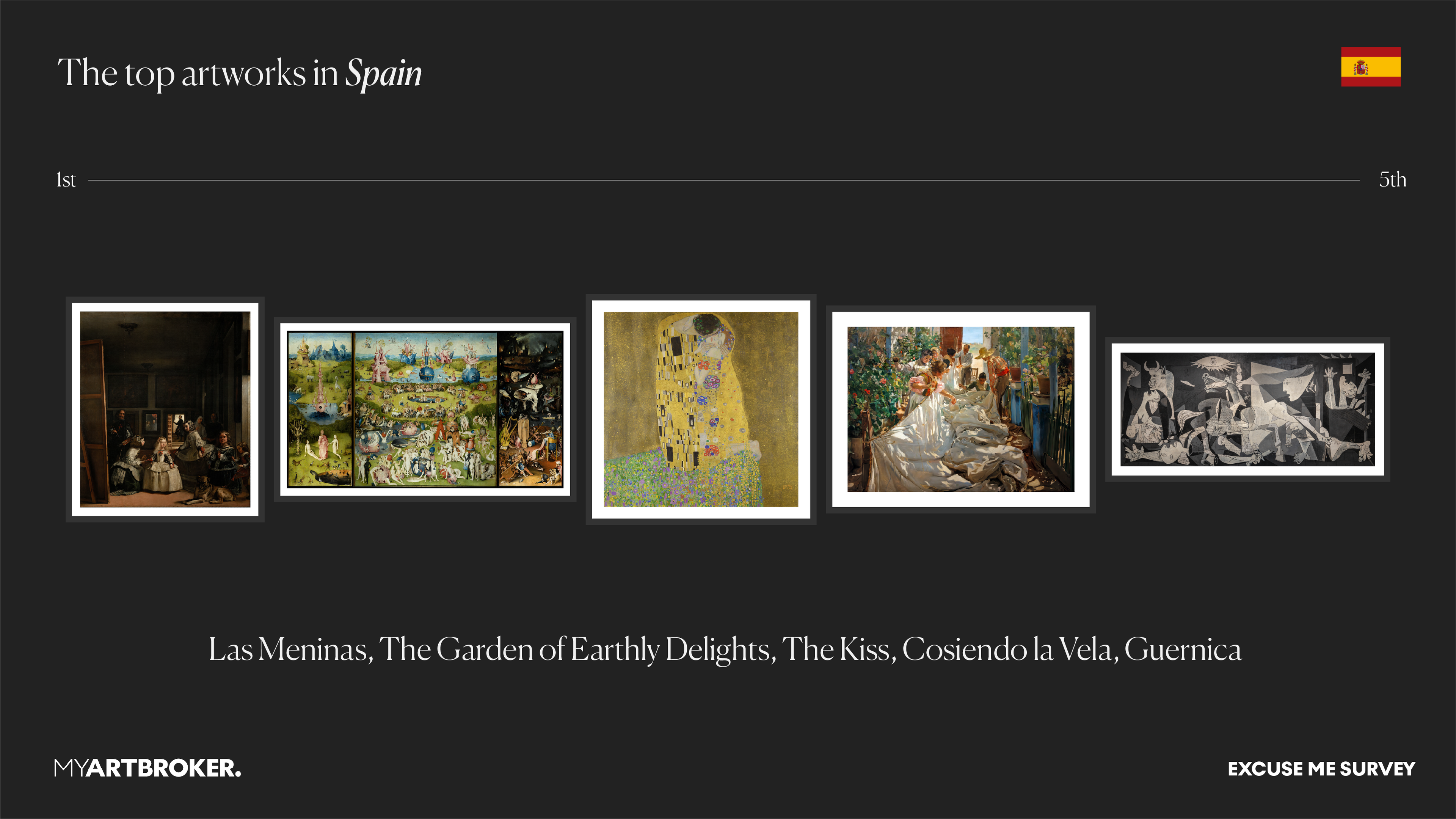
Spain’s Top 10 artworks reveal a nation proud of its art history. The dominance of Velázquez, Sorolla, and Picasso signals a living connection to Spain’s artistic heritage that continues to shape how people see themselves. Yet these national icons coexist comfortably with international masterpieces, their inclusion showing an admiration for works that echo universal emotions, values, and ways of seeing.