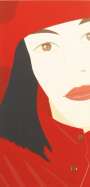
Red Coat
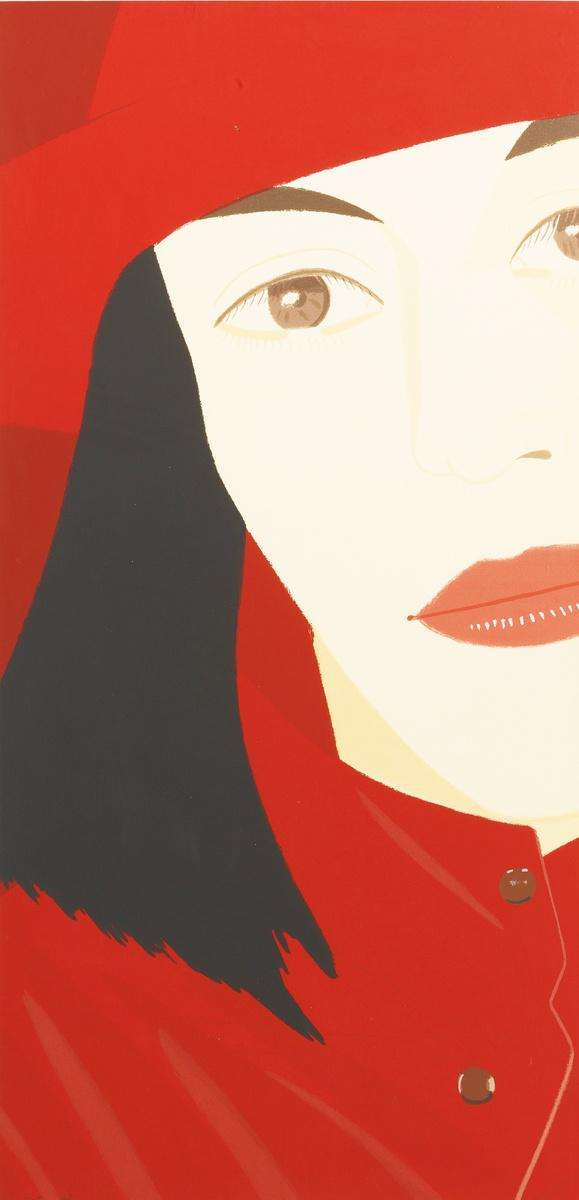
Red Coat
Signed Print
Alex Katz
147 x 74cm, Edition of 73, Screenprint, 1983
£23,000-£35,000
$45,000-$70,000 Market Value Indicator
$45,000-$70,000 Market Value Indicator
¥200,000-¥310,000 Market Value Indicator
€28,000-€40,000 Market Value Indicator
$240,000-$360,000 Market Value Indicator
¥4,840,000-¥7,370,000 Market Value Indicator
$30,000-$45,000 Market Value Indicator
There aren't enough data points on this work for a comprehensive result. Please speak to a specialist by making an enquiry.
Track Auction Value Trend
Meaning & Analysis
Alex Katz's Red Coat (1983) is a narrow close up portrait of his wife, Ada, wearing a red hat and red buttoned coat set against a field of saturated red tones. It is a signed and numbered screenprint in an edition of 73, co-published by the artist and Simca Print Artists, New York.
Katz crops the image tightly and enlarges Ada's face, bringing it right up to the front of the picture. The approach borrows the scale and framing of film, photography and advertising. Despite her proximity, her expressionless face leaves her thoughts and emotions illegible to the viewer. In stark contrast to her pale skin and black, the sheet is dominated by vibrant reds of the ground and her garments. The pale cream face is modelled with almost no shading, and the black hair is a single flat mass with a ragged lower edge. Two buttons and a seam on the coat provide the only incident in the lower half. The composition is cropped so that the face runs off the right-hand edge, a device that makes the figure seem larger than the sheet, in line with the billboard-influenced scale of his portraits. Red recurs in his work as both a pictorial and a graphic device.
The print is based on Katz's 1982 oil painting Red Coat, now in the collection of the Metropolitan Museum of Art, New York. It keeps the painting's proportions: both are twice as tall as they are wide, the print at 147.3 x 73.7 cm and the painting at 243.8 x 121.9 cm. For the painting, Katz made a full-size preparatory drawing, or cartoon. He pricked holes along its lines and pressed dry pigment through them to transfer the outlines onto the canvas.