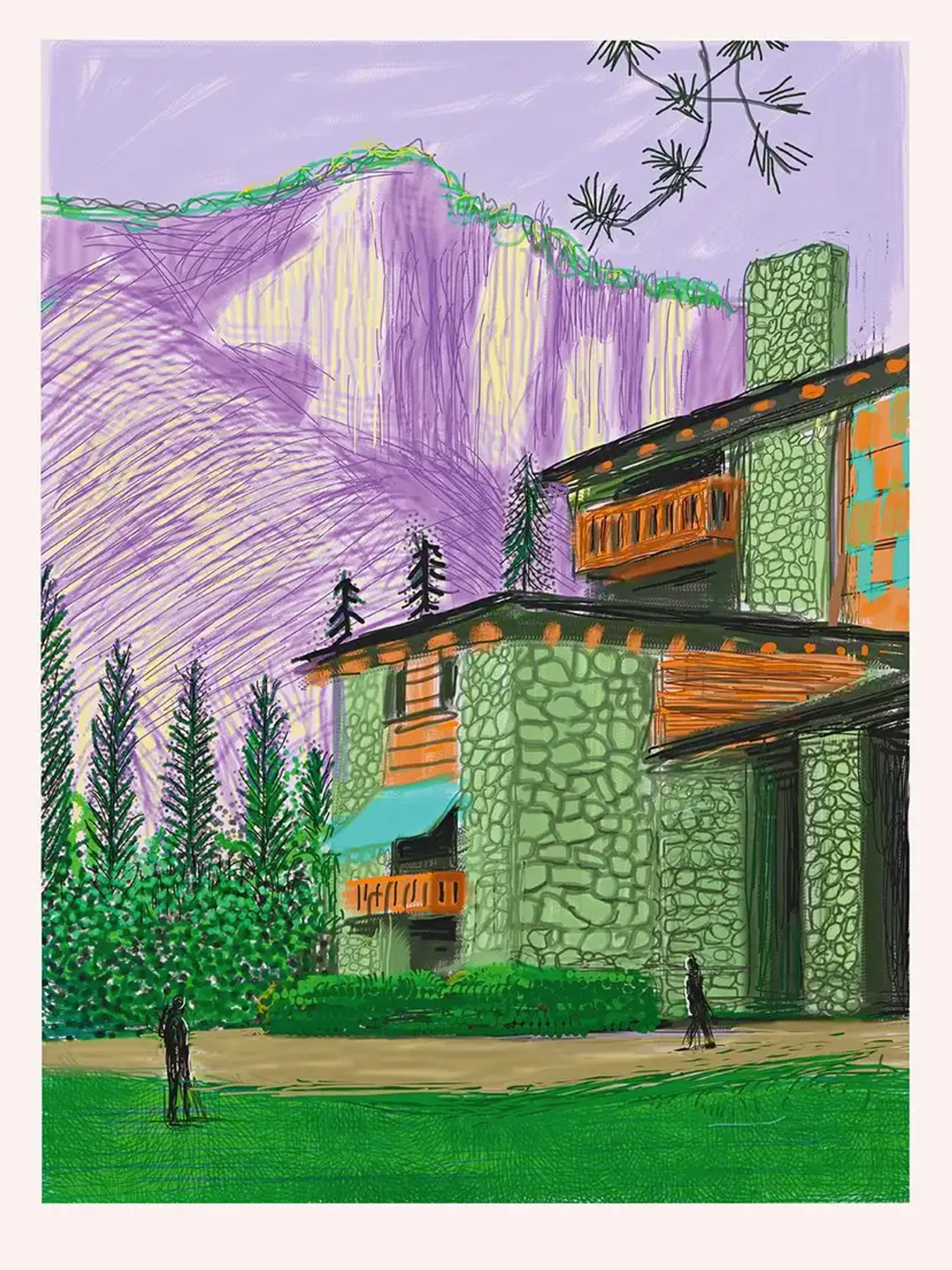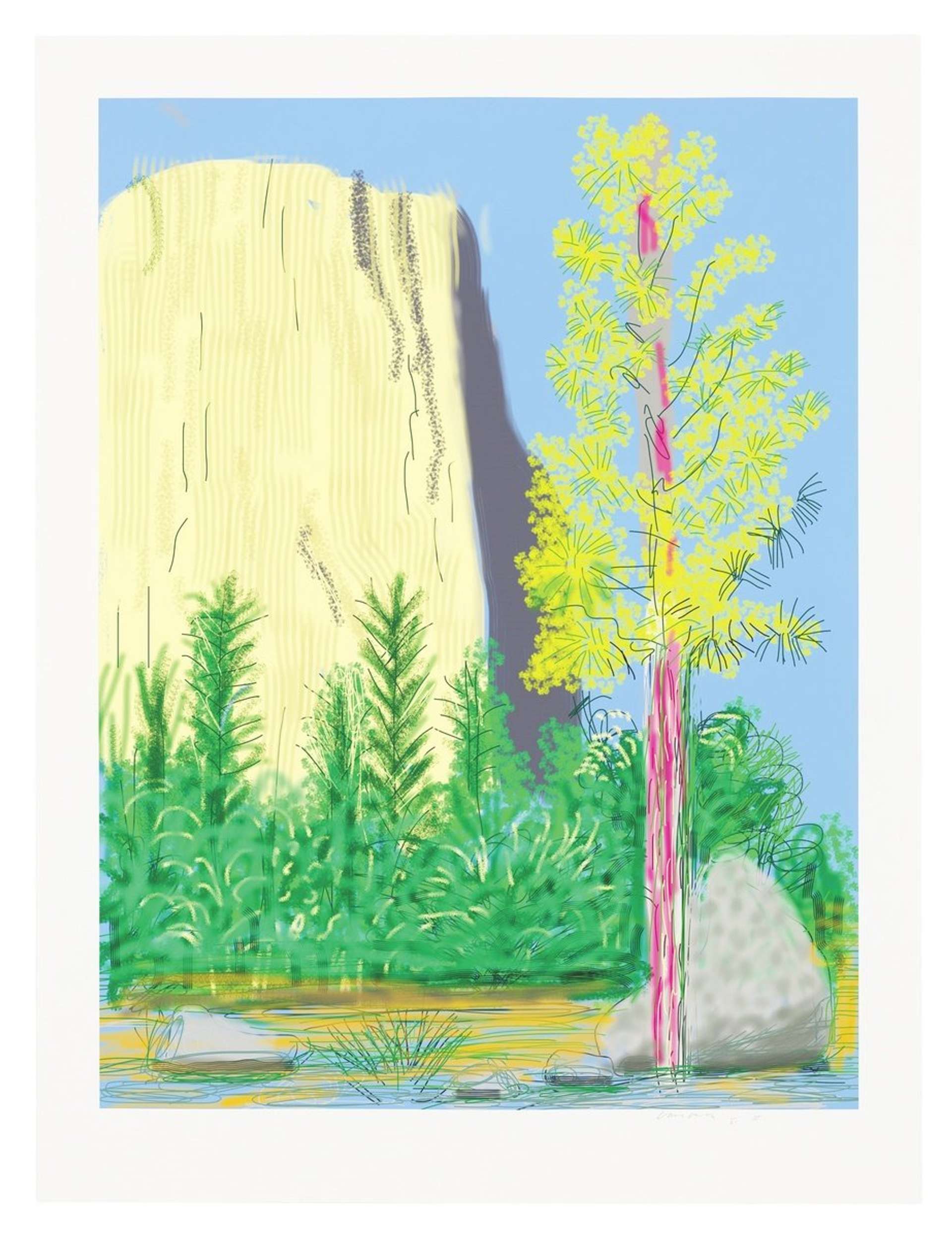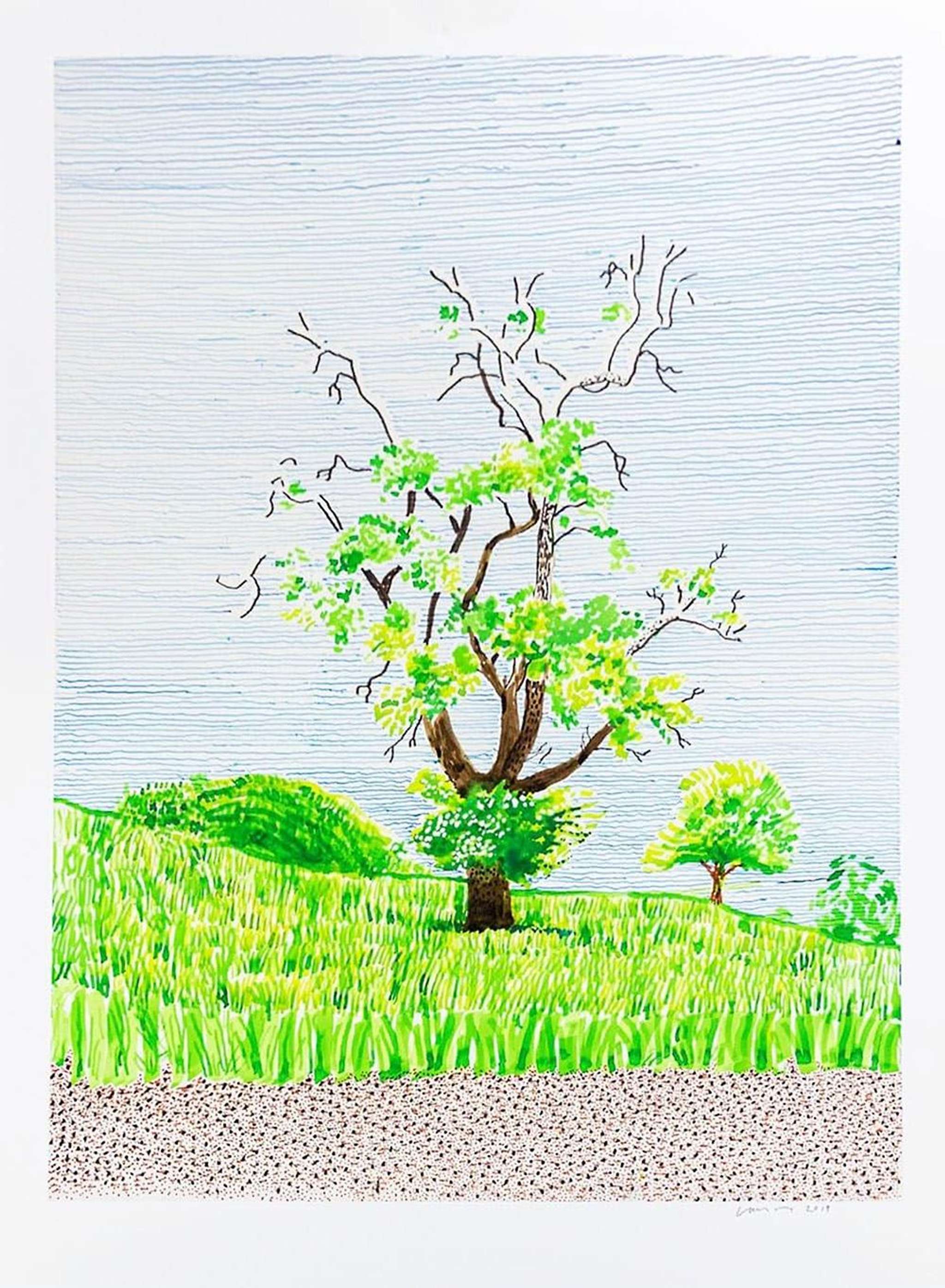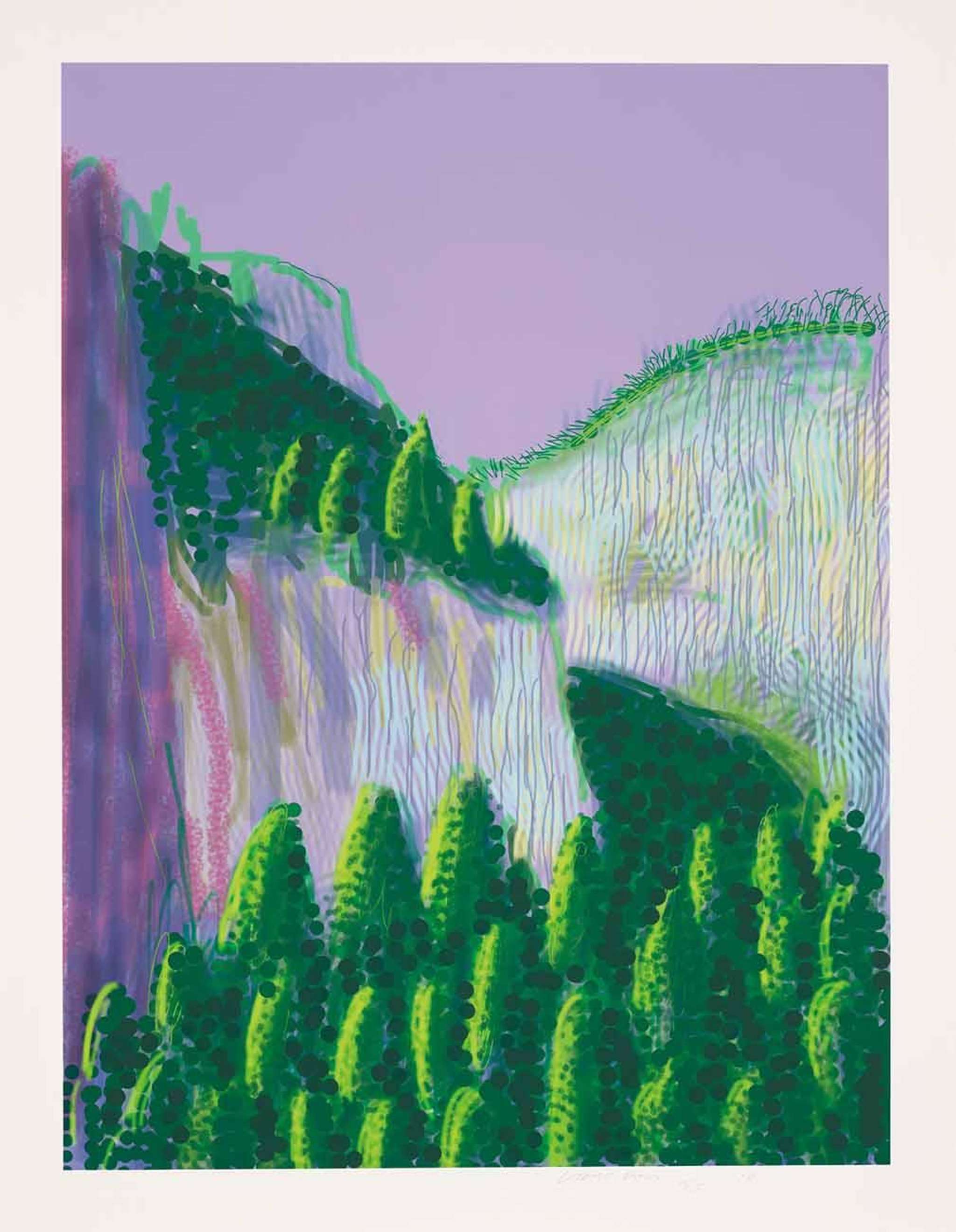


Yosemite’s huge cliff faces and towering waterfalls have traditionally symbolised the sublime in American art, from the 19th-century Hudson River School painters to the photographs of Ansel Adams. By choosing Yosemite, Hockney deliberately engages with this legacy, yet approaches the subject with his own distinct style. The Yosemite Suite continues Hockney’s ongoing fascination with how we see the natural world, using his iPad to reinterpret the grandeur of this iconic California landscape.
Why Did Hockney Depict Yosemite?
Yosemite National Park has inspired generations of artists as a paradigm of American natural grandeur. Painters such as Albert Bierstadt, Thomas Hill, and William Keith cemented Yosemite’s place in the American imagination with their vast canvases in the mid-nineteenth century, while photographers including Carleton Watkins and Ansel Adams later helped to mythologise its landscapes. Hockney’s decision to depict the park in 2010 can be read as an attempt to reassess how a familiar landscape might be represented through a contemporary lens.
The Yosemite Suite comes from an early period in which Hockney began using the iPad to capture landscape at scale. The works are built from repeated observations made across different locations and moments, a method that anticipates the sustained looking and attention to change later developed in his 2011 Arrival of Spring series. Hockney believed that a single, fixed viewpoint doesn’t match how we actually experience the world. When he worked on the iPad in Yosemite, he could draw quickly, revisit the same view at different times, and adjust colour and composition as light and conditions changed. The medium encouraged movement, repetition, and revision, embodying his belief that space is experienced over time. These methods align with earlier landscape experiments such as Nichols Canyon and his photographic joiners, in which space is imagined through movement instead of a single vanishing point, recreating landscape as something experienced through multiple viewpoints.
How Hockney’s Yosemite Suite Was Made
From iPad to Print
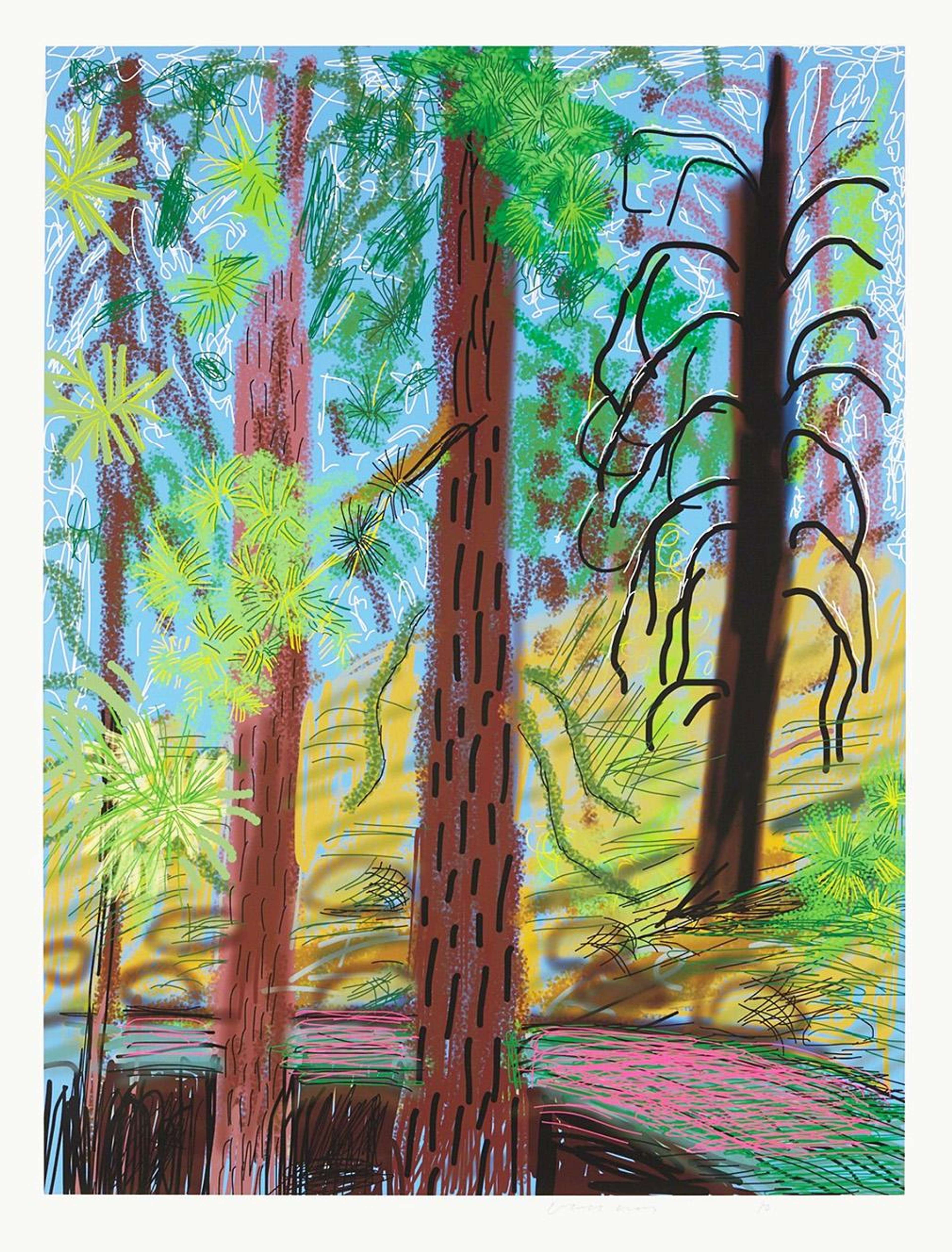
The Yosemite Suite began as a series of drawings made on an iPad during Hockney’s visits to Yosemite in 2010 and 2011. Working directly on the screen, he often drew from life, replacing the traditional plein-air set-up. Hockney has consistently framed digital tools as part of a long continuum, comparing the iPad to earlier technological developments in art, describing it simply “as another medium”. Many of the digital drawings were later produced as large-scale prints, reinforcing Hockney’s long-standing interest in speed and perception.
Scale also plays a central role in how the Yosemite Suite is experienced. Many of the works are larger than conventional works on paper, their scale amplifying the physical impact of Yosemite’s landscape.
Hockney’s Play With Colour
The Yosemite artworks are immediately recognisable for their striking colours. Hockney generally avoided the muted earth tones traditionally associated with Yosemite, opting instead for electric blues, greens, yellows, and unexpected pinks. These colours are expressive, used to convey light, heat, and atmosphere more than naturalistic surface detail.
Why Hockney Depicts Multiple Viewpoints
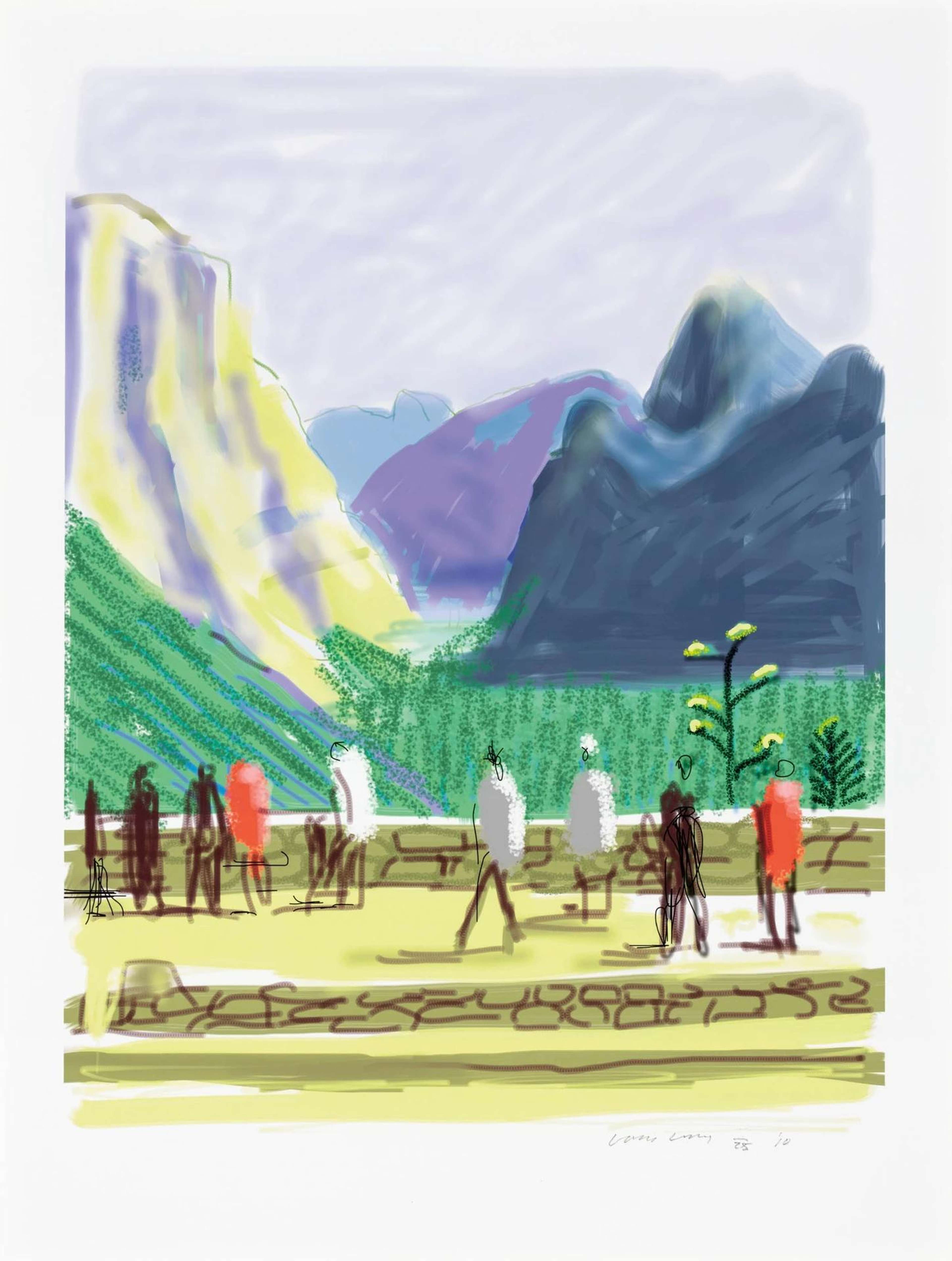
At the heart of the Yosemite Suite is Hockney’s rejection of single-point perspective. He has repeatedly argued that fixed viewpoints do not reflect how we actually see, which is through movement, time, and repeated looking. The Yosemite works embody this belief, and Hockney presents a variety of views including forests, roads, cliffs, and lookout points. Some images depict human figures, cars, and tourists, emphasising that landscape can be lived and shared rather than idealised.
Which Parts of Yosemite Did Hockney Show?
Rather than portraying Yosemite’s most celebrated landmarks, Hockney focused on the park as it is actually experienced. The Yosemite Suite returns repeatedly to forest interiors, roadsides, and tourist spots. By concentrating on these understated locations, Hockney reframes Yosemite as something encountered rather than mythologised through a single view. Trees block views and rock faces dominate, so Yosemite is presented as a sequence of places experienced through proximity instead of distant awe.
Where The Yosemite Suite Has Been Exhibited
The Yosemite Suite appeared among Hockney’s iPad drawings shown in major museum exhibitions in the early 2010s, including A Bigger Picture at the Royal Academy of Arts in London (2012), which travelled to Bilbao and Cologne, and later in the expansive A Bigger Exhibition at the de Young Museum in San Francisco (2013–14). Following these institutional presentations, works from the Yosemite Suite were increasingly shown together, helping to situate Hockney’s digital landscapes within his broader print and drawing practice.