The Artworks We All Agree On
Six artworks appeared in every generation’s Top Ten:
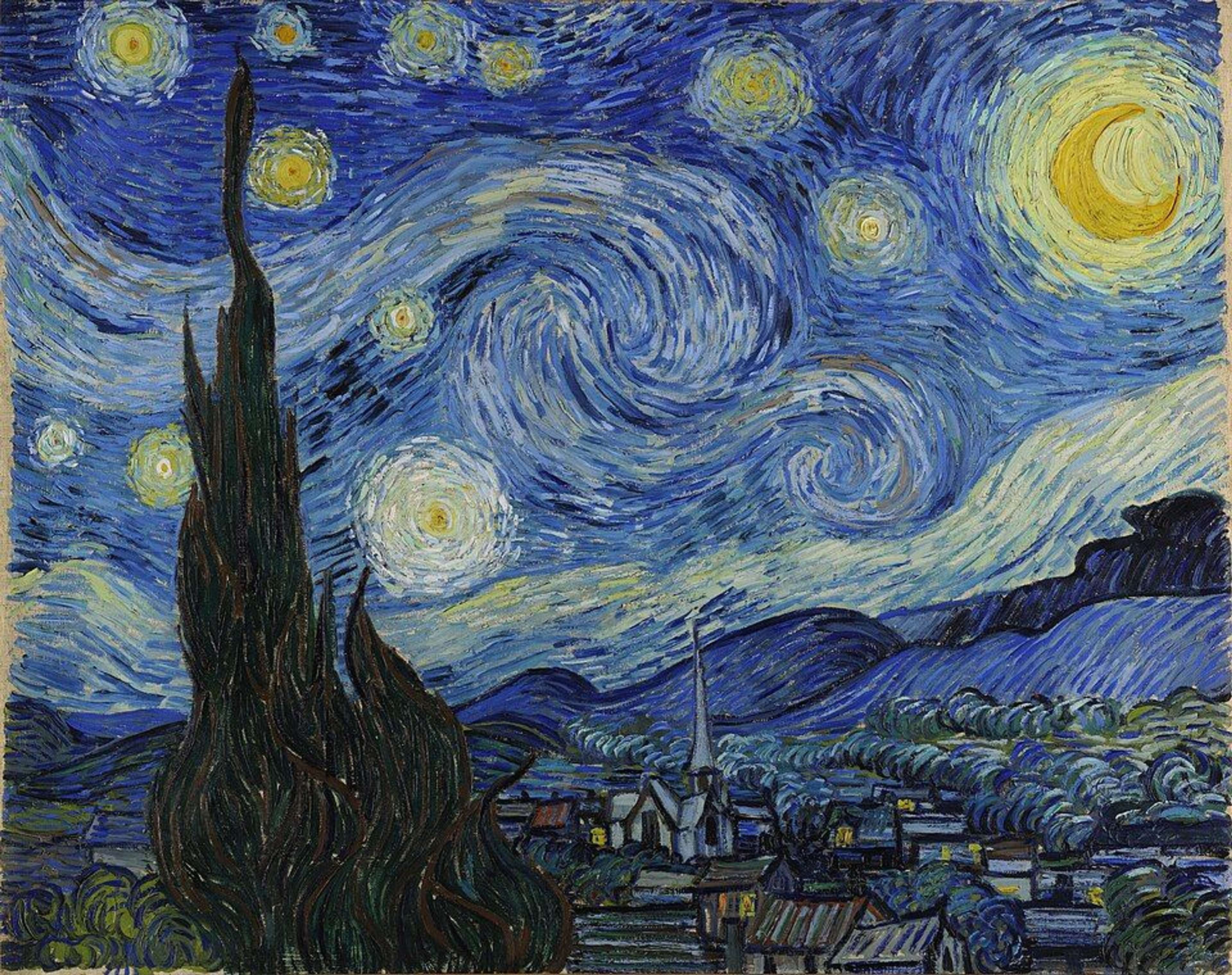
- Van Gogh, The Starry Night
- Hopper, Nighthawks
- Monet, Waterlilies
- Klimt, The Kiss
- Botticelli, The Birth of Venus
- Bosch, The Garden of Earthly Delights
The popularity of these artworks reinforces that art unites across age, culture, and upbringing because it operates on two levels. Firstly, at the human level, shared emotions of empathy, memory, and perception make certain images immediately understandable, while preserving enough ambiguity for personal projection. Strong works offer a balance of structure and openness: they present recognisable emotions, faces, gestures, and atmospheres that are universal, yet contain complexity to accommodate different personal narratives and states of mind. In that sense, art is a mirror - it reflects our inner lives while inviting the imagination.
Secondly, on a social level, museums, curricula, mass media, and now the internet stabilise and circulate famous artworks, turning them into a shared visual language. Repetition, reproduction, and searchability create common reference points; digital platforms amplify this effect by making images continually available and recontextualised. The result is a set of flexible moods and meanings that different audiences can inhabit for different reasons - a practical basis for cultural conversation across generations.
Where Tastes Diverge - and Meet
Similarities
In an era often described as polarised, with generations shaped by markedly different economic, cultural, and technological backgrounds, our global data reveals that art remains a common language. By mapping tastes across cohorts, clear patterns emerge alongside the expected divergences, revealing how formative experiences frame what each generation gravitates toward.
Edward Hopper’s Nighthawks and Gustav Klimt’s The Kiss appear in every generation’s top five, and van Gogh’s The Starry Night is almost as popular; topping the ranks for Gen X and Millennials, and coming in fourth with Boomers. Focusing on generational favourites, a shared core comes into focus, with the six earlier works mentioned recurring in every generation’s Top Ten. Clearly, the canon still unites.
Differences
However, tastes do diverge, and street art shows the most surprising split: Gen X chose it most often (42%), followed by Millennials (36%), Boomers (33%), and then Gen Z (26%). One might expect Gen Z to dominate here given Banksy’s ubiquity across social media and global headlines, yet the data points elsewhere. In reality, Gen X came of age as street art transitioned from the streets into museums. In the 1980s, Keith Haring’s subway drawings and Jean-Michel Basquiat’s stylised street art began to dominate the mainstream, appearing in galleries and used in advertising. A plausible reading is that, for Gen X, street art retains its status as a subculture that matured with them, whereas for Gen Z, it is less revolutionary: accepted and admired, but not the defining badge of taste.
By contrast, digital art follows a more intuitive trend. Gen Z selects it most frequently at 27%, then Millennials at 22%, Gen X at 16%, and Boomers at 12% - evidence that screen-native aesthetics sit most comfortably with those raised in digital environments. This is not only about the NFT boom; it also encompasses the wider absorption of digital tools into mainstream practice. David Hockney’s iPad drawings, exhibited at major institutions, have popularised digital art for audiences in an art world obsessed with notions of “high” art.
Admiration for the Old Masters category predictably increases with age, from 22% (Gen Z) to 45% (Baby Boomers), a pattern likely reflecting more museum exposure and emphasis in formal education. An explanation could be that older cohorts have simply spent more hours in front of canonical works, and are more likely to treat the canon as a benchmark of quality. For the pre-iPhone generation, long exposure to Old Master artworks through institutions, catalogues and exhibitions would likely instill a lasting preference for that style.
Beyond The Canon
A small but significant minority of participants voted for “anything by [artist]”, showing loyalty to the artist rather than a single work - 6.8% of Gen Z, 7.6% of Millennials, 7.4% of Gen X, and 9.5% of Boomers. This points to allegiance not just to iconic images but to an artist’s voice, showing the importance of authorship beyond a single masterpiece.
Breadth is also just as striking. Most respondents voted beyond the global Top Fifty artworks, with 80% of Gen X, 78% of Boomers, 77% of Gen Z, and 76% of Millennials naming something else. Globalisation and digitisation make this range possible: digitised collections, online museum tours, artists’ social channels and apps such as DailyArt let audiences follow artists over time and consider a wider selection periods and styles. As art circulates more freely online, the horizon of what feels ownable, meaningful or simply worth naming keeps widening.
What Gen Z Wants
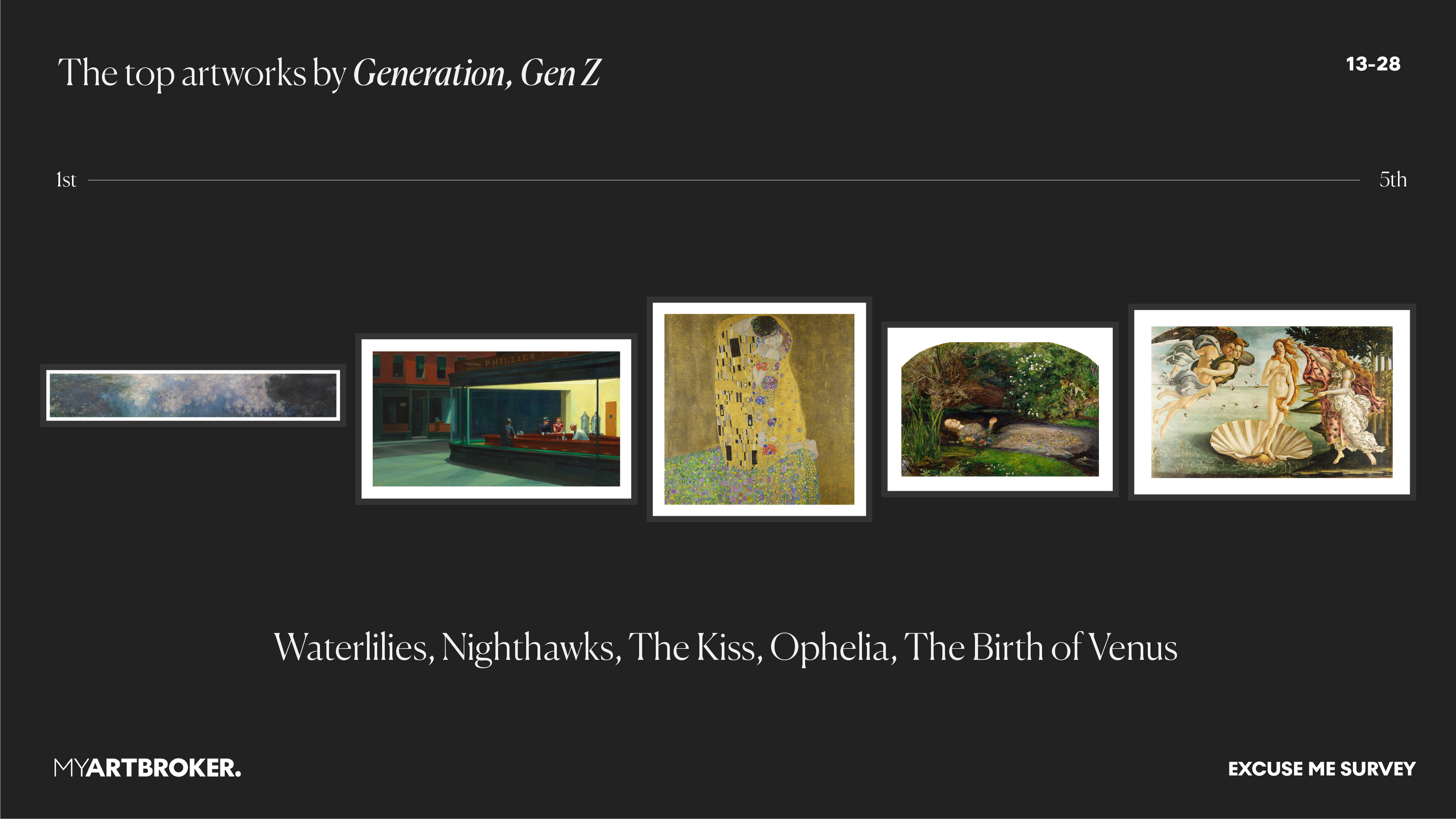
Gen Z’s leading choices combine canonical status with cinematic mood. Their top works are Monet’s Water Lilies, Hopper’s Nighthawks, Klimt’s The Kiss, Millais’ Ophelia, and a tie between Botticelli’s The Birth of Venus and Bosch’s The Garden of Earthly Delights. Taken together, they point to images that feel emotionally saturated and immediately legible, even when drawn from different centuries and traditions.
Two trends stand out. First, romance and melancholy: Ophelia appears far more often for Gen Z than for Boomers, suggesting a tilt towards works where narrative and mood carry weight. That inclination also surfaces in Nighthawks and The Kiss, which balance intimacy with ambiguity. Second, stylistic playfulness: Fragonard’s The Swing is chosen by Gen Z but not at all for Gen X and Boomers, signalling an appetite for theatricality and a willingness to embrace pleasure alongside seriousness. In a similar vein, Friedrich’s Wanderer Above the Sea of Fog was popular among Gen Z, reinforcing an interest in images of selfhood staged against scale and uncertainty. Gen Z’s most-named artists - Monet, van Gogh, Hopper, Klimt, and Millais - suggest admiration for a recognisable voice across a body of work, where consistent mood, approach and worldview matter as much as any single masterpiece.
Style preferences reinforce this pluralism. Digital art is chosen by 27% of Gen Z (the highest of any cohort), street art features in 26% of selections, and classical art remains highly popular at 62%. Tradition and novelty sit side by side rather than in opposition; a Monet and a digital image can command the same respect. Overall, Gen Z’s profile is broad and flexible, treating tradition and modernity as complementary rather than competing worlds.
What Boomers Want
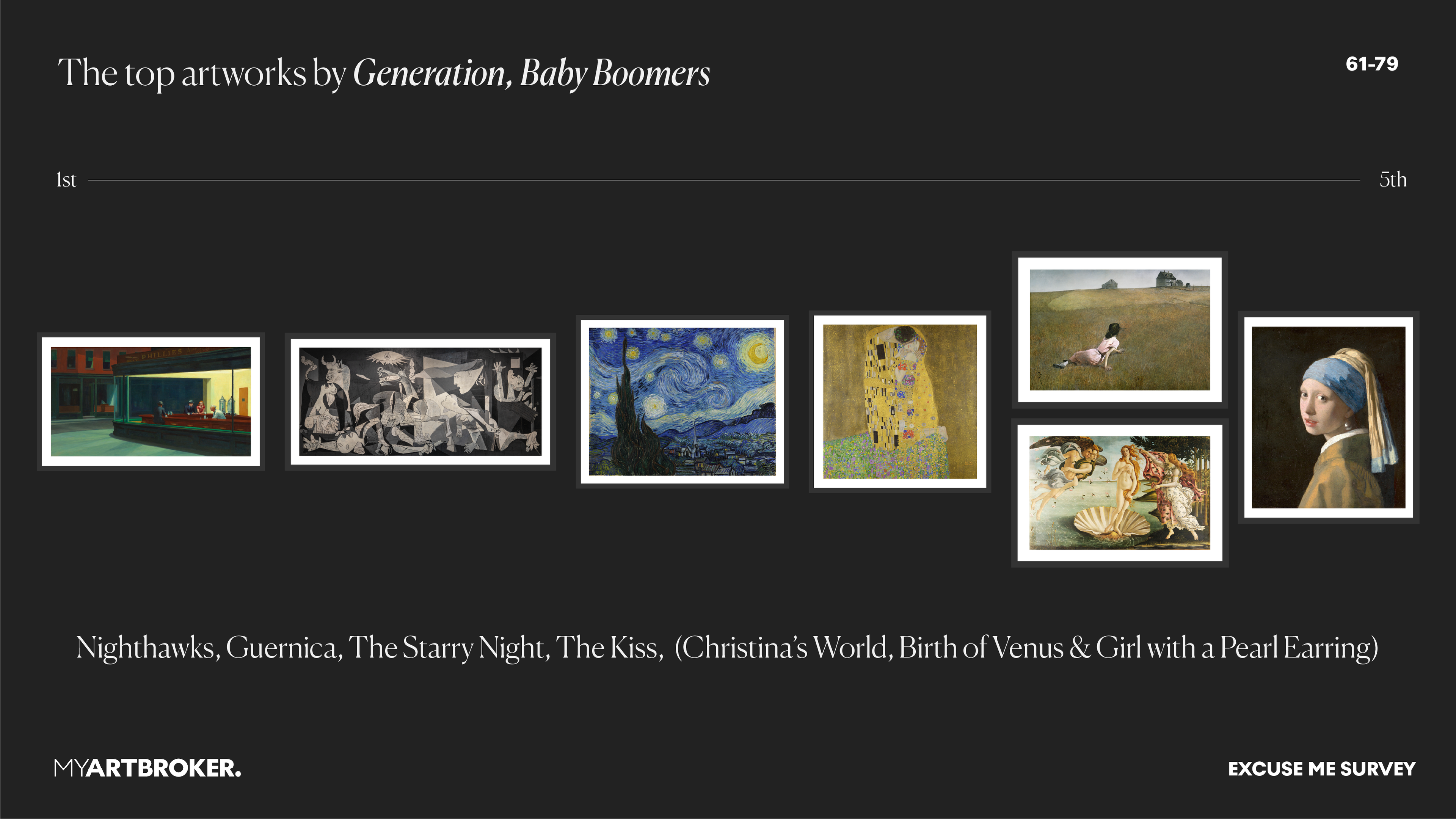
Boomers’ top choices gravitate towards moral weight, historical resonance and compositional clarity. Their top works are Hopper’s Nighthawks, Picasso’s Guernica, Klimt’s The Kiss, van Gogh’s The Starry Night, and Vermeer’s Girl with a Pearl Earring. Two features stand out. First, historical gravitas: Guernica appears markedly more often among Boomers than Gen Z, pointing to a cohort for whom civic memory and twentieth-century history remain active reference points. Second, while Gen Z leaned towards Ophelia and The Swing, Boomers chose Vermeer’s Girl with a Pearl Earring far more often - a work made familiar by books, museums and film, and a benchmark of classical excellence for older viewers.
Boomers are also the most likely to select Old Masters and the least likely to choose digital art, signalling a preference for the museum canon and a more traditional style. Even so, street art remains substantial at 33%, indicating openness to contemporary forms without making them a defining badge of taste. Behaviourally, Boomers are the most inclined towards “artist-only” answers (9.5%), suggesting allegiance to an artist’s body of work rather than to a single image. As a cohort, Boomers tended to champion works that showcase clarity, craft and historical consciousness, yet they still often arrived at the same cross-generational artworks as younger groups.
As art becomes ever more accessible, the boundaries of taste only widen. The canon endures, but it now coexists with personal, playful, and infinitely scrollable forms of engagement. Our survey shows that across generations, people don’t just want to own art; they want to relate to it. So whether it's Van Gogh’s turbulence or Banksy’s satire, the desire to possess art remains a shorthand for something larger: the wish to hold onto meaning in a world that keeps changing.