
The global art market grew 4% in 2025 to $59.6 billion, marking a modest recovery after two years of contraction. But even with growth returning, the market remains 9% below its 2023 level and 7% smaller than it was in 2015.
This year, however, the narrative of the market isn’t interpreted as a simple exercise in determining whether the market has grown or contracted. Instead, the emphasis has subtly moved toward how collectors behave, how artworks circulate, and how the infrastructure of the art trade itself is evolving.
In previous editions, the narrative tended to revolve around percentage movements in key indicators. This year the report reads more as a study of structural behaviour within the market. Recovery is present in the data, but the underlying message is that the art market appears to be entering a phase defined less by cyclical growth and more by longer-term structural change.
Global Art Market Growth in 2025: Recovery After Two Years of Contraction
The first paradox appears in the market’s headline figures.
While sales increased in 2025, the market remains 9% below its 2023 level and 7% smaller than it was in 2015. Even after a decade marked by major expansion in contemporary art, new wealth centres, and digital platforms, the global art market has not grown in a straight line.
Public auction sales rose 9% in 2025, signalling renewed confidence among consignors. In contrast, private sales at auction houses fell by 5%, reversing the pattern seen during the more uncertain market conditions of 2024.
This shift suggests that sellers are again willing to expose works to the competitive dynamics of the auction room, where bidding can drive prices beyond expectations. In uncertain markets, sellers often prefer the discretion and control of private transactions; in more confident environments, auctions regain their appeal.
Yet even as sales values stabilise, the report shows that the structure of the market itself is changing.
Online Art Sales in 2025: Why the Digital Art Market Is Driven by Mid-Price Works
One of the most revealing findings in the Art Basel & UBS Art Market Report 2026 concerns the continued development of online sales.
Online art sales fell to $9.2 billion in 2025, their lowest level since 2019. At first glance, this decline might appear to signal a retreat from digital channels after the pandemic-era boom. But the reality is more nuanced. The digital market has not disappeared. Instead, it has settled into a specific segment of the market defined by price.
More than 56% of the value of offline auction sales comes from works priced above $1 million, while those works account for just 2% of online-only auction value. By contrast, 63% of online auction value comes from works priced below $50,000, with the largest concentration in the $5,000–$50,000 range.
In other words, the internet has not moved the top of the art market online. Instead, it has expanded the middle of the market, where collectors buy more frequently, experiment with artists, and often enter the market for the first time.
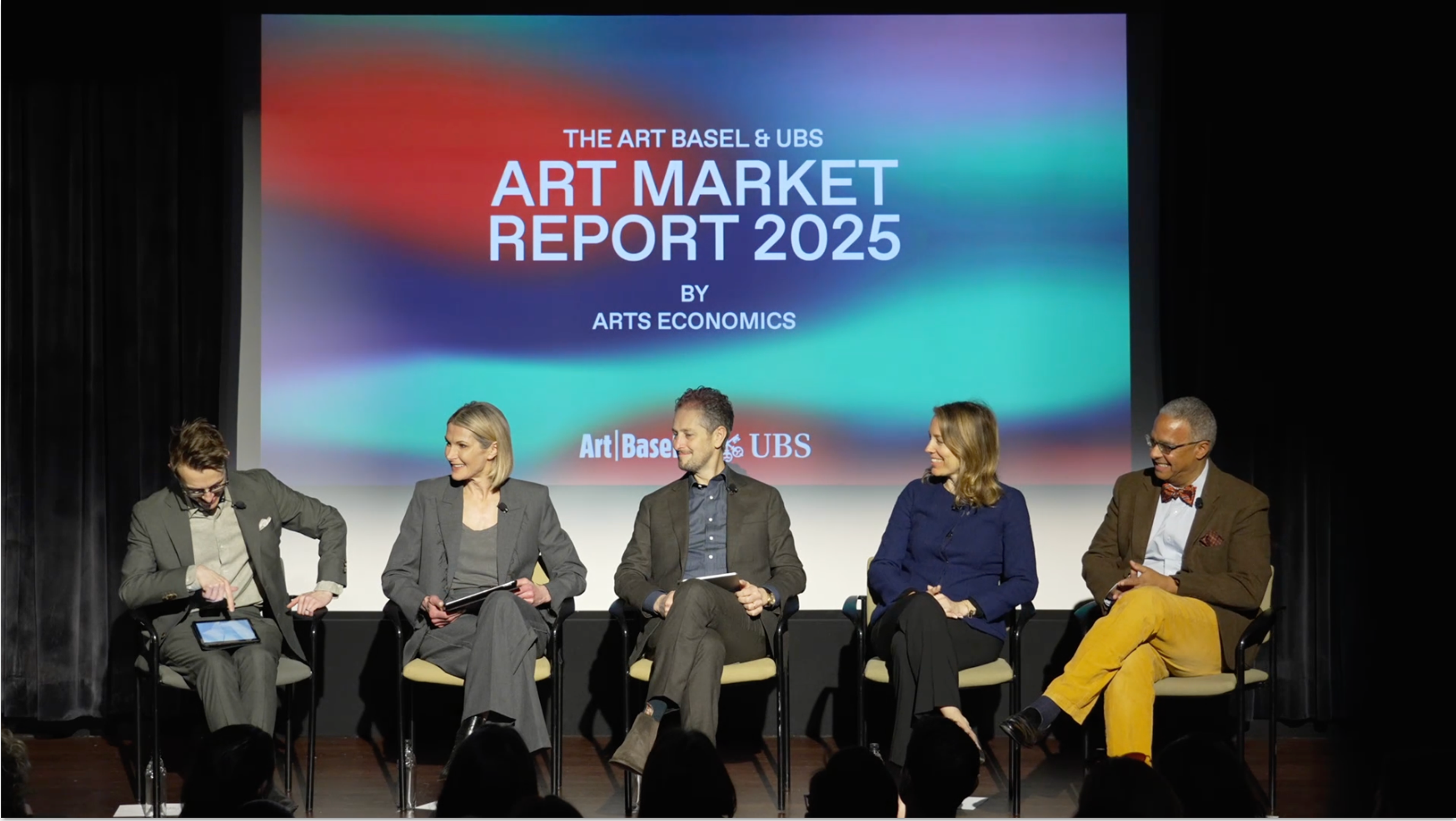
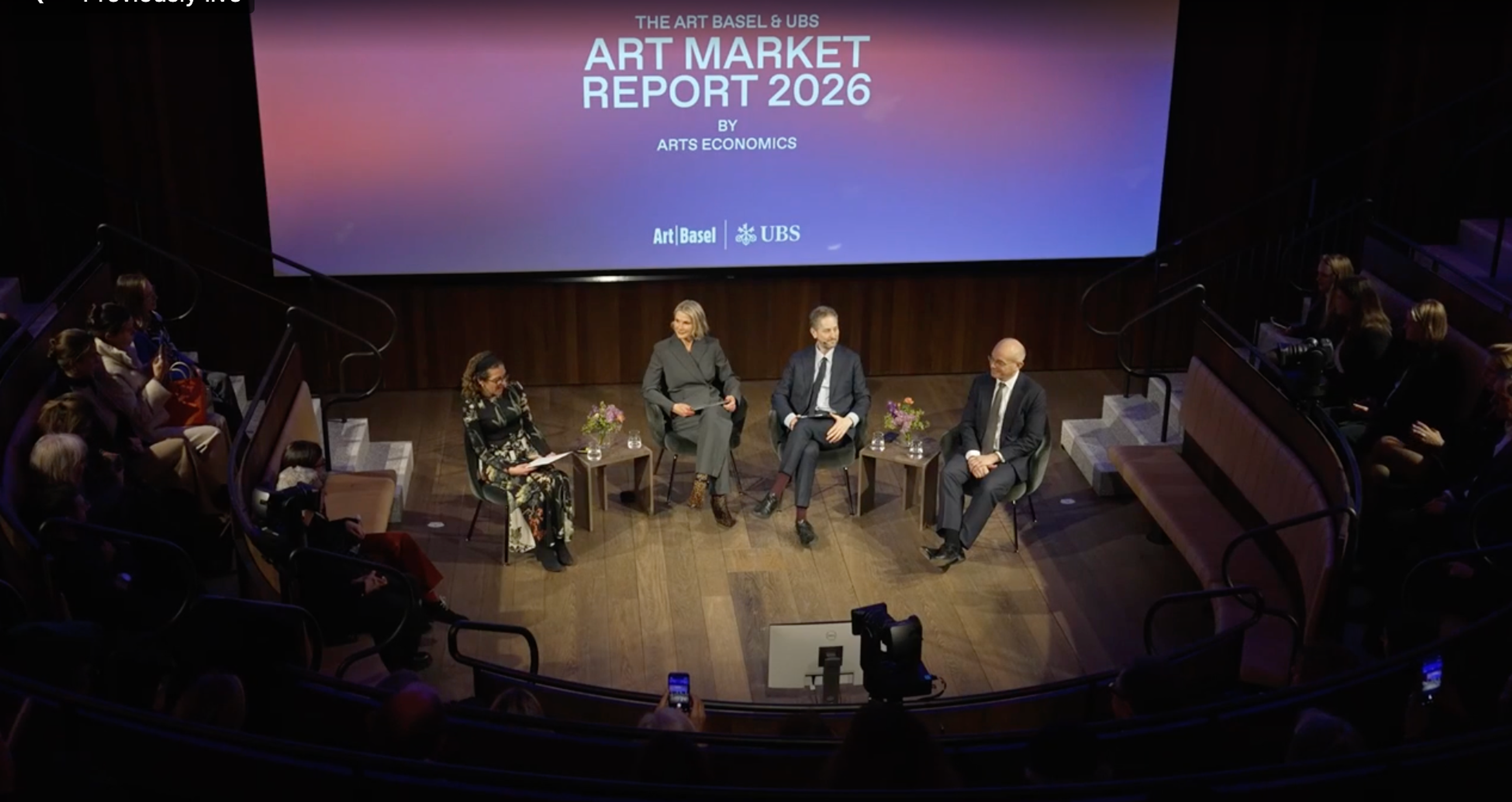
This dynamic was echoed during the report’s launch discussion, where Noah Horowitz, CEO of Art Basel, noted that much of the activity at lower price levels is being driven by collectors “sticking their toes in the water.” For the industry, he suggested, this requires adapting to a new environment in which discovery increasingly takes place through digital channels. “People are going to be researching and finding artists,” he said, adding that dealers and gallerists themselves now frequently use social media platforms to discover emerging talent.
Technology, Horowitz acknowledged, can feel overwhelming. Yet it also opens new avenues for participation and visibility across the market.
Art Market Participation Is Expanding – But Sales Remain Concentrated Among Few Artists
Another contradiction emerges in the report’s analysis of participation.
During the launch panel, Paul Donovan, Chief Economist at UBS Global Wealth Management, returned to the idea of democratisation – a concept that gained traction in discussions around the art market several years ago but appears newly relevant in the current environment.
In many respects, the data supports this view. Participation in the art market is widening, with collectors entering at lower price points and engaging more actively with galleries and auctions through digital channels. The expansion of online sales infrastructure, combined with the growing visibility of artists across digital platforms, has broadened how collectors encounter and participate in the market.
Yet the report makes clear that this widening participation has not fundamentally altered the concentration of value.
Dealer data shows that 11% of artists generate 58% of sales, despite the average gallery representing more than thirty artists. Even as the collector base expands and more artists gain visibility, the economic structure of the market remains heavily weighted toward a relatively small group of established names.
The result is a market that is simultaneously more accessible and more concentrated – with participation expanding even as value remains clustered around a limited number of artists and transactions.
The Art Market’s Pressure In The Middle
This widening participation combined with concentrated value distribution has produced another structural feature of the current market: a growing barbell effect.
The Art Basel & UBS Art Market Report 2026 reveals an uneven distribution of confidence across the market. Among the largest dealers – those with annual turnover above $10 million – 45% expect sales to improve in 2026, up sharply from just 19% a year earlier. At the other end, smaller dealers with turnover below $250,000 also grew more optimistic, with 48% predicting better sales compared to 31% in 2024.
The middle has not followed. In the $500,000 to $1 million turnover segment, the share predicting better sales fell from 51% to 34% – the only dealer segment to see a year-on-year decline in optimism, and the one with the largest share expecting sales to fall.
The profitability data tells a similar story. While 43% of dealers with turnover above $10 million reported higher profit in 2025, the middle market fared considerably worse. In the $250,000 to $500,000 segment, 45% reported declining margins despite rising sales – the weakest profitability reading of any segment.
At auction, the picture is consistent. The high end recovered strongly in 2025, restoring its share of total sales value to 54% after a sharp contraction in 2024. Both the middle and lower ends lost share as a result. The Art Basel/UBS report notes that the middle market segment has lost considerable weight in sales since the start of the 2010s, as the market has become increasingly polarised and inflation has effectively lowered the threshold for high-end spending – drawing works that once sat in the middle tier upward by value rather than by demand.
By volume, the picture is more stable. The share of transactions in the sub-$50,000 range has remained between 89% and 96% over the past two decades, with the $1 million-plus segment accounting for less than half a percent of lots in 2025. Volume distribution has barely shifted. Value distribution has shifted considerably – and it is moving away from the middle.
The result is a market that is increasingly bifurcating: strength at the top and resilience at the entry level, while the segment between them absorbs pressure from both directions.
Collector Buying Trends & Diversification Across Mediums in 2025
Another notable shift involves the types of artworks collectors are buying.
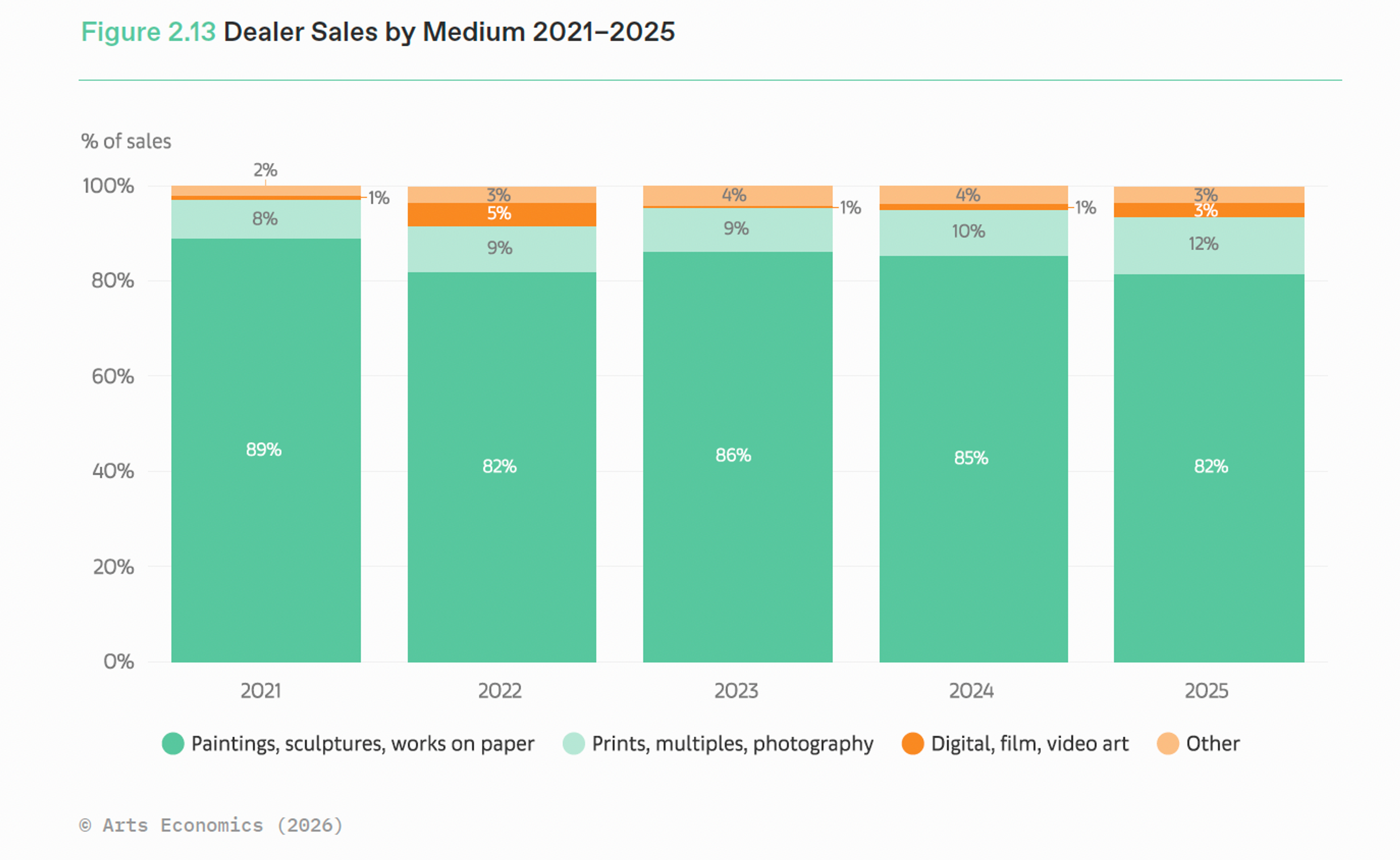
While paintings remain dominant – accounting for 59% of dealer sales – the report highlights growing diversification across other mediums. Photography doubled its share of dealer sales from 3% to 6%, while prints and multiples increased to 12% of sales, reflecting broader activity in works on paper. Digital, film, and video art also expanded their share of dealer inventories, rising from 1% to 3%.
Surveys of high-net-worth collectors show a similar pattern. While 67% of collectors purchased a painting, significant numbers also reported buying sculpture, photography, digital works, and other mediums.
Taken together, the findings of the Art Basel & UBS Art Market Report 2026 confirms collectors are increasingly constructing multi-medium collections, rather than concentrating spending exclusively on painting.
Global Art Trade Trends: Regionalisation and Changing Cross-Border Sales
The report also highlights an emerging geopolitical dimension to the art trade.
Rising tariffs, shifting trade relationships, and political uncertainty are beginning to influence how artworks circulate internationally. While global trade in art remained broadly stable in 2025, there are signs that activity is becoming more regionalised.
In both the United States and the United Kingdom, imports increased while exports declined. In the UK, imports rose 47% while exports fell 39% during the period analysed in the report.
This suggests that domestic buying may be playing a larger role in market activity, while some transactions bypass traditional international hubs.
For a market historically built on the free circulation of artworks across borders, this gradual shift toward regional networks could reshape the geography of the art trade over time.
Rising Costs and Profitability Pressures in the Art Market
The report reveals a striking contradiction around profitability.
Despite the return to growth in 2025, a significant share of businesses reported lower profits than the previous year, including 38% of dealers and 40% of mid-tier auction houses. Rising costs – including art fair participation, travel, regulatory compliance, and operational overheads – are placing increasing pressure on margins.
In other words, the art market’s central challenge is no longer simply attracting demand. It is managing the complex infrastructure required to sustain a global market in an environment shaped by rising costs, geopolitical uncertainty, and changing collector behaviour.
What the Art Basel & UBS Art Market Report Reveals About the Future of the Art Market
Taken together, the findings of the 2026 Art Basel & UBS Art Market Report suggest that the art market is entering a new phase.
The central question is no longer whether the market is growing or contracting in a given year. Instead, the report highlights deeper shifts in how collectors discover artists, how artworks circulate globally, and how different segments of the market interact.
The art market is becoming more digital, more diversified, and more regionally complex, even as the distribution of value remains concentrated among a relatively small number of artists and transactions.
In that sense, the most important change may be conceptual. The art market is no longer being understood primarily as a cycle of boom and correction. It is increasingly being analysed as a system whose behaviour – rather than its headline growth rate – reveals where the market is heading next.