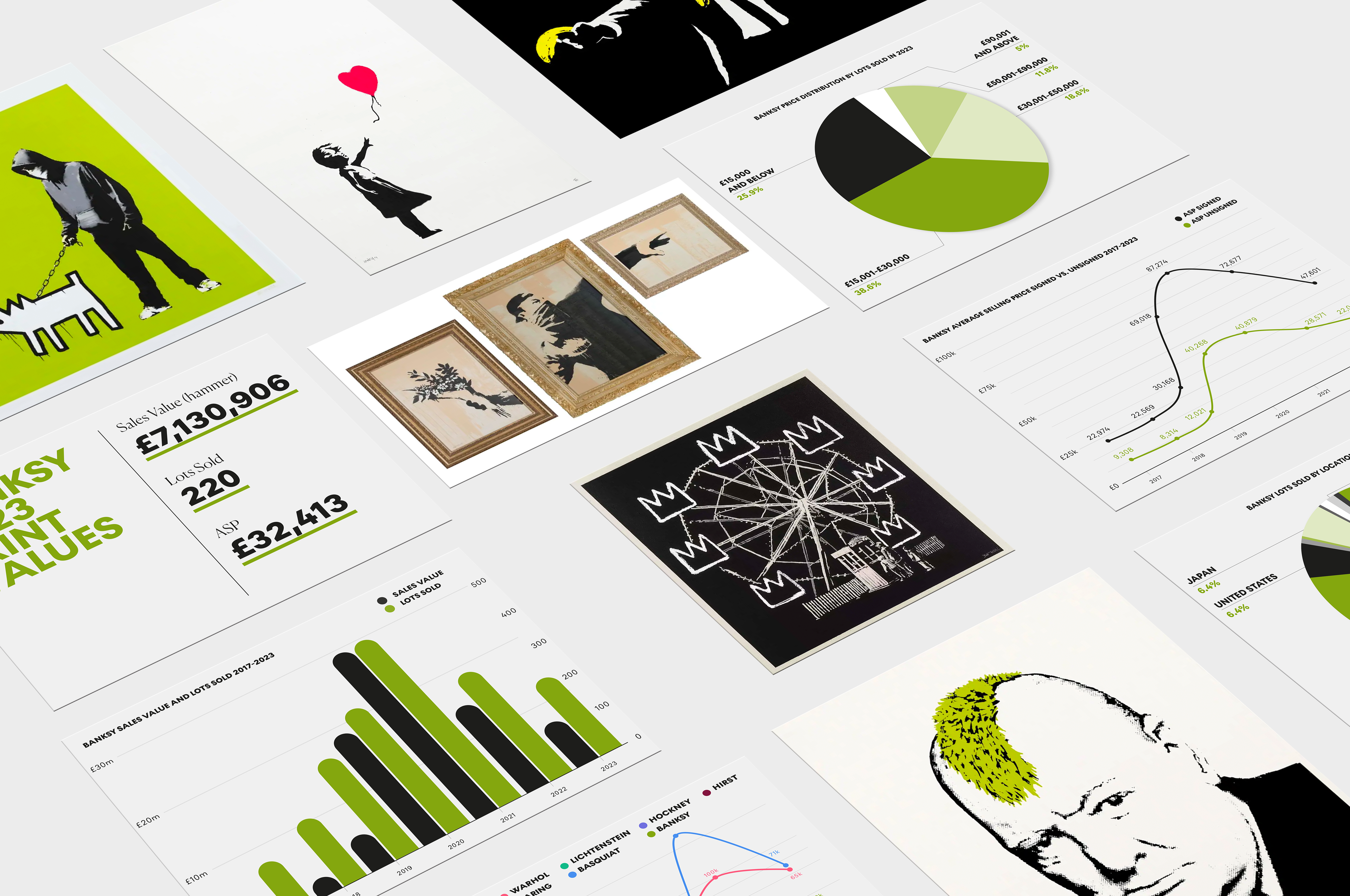


A combined view of sales value and sales volume from 2017 through 2025 illustrates the defining feature of Banksy’s market cycle. The sharp rise in total value between 2019 and 2021 was driven far more by price expansion than by growth in the number of works traded. As prices corrected from 2022 onward, volumes remained comparatively resilient, signalling not a collapse in demand but a recalibration in how collectors engage with the market.
Is Buying A Banksy Print A Good Investment?
The Boom Years: 2018–2021
Banksy’s print market acceleration began in earnest in 2018, driven by a convergence of cultural visibility and expanding access to the secondary market. High-profile moments, most notably the self-destruction of Girl With Balloon at Sotheby’s and its re-emergence as Love Is In The Bin, brought unprecedented attention to Banksy’s relationship with the commercial art system and amplified global collector awareness.
Between 2019 and 2021, total sales value rose at a pace that far exceeded growth in lot volume. Demand increasingly concentrated around recognisable imagery, while distinctions between editions, variants, and format were often secondary considerations. By 2021, Banksy’s print market had surpassed many established blue chip peers in total sales value, reflecting a peak driven as much by sentiment and momentum as by underlying market fundamentals.
The Correction: 2022–2024
From 2022 onward, Banksy’s print market entered a sustained correction. Rising interest rates, tightening liquidity, and a broader retreat from speculative collecting led to declining average prices across both signed and unsigned editions. By 2024, average selling prices had retraced significantly from their highs, while the number of high-value works appearing at public auction fell sharply.
Crucially, this correction did not result in market inactivity. Instead, it revealed structural differences within Banksy’s print ecosystem. Iconic works continued to trade with consistency, while secondary imagery and less recognisable editions softened more markedly. The correction filtered out momentum-driven demand and reintroduced price sensitivity, allowing the market to reset on more stable footing.
What Happened In Banksy's Print Market At Auction in 2025?
By 2025, Banksy’s print market is no longer defined by growth narratives but by hierarchy. Performance is concentrated around a narrow group of benchmark images, while overall transaction volume is distributed across lower-value tiers. According to current average selling price data, signed prints now sit at approximately £51,000, while unsigned prints average around £13,000. These levels align more closely with long-term historical norms than with the speculative distortions of the pandemic period.
Several structural features continue to shape Banksy’s market. New supply is tightly constrained, with no widely accessible print releases since 2017, meaning demand is concentrated on a finite pool of existing works. At the same time, authentication is controlled exclusively by Pest Control, creating a clear divide between works that can circulate in the market and those that cannot.
Cultural visibility remains high, sustained by periodic public interventions. Demand is global, extending well beyond traditional art capitals. Together, these factors support liquidity without guaranteeing uniform price appreciation, reinforcing the importance of selectivity and structure.
What Is The Average Value Of My Banksy Signed/Unsigned Print?
An examination of signed and unsigned average selling prices between 2017 and 2025 reveals two parallel markets operating within Banksy’s print ecosystem. While both segments follow the same broad market cycle, their price levels and volatility profiles differ materially.
Signed prints experienced a dramatic surge during the speculative peak, reaching an average of £394,426 in 2021 before correcting sharply to approximately £51,364 in 2025. Unsigned prints followed a flatter trajectory, peaking at £65,118 and settling at £13,294 over the same period. This sustained price gap demonstrates that signed and unsigned works function not as interchangeable formats, but as distinct market tiers.
Over time, signed prints have behaved as a higher-conviction segment, more exposed to capital concentration during expansionary periods and more vulnerable to correction when sentiment reverses. Unsigned prints, by contrast, have provided a broader liquidity base, absorbing demand at lower price points and exhibiting comparatively lower volatility. During periods of market expansion, the gap between signed and unsigned averages widens as capital flows upward; during contractions, that gap narrows as signed prices adjust more aggressively.
Viewed in this context, the “average” value of a Banksy print is best understood not as a single figure, but as the interaction between two structurally different markets. One is driven by scarcity and premium positioning, the other by accessibility and volume, each offering a distinct risk and participation profile within the broader print landscape.
As Joe Syer has observed, “People forget: Banksy’s market was frothy, yes, but the floor never fell out. What we’re seeing now is a reset, and the smart money is quietly accumulating again.”
Top Performing Print Collections In Banksy's Current Market
Data from 2025 shows a market still anchored by a small number of highly recognisable print collections. Girl With Balloon remains the clear perennial benchmark, leading total sales value despite relatively low lot volume. This pattern reinforces its role as the market’s primary reference point, where recognisability and scarcity continue to concentrate capital.
Choose Your Weapon has also maintained its position as a core series. Consistent appearances and strong aggregate value reflect sustained demand across colourways, even as pricing remains highly stratified by variant. Performance within the series is shaped less by volume than by colourway hierarchy and condition sensitivity.
One of the more notable developments in 2025 has been renewed momentum behind Soup Cans. Multiple sales during Q3 included examples that set new price records for the series, suggesting fresh collector appetite for Banksy works that engage directly with art-historical satire. This resurgence reflects selective demand rather than broad market rotation, particularly where supply has remained constrained.
Kate Moss has similarly shown renewed enthusiasm. Fewer lots translated into disproportionately strong total value, indicating focused demand rather than widespread turnover. This pattern reinforces the series’ position as a culturally resonant, high-conviction segment within Banksy’s print market.
The Most In-Demand Banksy Prints From Investors
Private transactions continue to play a significant role in Banksy’s print market, particularly at the upper end of the pricing spectrum. Many of the rarest works, including unique colourways, Artist’s Proofs, and hand-finished editions, surface infrequently or not at all in public auctions. As a result, price discovery for these works increasingly takes place off-market. This includes examples such as hand-finished works like Dumbo, which have never appeared publicly, as well as ultra-rare variants within core series. Girl With Balloon, off-market examples include a silver and blue balloon which has never been traded publicly.
The private market functions as a parallel channel where scarcity, condition, and provenance can be priced more discreetly. For investors, this reinforces the importance of understanding not only public auction results but also the broader ecosystem in which Banksy prints trade.
Pest Control Authentication and Its Role in Banksy’s Market
A defining structural feature of Banksy’s market is the role of Pest Control as the sole authentication authority. Unlike many blue chip print markets, where provenance and condition can be debated or resolved after a sale, Banksy’s market draws a clear line: works without a Pest Control certificate are excluded from serious trade.
This centralised authentication framework reduces ambiguity, supports liquidity, and underpins confidence across both public and private transactions. It also allows off-market price discovery to operate with a level of clarity rarely seen in contemporary prints, reinforcing the resilience of Banksy’s market even during periods of correction.
What Are The Top Performing Blue Chip Artist Markets?
When compared with other major blue chip print markets, Banksy stands out for the speed and magnitude of his price movements. Between 2017 and 2021, average values rose more sharply than those of peers such as Andy Warhol or Roy Lichtenstein, reflecting heightened sensitivity to shifts in sentiment during the pandemic-era boom.
From 2022 onward, Banksy’s average values declined more visibly than those of Warhol, Hockney, or Lichtenstein, converging toward a tighter range by 2024 and 2025. This retracement represents a normalisation of pricing. In contrast, Warhol and Lichtenstein exhibit greater price continuity, while David Hockney’s market shows a steadier upward trajectory from a lower base, reflecting differing stages of market maturity.
Viewed through an investment lens, Banksy’s print market is more responsive to shifts in sentiment, while older blue chip markets tend to prioritise price continuity over acceleration. This higher elasticity introduces greater volatility, but also explains why Banksy remains accessible across a wider range of price points. In 2025, average values across the cohort appear to be converging, suggesting a market environment where relative opportunity is shaped less by headline peaks and more by selectivity, structure, and timing.
Liquidity In Banksy's Print Market
Investor demand in Banksy’s print market is shaped by the interaction between recognisability, liquidity, and scarcity rather than rarity alone. Highly visible works such as Girl With Balloon continue to trade regularly and function as pricing benchmarks, providing repeat-sales data and dependable liquidity that anchors the wider market.
Alongside this core, structurally scarce works including early NOLA editions and politically charged imagery such as Rude Copper surface far less frequently. When they do appear, they operate within a different risk and reward profile, attracting selective capital at higher volatility. The top individual sales of 2025 illustrate this two-speed structure clearly. Liquid benchmark works sustain confidence through consistent turnover, while scarcer editions and tougher subject matter command attention precisely because of their limited availability.
For smart investments, performance in Banksy’s print market is therefore less about pursuing absolute rarity and more about understanding where a work sits within the hierarchy of liquidity, visibility, and supply. In a post-speculative environment, structure matters more than momentum.
This guide is intended for informational and research purposes only and does not constitute investment advice. All analysis and commentary reflect MyArtBroker’s interpretation of historical and current market data at the time of writing. As market conditions evolve, our views and analysis may change. Individual artworks and editions can perform differently depending on factors such as condition, provenance, timing, and market context. Readers are encouraged to conduct their own research and consult with a specialist before making any acquisition or sale decisions.
Myportfolio
Reading all our stories and articles is free, you just need to sign up.
Becoming a member is always free, and gives you access to unlimited data and articles, we just need to verify your account.
- Track auction results against your collection from over 400 auctions.
- Request free valuations from our specialist team.
- Browse all data, stories and articles unlimited.

Jess Bromovsky
Senior Director

Louisa Earl
Sales Director

Jasper Tordoff
Specialist

Joey Syer
Co-Founder & Specialist