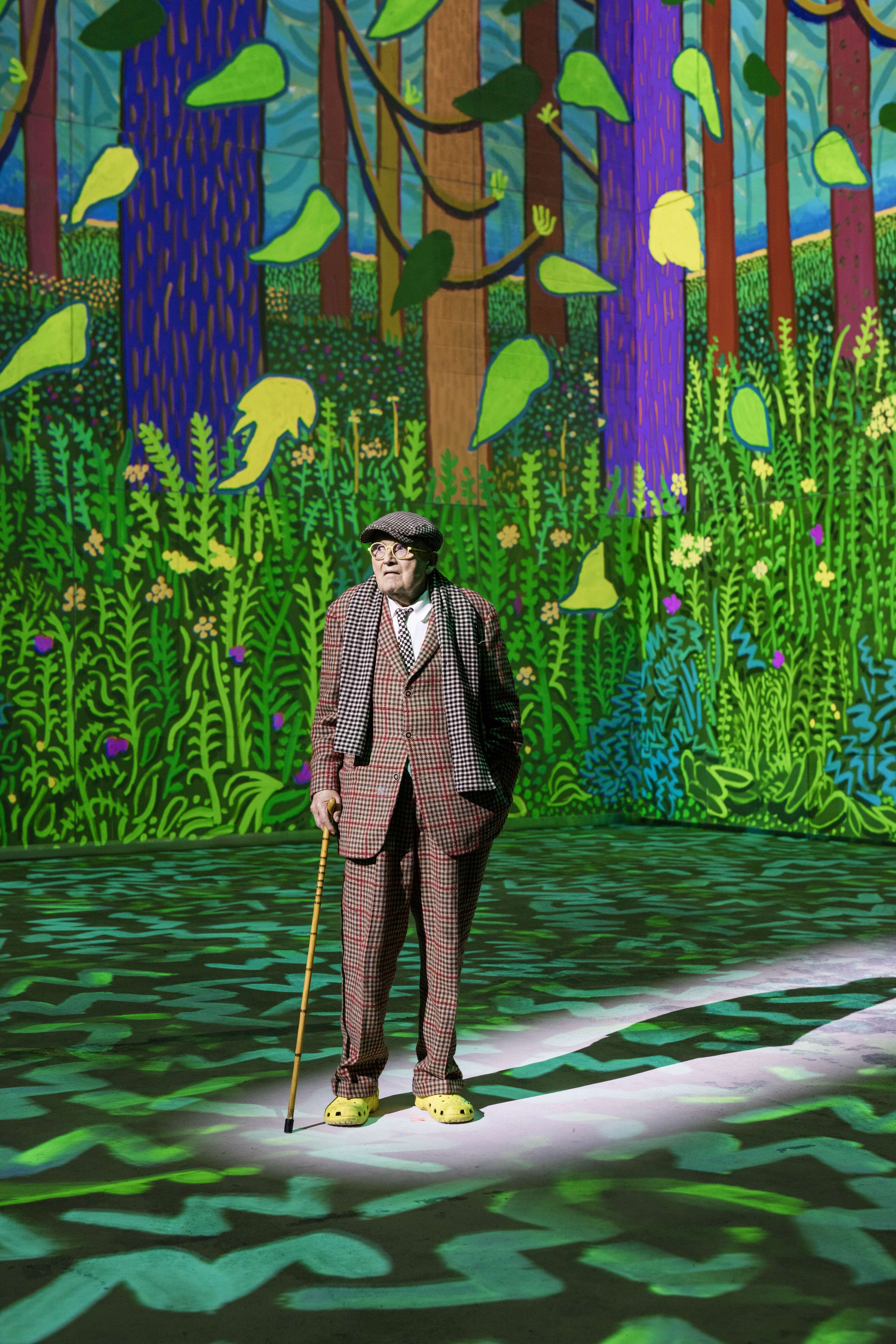


Il existe des artistes qui définissent un moment, et d'autres qui définissent une époque. Hockney a accompli les deux, pour ensuite continuer à évoluer. Qu'il observe la lumière du soleil sur une piscine de Los Angeles, le changement des saisons dans le Yorkshire, le portrait d'un ami ou d'un membre de sa famille, ou encore qu'il réalise un dessin sur iPad, il aborde chaque sujet avec la même curiosité et le même enthousiasme. Sur plus de six décennies, sa fascination pour le regard et la vision n'a jamais faibli.
Qui était David Hockney ?
Né à Bradford en 1937, David Hockney s'est imposé dès sa sortie du Royal College of Art au début des années 1960 comme l'une des figures de proue du pop art britannique. Son œuvre a rapidement acquis une renommée internationale grâce à son ambition technique et à l'intérêt profond qu'il porte aux êtres humains comme aux lieux.
Alors que nombre d'artistes se trouvent cantonnés à un style unique, David Hockney a passé sa carrière à naviguer entre différents médiums et concepts. Il s'est approprié avec un enthousiasme égal la peinture, le dessin, la photographie, la scénographie, l'estampe, puis plus tard les technologies numériques. À travers chacune de ces évolutions, il est resté fidèle à une question aussi simple que profonde : comment voyons-nous ?
Ses œuvres les plus célèbres semblent souvent d'une simplicité trompeuse — une piscine, une route de campagne, le portrait d'un ami, la météo, ou des scènes tirées d'histoires et de poèmes ayant inspiré certaines de ses eaux-fortes les plus remarquables. Pourtant, sous cette apparente sobriété se cache une quête permanente sur la perspective ainsi qu'une observation aiguë du changement, autant d'éléments qui ont contribué à façonner le langage visuel de l'art contemporain.
L'héritage de David Hockney dans le domaine de l'estampe
Bien que Hockney soit avant tout reconnu comme peintre, l'estampe occupe une place centrale dans sa pratique artistique. De l'eau-forte à la lithographie, en passant par la sérigraphie, la photocopie, les transmissions par fax et le dessin numérique, il n'a cessé d'élargir les possibilités offertes par l'estampe.
Loin de se limiter à la simple reproduction d'œuvres existantes, les éditions de Hockney sont devenues un terrain d'expérimentation pour des idées qui allaient structurer une grande partie de sa carrière. Sa fascination pour le dessin et pour une conception plus formelle de l'image s'est étendue à la technologie, imprégnant tout son travail, de ses premiers assemblages photographiques et œuvres réalisées par fax à ses projets numériques plus récents. Tout au long de sa carrière, l'estampe fut moins un médium qu'une manière de penser : une approche qui encourageait l'adoption de nouvelles technologies bien avant qu'elles ne deviennent monnaie courante dans le monde de l'art.
Avec le recul, il est difficile de ne pas voir les échos de cette démarche dans certains des derniers projets publics majeurs de Hockney. « A Year in Normandy », sa frise numérique monumentale inspirée de la tapisserie de Bayeux, synthétise des décennies de réflexion sur le paysage et sa transformation continue au fil des saisons, tandis que le vitrail conçu pour la Turner Contemporary renoue avec sa fascination de toujours pour la couleur et la lumière. Si aucun de ces projets n'a été conçu comme un adieu, tous deux s'imposent désormais comme des reflets fidèles des idées qui l'ont habité tout au long de sa carrière.
Ce qui rendait Hockney unique, c'était sa conviction que l'art devait être à la fois ambitieux et accessible. Il a produit des œuvres qui figurent aujourd'hui dans les plus grands musées du monde, tout en restant attaché à l'édition comme moyen d'introduire l'art dans les foyers. Durant toute sa carrière, l'estampe a été un vecteur permettant d'atteindre un public plus large sans jamais compromettre son intégrité artistique.
Plus tôt cette année, nous avons consacré un numéro entier d' EDITION à l'héritage artistique et à l'œuvre gravée de Hockney, réunissant analyses du marché, points de vue de collectionneurs, commentaires d'experts et entretiens avec ses plus proches collaborateurs. Avec le recul, ce qui frappe, ce n'est pas la solidité redoutable de son marché, mais la diversité des publics qui s'y sont identifiés. Rares sont les artistes ayant su bâtir une base de collectionneurs qui englobe, avec une telle constance, des musées, des institutions, des collectionneurs aguerris et des nouveaux acquéreurs. Sa popularité n'était pas une simple tendance : elle est le fruit de décennies passées à créer des œuvres avec lesquelles le public a réellement souhaité vivre.
Pourquoi Hockney a séduit les collectionneurs
Une part de l'attrait exercé par Hockney réside dans son refus de dissocier l'innovation artistique du plaisir. Si son œuvre est intellectuellement rigoureuse, elle est aussi empreinte de joie. La couleur, la lumière, le paysage, l'amitié et l'observation du quotidien sont demeurés des thèmes centraux tout au long de sa carrière.
Cette capacité à conjuguer accessibilité et portée artistique lui a permis de constituer l'une des bases de collectionneurs les plus solides de l'art contemporain. Qu'il s'agisse d'une peinture aux dimensions muséales, d'une eau-forte, d'un dessin sur iPad ou d'une édition d'estampes, Hockney invite les spectateurs dans l'intimité de son monde plutôt que de les tenir à distance.
Nous avons eu la chance de nous entretenir longuement avec Nick Hockney au sujet du rapport de David à l'estampe. Ses souvenirs ont révélé un artiste abordant ses éditions avec le même sérieux que pour n'importe quel autre médium. La couleur comptait. Le métier comptait. L'accessibilité comptait. C'est peut-être cette alliance de rigueur et d'ouverture qui continue, aujourd'hui encore, d'attirer les collectionneurs vers son travail.
Pour beaucoup, l'œuvre de Hockney incarne un optimisme exempt de sentimentalité. Même tardivement, son travail a conservé un sens de l'émerveillement et une curiosité qui semblent se raréfier, tout en restant parfaitement authentiques – une passion intacte pour une vision renouvelée du monde qui ne semble jamais avoir faibli.
L'héritage de David Hockney perdure
Durant les dernières décennies de sa vie, Hockney n'a cessé d'expérimenter de nouvelles technologies et de nouvelles manières de percevoir le monde. Les visiteurs de l'exposition David Hockney: Bigger & Closer (not smaller & further away) au Lightroom ont pu découvrir un artiste qui, même octogénaire, est resté déterminé à repousser les limites et à remettre en question les conventions sur la manière d'appréhender une œuvre.
Il évoquait fréquemment l'importance de regarder – réellement regarder – le monde qui nous entoure. C'est sans doute le moyen le plus simple d'appréhender son héritage. Par une expérimentation constante, Hockney a appris à des générations entières à observer le monde avec une attention renouvelée.
Sa disparition marque la fin de l'une des carrières artistiques les plus remarquables du siècle dernier. Pourtant, l'héritage qu'il laisse derrière lui est extraordinaire : un corpus d'œuvres qui a façonné, et continuera de façonner, l'art contemporain. Hockney a élargi les possibilités de l'estampe et a inspiré des millions de personnes à poser un regard nouveau sur le monde.
Le monde de l'art est plus silencieux aujourd'hui. Mais l'œuvre de Hockney – vibrante, curieuse et riche de possibles – demeure.
David Hockney
1937–2026