
A timeline of Hockney’s printmaking is therefore also a timeline of his changing ideas about image-making itself. Certain concerns remain constant: line, flatness, seriality, perspective, portraiture, and the relationship between looking and remembering. What changes is the means by which those concerns are pursued. Each studio, printer, and publisher brought with it a different technical proposition, and Hockney proved unusually alert to what each process could make possible. This is what gives his printed work its particular coherence across more than seven decades.
1954–1959: Bradford School of Art and The Beginnings of Lithography
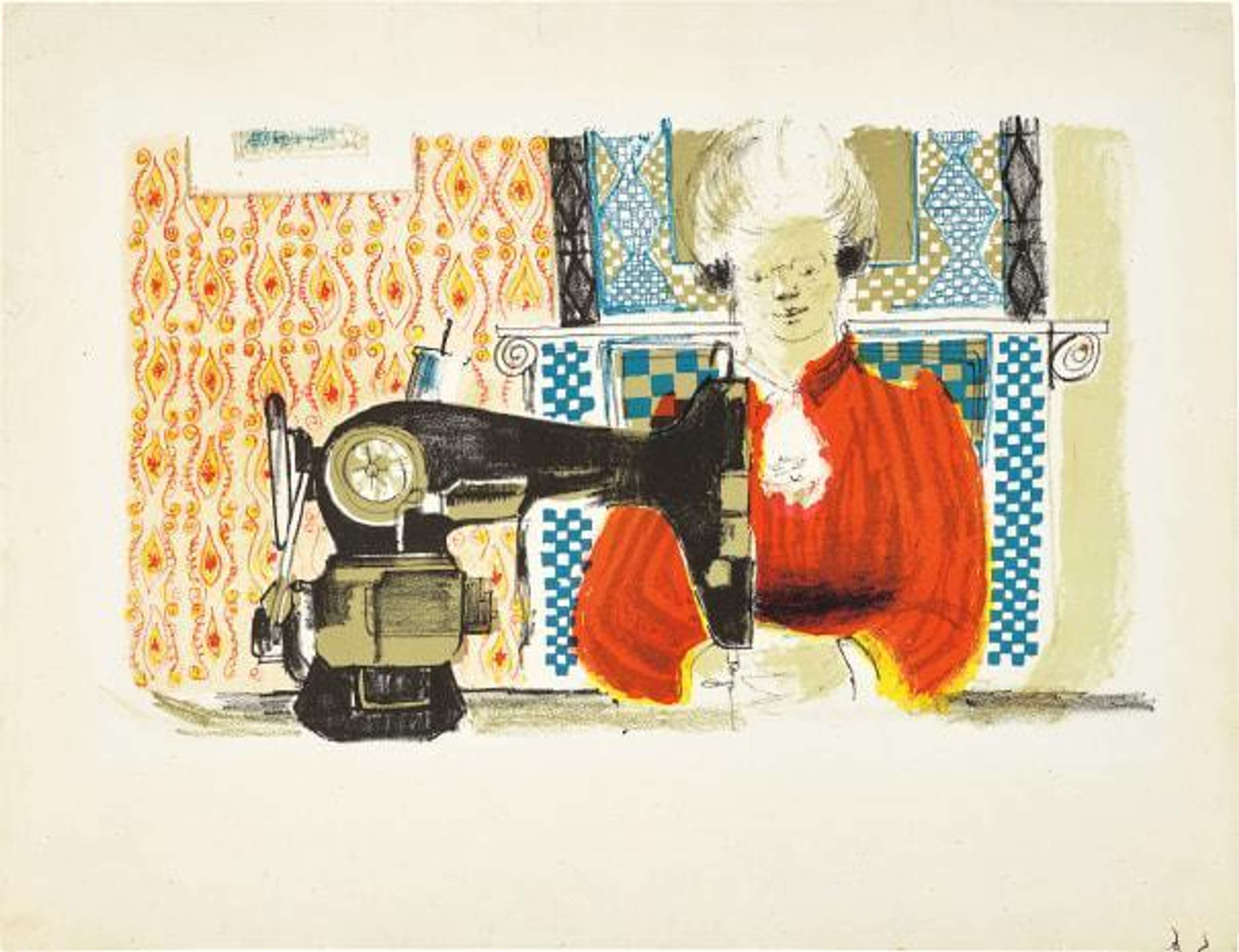
Hockney’s printmaking begins in Bradford. While still a teenager at Bradford School of Art, he encountered lithography and used it to make some of his earliest surviving prints. The medium was well suited to him from the outset: it is direct, drawing-based, and comparatively immediate, allowing the artist to work on a flat surface rather than incising a plate. Lithographs remain one of the core categories within his graphic practice, a useful indication that these early works were the beginning of a long and serious engagement with the medium.
The Bradford lithographs already contain many of Hockney’s enduring subjects. Domestic interiors, self-presentation, and scenes of ordinary life appear in embryo, and they do so through a medium that preserves the alertness of drawing. Works such as Fish And Chip Shop and Woman With A Sewing Machine are especially important because they show Hockney using printmaking to sharpen observation and structure pictorial space.
1959–1963: Royal College of Art, Etching & The First Major Narrative Prints
When Hockney entered the Royal College of Art in 1959, printmaking became central to his development. Here he moved decisively into etching and aquatint, discovering in intaglio a medium capable of supporting both autobiographical wit and complex narrative sequencing. Cataloguing of early works such as Myself And My Heroes notes that they were printed at the Royal College of Art in London and published by the artist, which is important: before the major commercial publishers entered the picture, Hockney was already using the institutional facilities of the RCA to establish himself as a printmaker of ambition.
The defining project of this period is A Rake’s Progress (1961–63), a sequence of sixteen etchings that reworks Hogarth’s eighteenth-century model through the lens of Hockney’s own first trip to New York. The set was published by Editions Alecto in association with the Royal College of Art. The significance of this project lies in both its subject and its infrastructure: it marks the point at which Hockney’s printmaking moved from art-school production into the orbit of a serious London publisher.
Editions Alecto would prove crucial in these years. The firm published A Rake’s Progress and other early etchings, and Hockney’s 1963 exhibition The Rake’s Progress and Other Etchings was held at the Print Centre, Editions Alecto Gallery, in London. That exhibition history matters because it shows how closely Hockney’s rise as a printmaker was tied to the London print economy of the early 1960s.
1964–1966: Editions Alecto, Lithography & The Move Toward Los Angeles
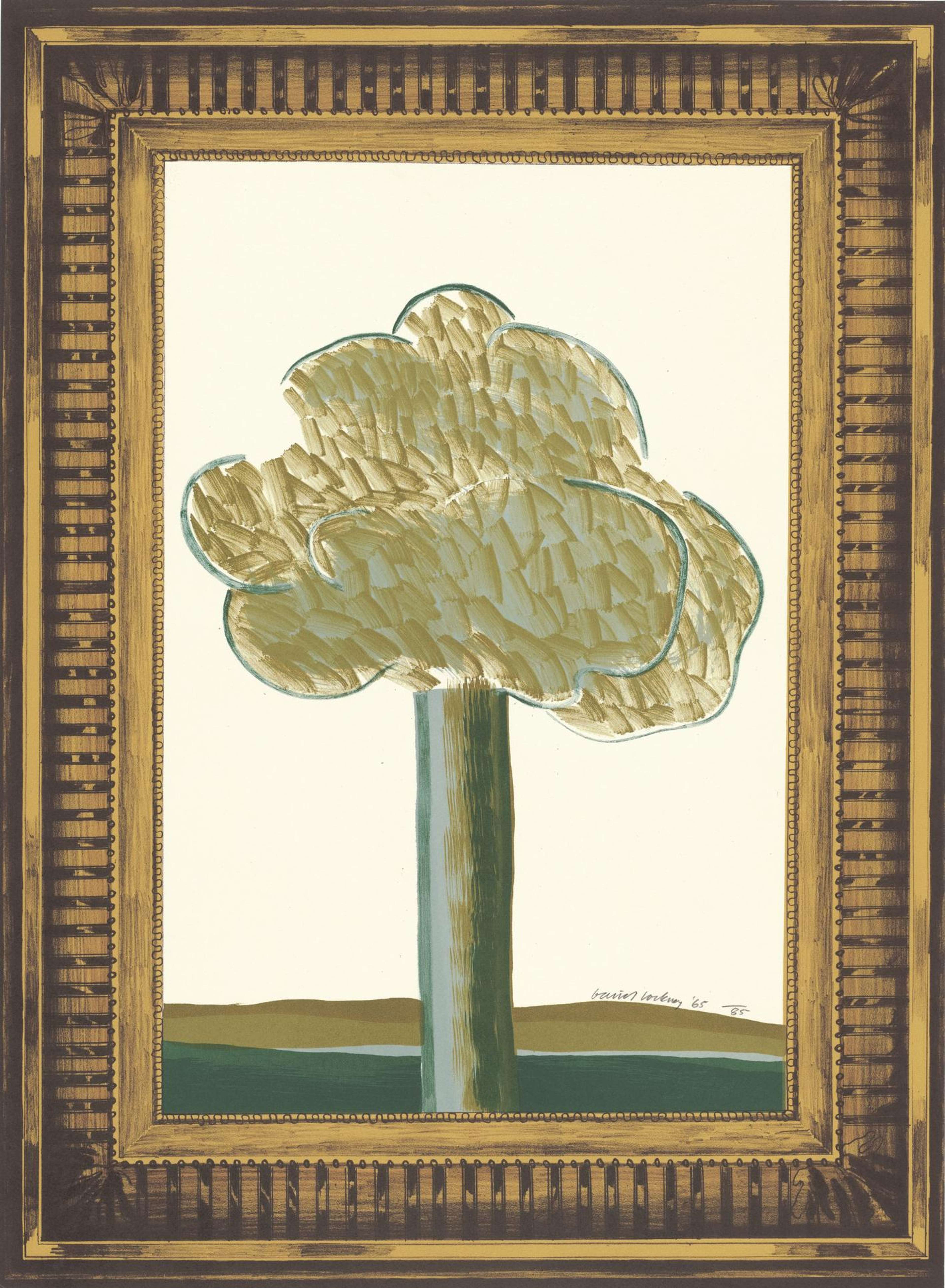
By the mid-1960s, Hockney’s printmaking broadened. Lithography returned with renewed importance, and Editions Alecto continued to play a key role as publisher. In 1965, A Hollywood Collection brought together six lithographs that explore framing, illusion and the status of the image as object. The series was published by Editions Alecto in London and printed by Gemini G.E.L. in Los Angeles. That transatlantic structure is revealing: even before Hockney’s full Californian immersion, his printmaking was already being shaped by the technical resources of Los Angeles workshops.
This is the first major point in the timeline where a studio becomes artistically decisive. Gemini G.E.L., founded in 1966 as an artists’ workshop and fine-art publisher in Los Angeles, offered a level of technical sophistication that suited Hockney’s increasingly ambitious lithographs.
1966: Illustrations for Fourteen Poems by C.P. Cavafy & Consolidating The Literary Print
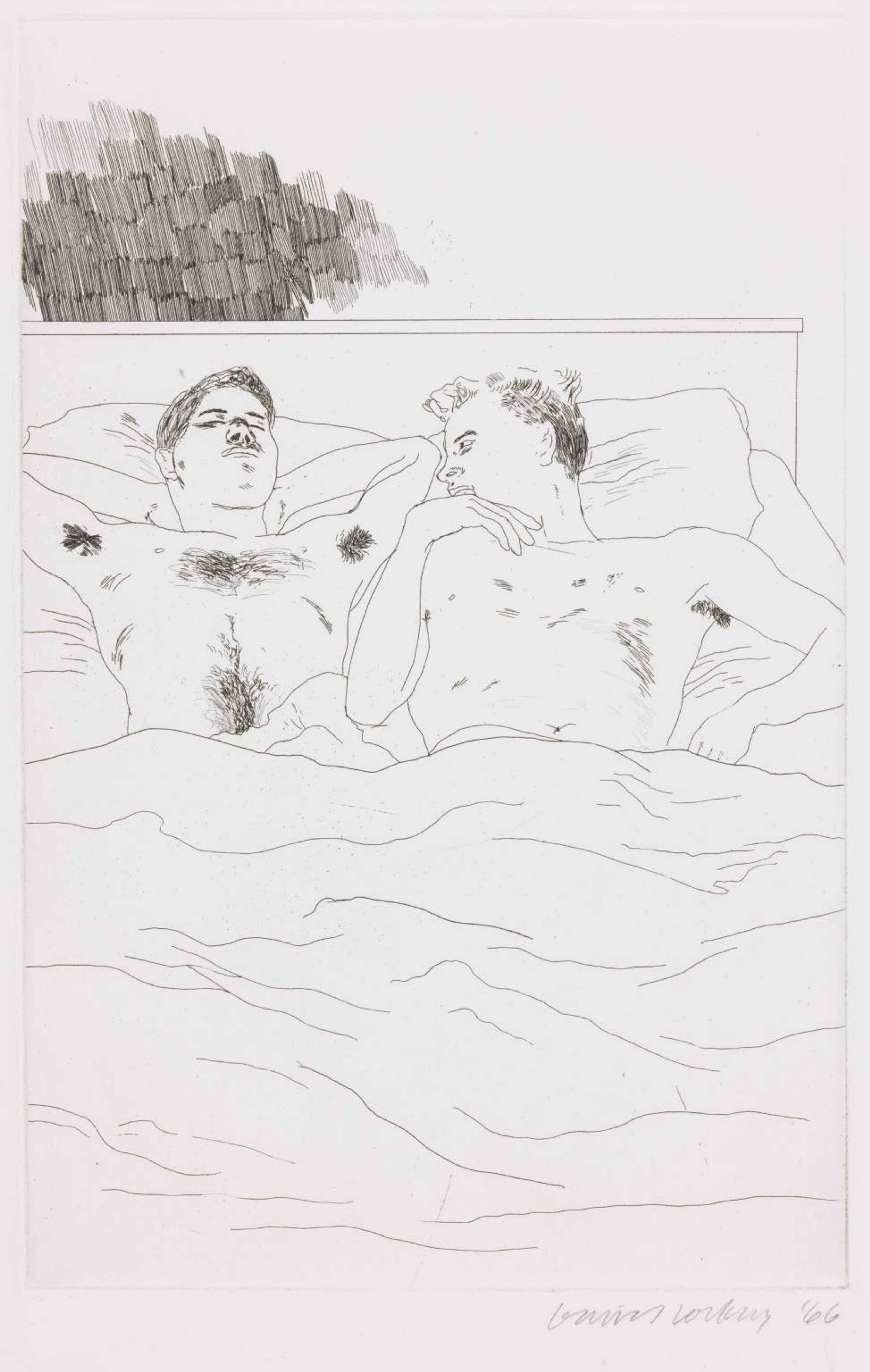
If A Rake’s Progress established Hockney as a young printmaker of unusual narrative intelligence, Illustrations for Fourteen Poems by C.P. Cavafy (1966) confirmed that literary subject matter would remain central to his graphic practice. The portfolio was published by Editions Alecto, London, placing it firmly within the same institutional and commercial framework that had supported the RCA-period etchings.
The Cavafy etchings are especially important because they deepen the autobiographical and homoerotic undercurrents already present in Hockney’s early work while also formalising his engagement with the artist’s book and the literary portfolio. In chronological terms, they form a crucial bridge between the satirical, self-conscious modernity of A Rake’s Progress and the denser, more technically ambitious print cycles that follow at the end of the decade. They also demonstrate how closely Hockney’s printmaking was tied to reading, translation and adaptation: using print as a way to inhabit and reinterpret texts.
1968–1970: Petersburg Press & Etched Series
If Editions Alecto underpinned Hockney’s emergence, Petersburg Press became one of the most important publishers of his mature printmaking. Cataloguing repeatedly identifies major Hockney projects of the late 1960s and 1970s as published by Petersburg Press in London, and in some cases in London and New York. That is true of individual early works retrospectively issued by Petersburg Press, such as The Marriage of 1962, published in 1968, as well as later projects conceived directly within its orbit.
The key achievement of this period is Illustrations For Six Fairy Tales From The Brothers Grimm (1969–70). The series was printed by the Print Shop in Amsterdam and published by Petersburg Press, London. Petersburg Press provided the publishing framework and distribution network; the specialist execution was handled by the Print Shop in Amsterdam, where the technical demands of Hockney’s soft-ground etching and aquatint could be fully realised. The result was one of the most sophisticated print cycles of his career: materially rich and highly experimental.
Petersburg Press also published lithographs from this period, including Tree (1968), demonstrating that its role in Hockney’s print career was not limited to etching. By the end of the decade, Hockney had effectively established parallel print identities: one rooted in the etched book and narrative portfolio, the other in the increasingly expansive possibilities of lithography.
1971–1977: Gemini G.E.L., Portrait Lithography, & Petersburg Press in Parallel
The 1970s are best understood as a period of dual allegiance. On one side stands Gemini G.E.L. in LA, with its extraordinary lithographic resources and close technical dialogue between artist and printer. On the other stands Petersburg Press, continuing to publish some of Hockney’s most intellectually ambitious etchings.
At Gemini, Hockney produced some of his most celebrated lithographs. Works like Still Life with Book (1973) and Sun from The Weather Series were published here. This was a durable collaboration that shaped the look and scale of Hockney’s 1970s graphic work. The Weather Series and related Gemini projects demonstrate Hockney moving beyond monochrome linearity into more complex colour orchestration. Portfolios like The Weather Series and the 1976 Friends portfolio also underscores how central Gemini and printer Ken Tyler were to this shift.
Meanwhile, Petersburg Press remained central to the etched line of his practice. Artist And Model (1974) was published by Petersburg Press, as were Celia Observing (1976) and the 1977 Blue Guitar portfolio. This is set of 20 etchings is one of the crucial moments in Hockney’s career: the portfolio is both art historically self-aware, in dialogue with Picasso and Wallace Stevens, and technically assured. Petersburg Press gave Hockney the publishing continuity for such substantial projects, while Gemini offered workshop innovation in lithography.
1978–1980: Paper Pools, Tyler Graphics & The Print as Book-Object
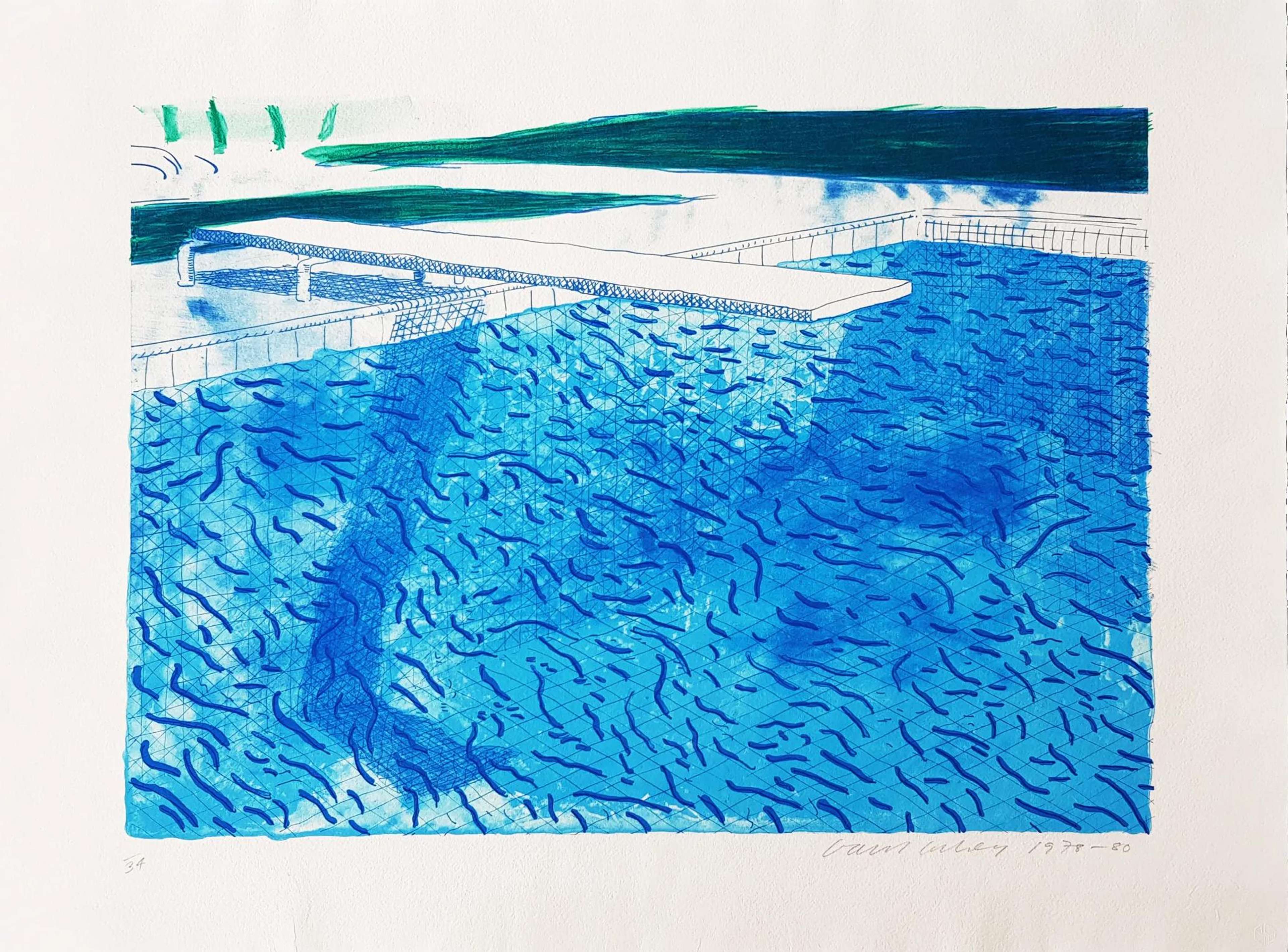
The transition from the Petersburg and Gemini years into the later 1970s is marked by Hockney’s collaboration with Tyler Graphics, though the works produced in this period need to be carefully distinguished from one another. The Paper Pools themselves were a group of unique paper pulp works made between 1978 and 1980. These one-of-one works are significant because they show Hockney moving beyond the printed sheet and into a more materially experimental graphic field, using coloured paper pulp to create images that retain the logic of editioned practice while resisting repetition in the usual sense.
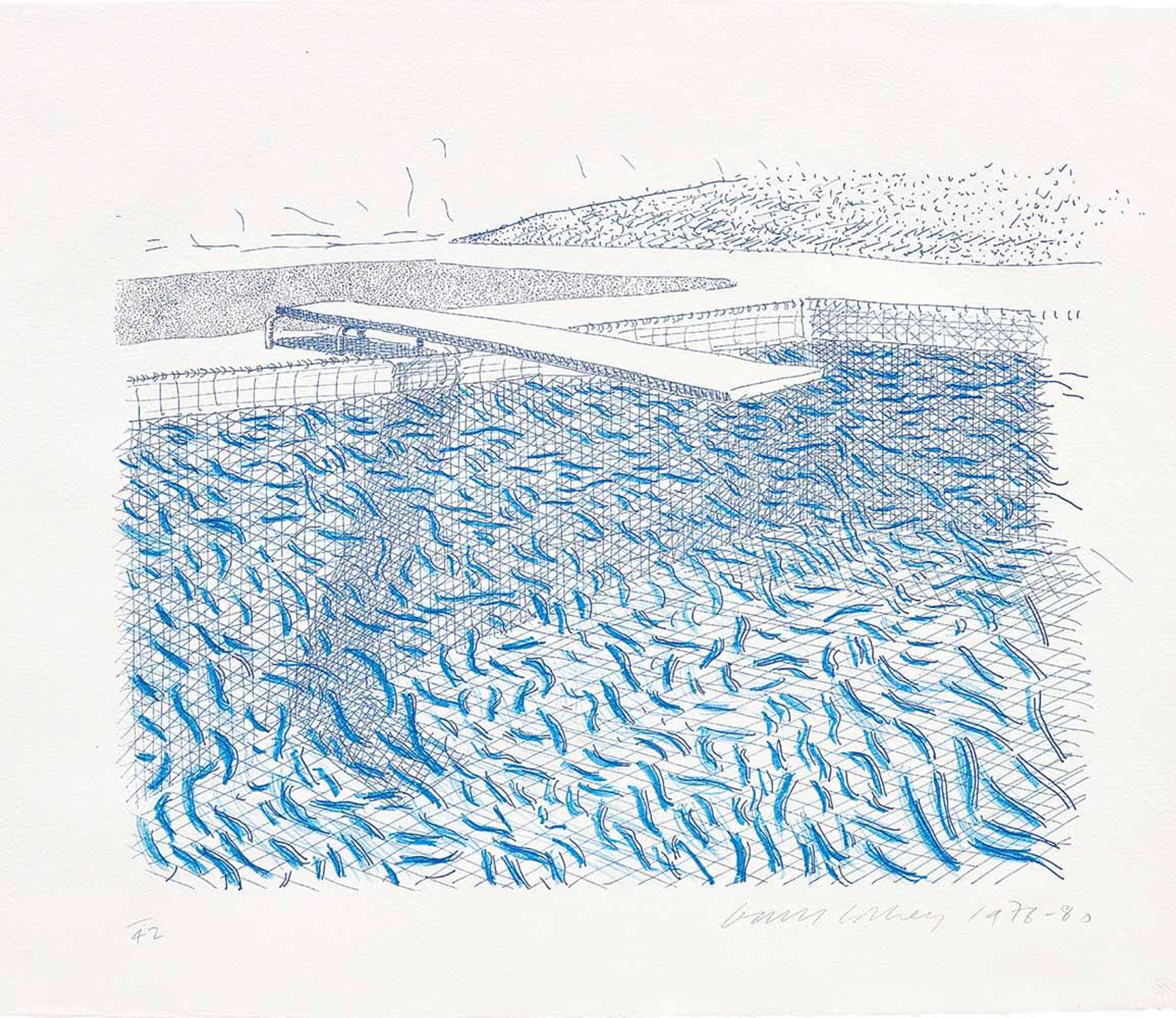
Alongside these unique works, Hockney also produced related lithographic projects with Tyler Graphics, including Pool Made With Paper And Blue Ink For Book and the Lithograph Of Water works. These belong to a different category from the paper pulp pieces themselves. These works translate some of the same visual and conceptual concerns as the Paper Pools – water, surface, colour, and the tension between image and material – into lithographic form. In the case of Pool Made With Paper And Blue Ink For Book, the work belongs to a publication-based project, which introduces another important dimension of this moment in Hockney’s printmaking: the print as part of a book-object, rather than only as an autonomous framed edition.
The Tyler collaboration therefore marks a crucial formal crossroads. It extends Hockney’s long-standing fascination with pools and Californian light, but does so through a more exploratory understanding of graphic production. By the end of the 1970s, the edition was no longer only a printed sheet for the wall. It could also take the form of a unique paper work, a lithographic sequence, or a book-based project in which publication format and objecthood were integral to the meaning of the work. That expansion in form would prove central to Hockney’s printmaking in the decades that followed.
1979–mid-1980s: Gemini G.E.L., Tyler Graphics & The Widening of The Printed Image
By 1979 Hockney’s printmaking entered another phase, one in which portraiture, painterliness and technical hybridity came to the fore. In this year alone, he produced his Gemini G.E.L. 1979 Portfolio and the Tyler Graphics 1979 Portfolio, demonstrating how Hockney’s workshop relationships had become multiple rather than singular. Gemini remained central, but Tyler Graphics also enters the story as a recognised Hockney collaborator.
This period includes some of Hockney’s finest lithographic portraits, especially of Celia Birtwell and his wider circle. Gemini’s own exhibition history confirms the ongoing importance of these portrait editions, while NGA object records identify Gemini printers such as Mark Stock, James Reid and Christine Fox on specific Hockney works from 1976 to 1981. These details matter because they remind us that Hockney’s printmaking was not simply a matter of publishers’ imprints. It was built through long, technically exacting relationships with named printers and workshop specialists.
In parallel, Hockney was beginning to question the limits of traditional printmaking. The 1980s Home Made Prints, grouped as such on the official Hockney site, brought Xerox photocopying into his graphic practice. Here the studio model becomes more dispersed: rather than relying exclusively on master-printer collaboration, Hockney adapted office technology into a personal print process. This shift did not replace Gemini or other workshops, but it changed the terms of printmaking in his work by moving toward immediacy and direct control.
1984–1986: Moving Focus & The Culmination of The Tyler Graphics Years
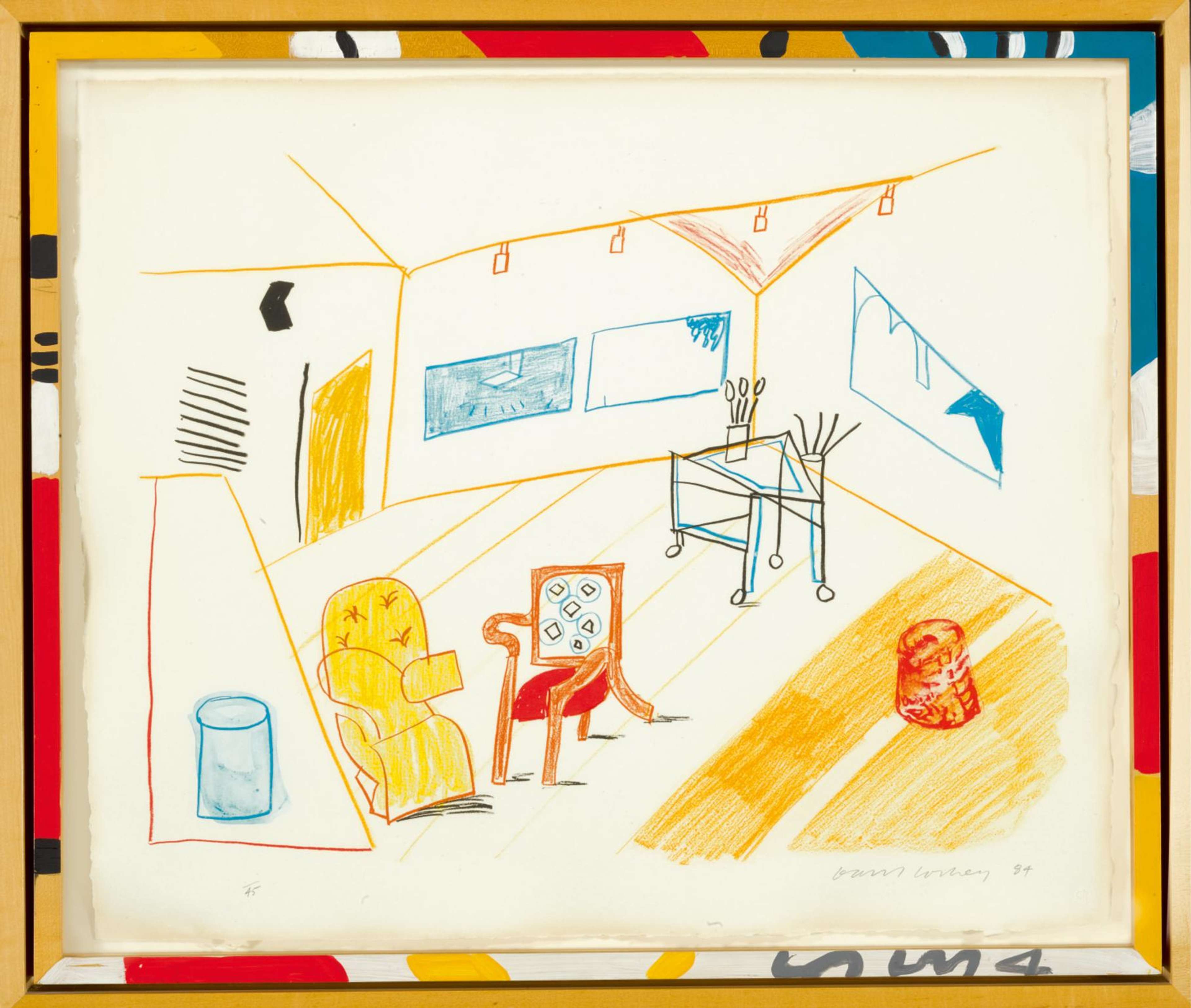
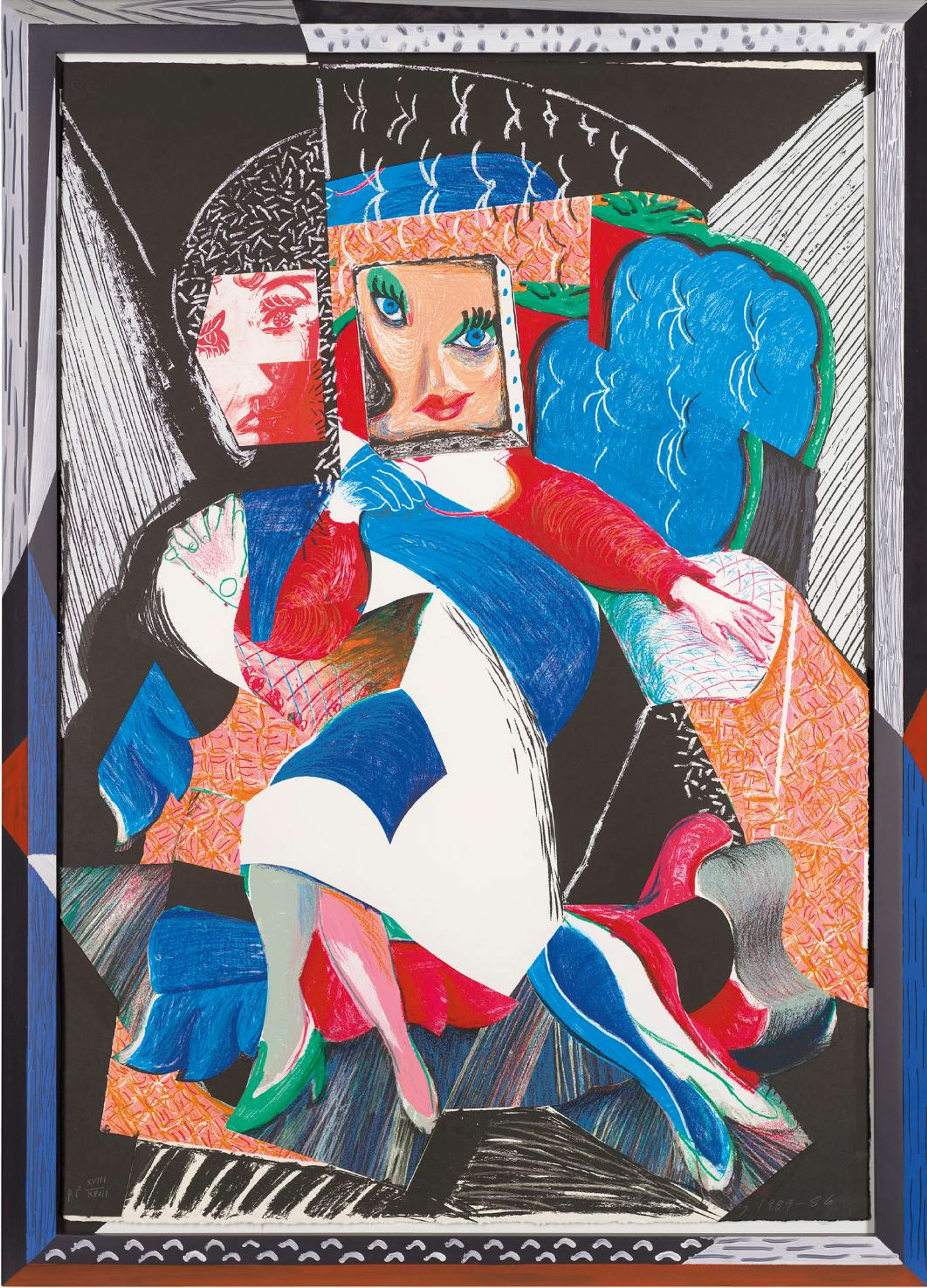
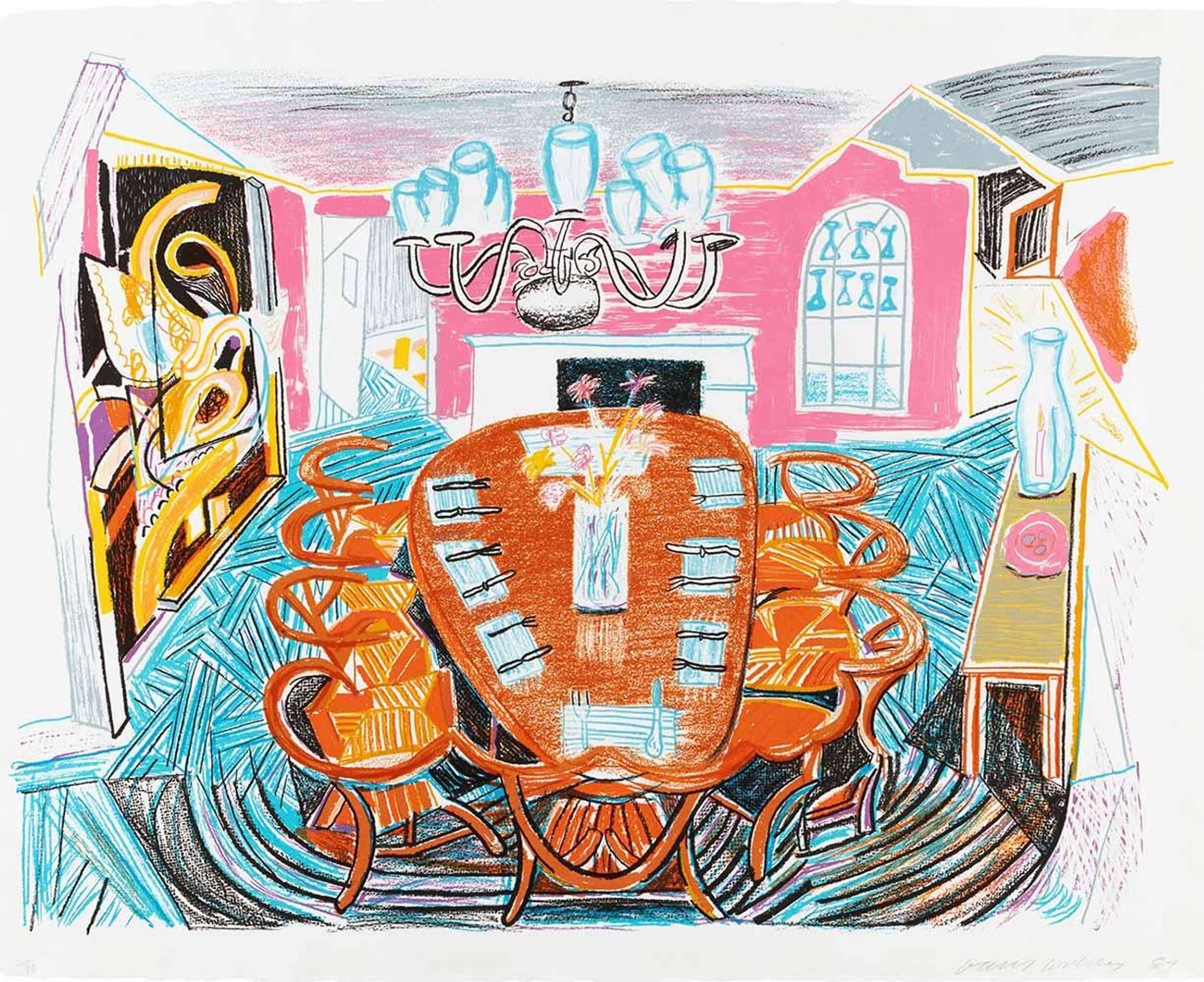
The Moving Focus series should be treated as one of the major achievements of Hockney’s mature printmaking. Hockney’s own illustrated chronology is explicit on this point, describing the series as “the culmination” of his experiments with Cubism and noting that he worked with Ken Tyler on a group of technically complex lithographs based on drawings made the previous autumn. Works from the series includes Two Pembroke Studio Chairs, Hotel Acatlán: Second Day, and Amaryllis In Vase – all published by Tyler Graphics, Ltd. and printed as lithographs in colours on handmade paper.
Moving Focus is where workshop history and formal development align most clearly. The series is not significant simply because it is technically ambitious, though it is. Its deeper importance lies in the way it translates Hockney’s longstanding concerns with multiple viewpoints, shifting spatial construction and photographic fragmentation into the language of lithography. The Tyler workshop gave him the scale, chromatic control and material finesse needed to make these experiments fully persuasive in print. What had been explored through joiners and photographic collage in the early 1980s here returns in a distinctly graphic form, demonstrating that print remained one of the most serious sites of Hockney’s formal thinking.
Mid-1980s–1990s: From Print Studio to Photocopier, Photography & Hybrid Surfaces
The later 1980s and 1990s do not mark a retreat from printmaking so much as an expansion of its logic. Hockney’s Home Made Prints continue the graphic line of his practice, while the photographic collages and joiners of the early 1980s, though not printmaking in the strict sense, emerge from many of the same questions about reproducibility, fragmentation and perspective. The official Hockney site keeps these bodies separate – graphics, photographs, digital works – but seen historically they are deeply connected.
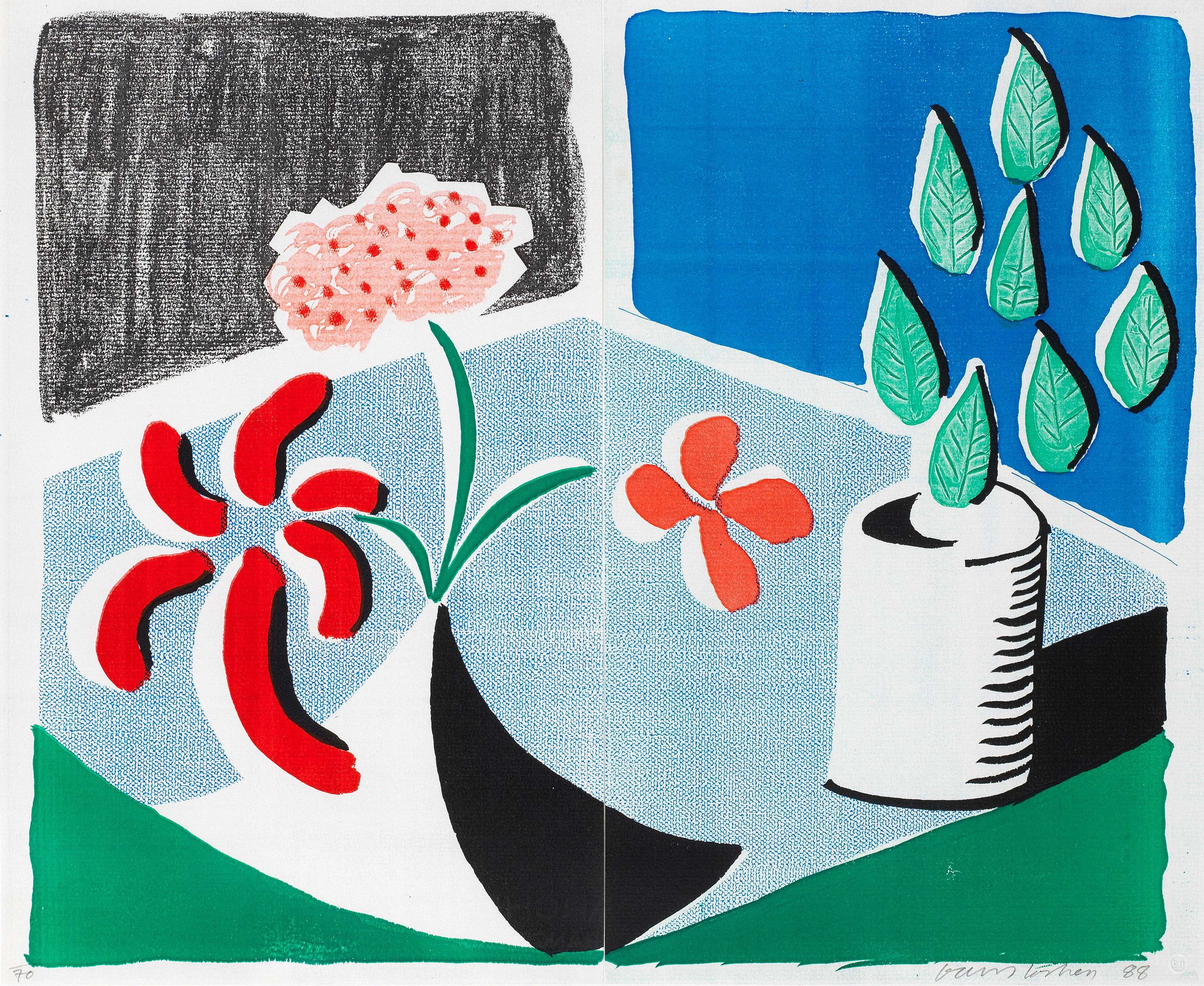
Gemini remained important into the 1990s. Its current cataloguing includes Hockney’s large-scale 1993–94 lithograph-screenprints such as Pushing Up, Gorge d’Incre, Going Round, and Slow Forest, all from the Some New Prints series. These works show the late flowering of the workshop relationship: technically elaborate, highly coloured, and often physically expansive. They belong to a mature printmaker who had absorbed decades of collaboration and was using the workshop not merely to reproduce images, but to generate them.
2000–2008: Consolidating The Graphic Legacy and Preparing For a New Digital Phase
The years immediately after 2000 are sometimes treated as a quieter interval in Hockney’s printmaking, but that risks missing their importance. Exhibition records show that his printed work remained active and visible, even as his attention moved between drawing, photography, watercolour, portraiture and large-scale landscape. L.A. Louver’s biography records Photo Collages, Home Made Prints and Digital Inkjet Prints at Pillsbury & Peters Fine Art in Dallas in 2000, indicating that by the turn of the century Hockney’s graphic production was already being framed not only through traditional print categories, but through a broader continuum that included photocopy works and early digital inkjet prints. Indeed, Hockney’s printmaking had already expanded beyond lithographic stone and etched plate before the iPhone and iPad entered his practice.
What changes in this period is less the disappearance of printmaking than the loosening of its conventional workshop model. Earlier decades were structured around named publishers and ateliers, whereas the early 2000s reveal a more fluid relationship between unique works, photographic processes, inkjet output and exhibition-based editions. Annely Juda’s exhibition history records A Year in Yorkshire in 2006 and Drawing in a Printing Machine in 2009, helping to bridge this transition. The titles alone are revealing. By the later 2000s, Hockney was investigating what a “printing machine” could become as a drawing tool.
2009–2012: The Emergence of Digital Prints & iPad Drawings
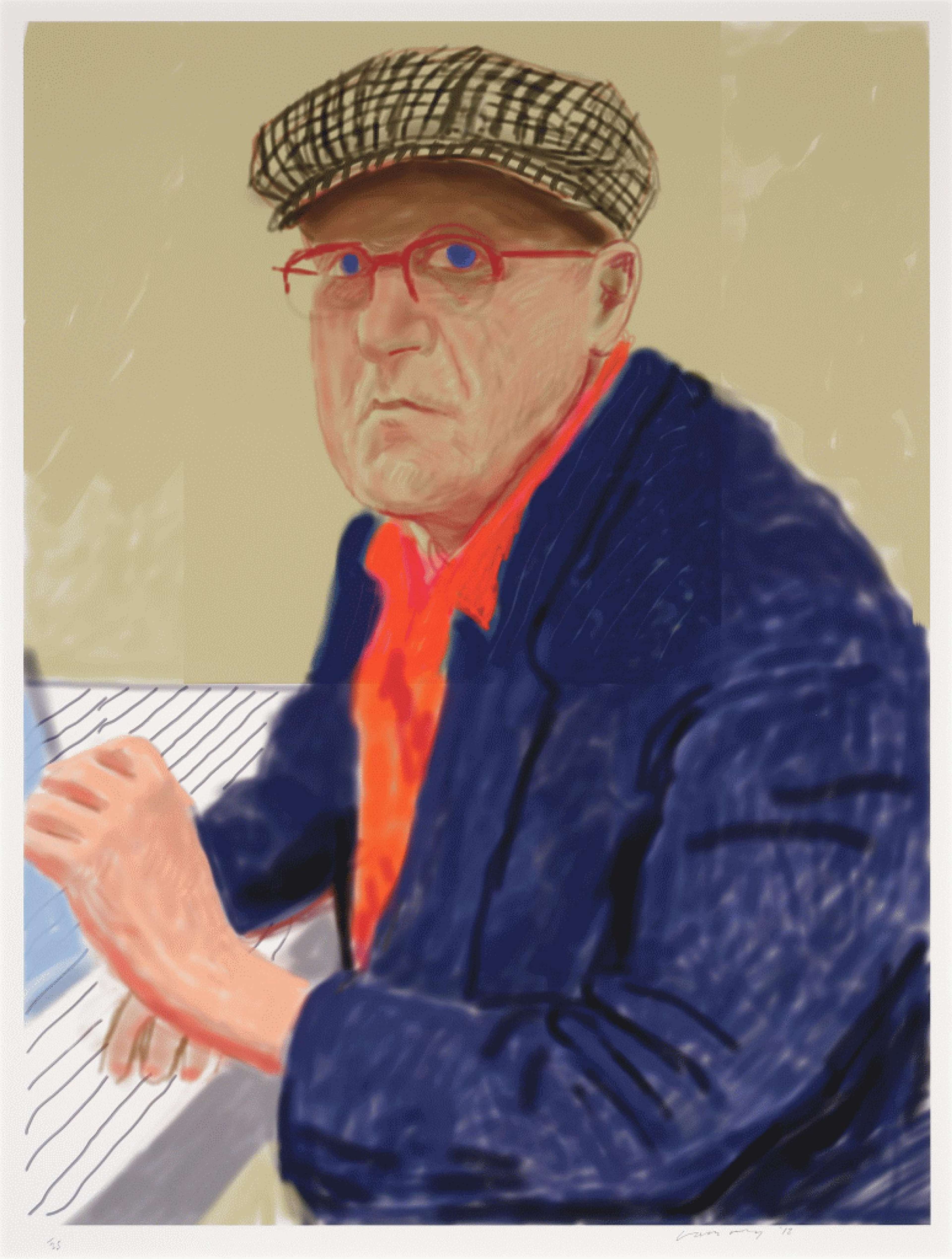
The decisive break comes in 2009. Annely Juda’s exhibition Drawing in a Printing Machine makes clear that Hockney’s new phase was not incidental experimentation, but a serious and public investigation into digitally mediated graphic production. From this point, the printing process itself becomes both subject and method: rather than using a machine to reproduce an already finished image, Hockney uses digital technology to generate original works whose final form is inseparable from printing.
The official David Hockney website is especially important here because it provides Hockney’s own framing of these works. In the Digital Works section, he states that these prints are “made by drawing and collage,” that they exist either in the computer or on paper, that they were “made for printing,” and that they are “not photographic reproductions.” That distinction is fundamental. It places the digital works directly within the history of original printmaking and editioned graphic art, rather than treating them as derivative outputs of another medium. It also clarifies Hockney’s continuity of purpose: digital technology did not pull him away from printmaking but offered a new way to pursue it.
This phase begins with iPhone and early iPad drawings and expands rapidly into ambitious bodies of work. Exhibitions like David Hockney’s Drawings on the iPhone and iPad at the Royal Ontario Museum in 2012 and Fleurs Fraiches in Paris in 2011, demonstrating how quickly these works were institutionalised. The official site also separates computer drawings, iPhone, and iPad as distinct categories, suggesting that Hockney himself saw these as technically and visually specific strands within a broader print practice.
2011–2016: The Arrival of Spring & The Yosemite Suite
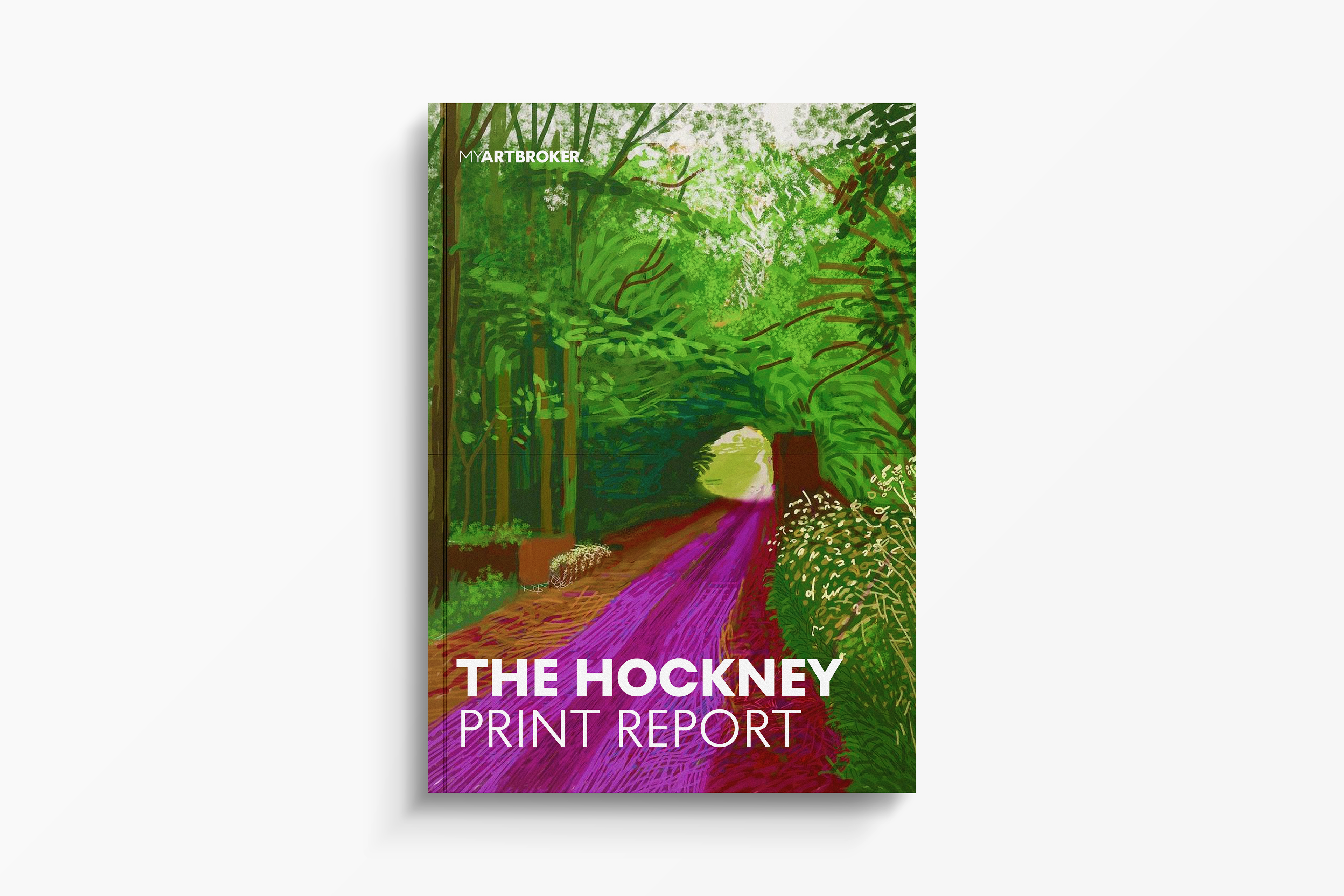
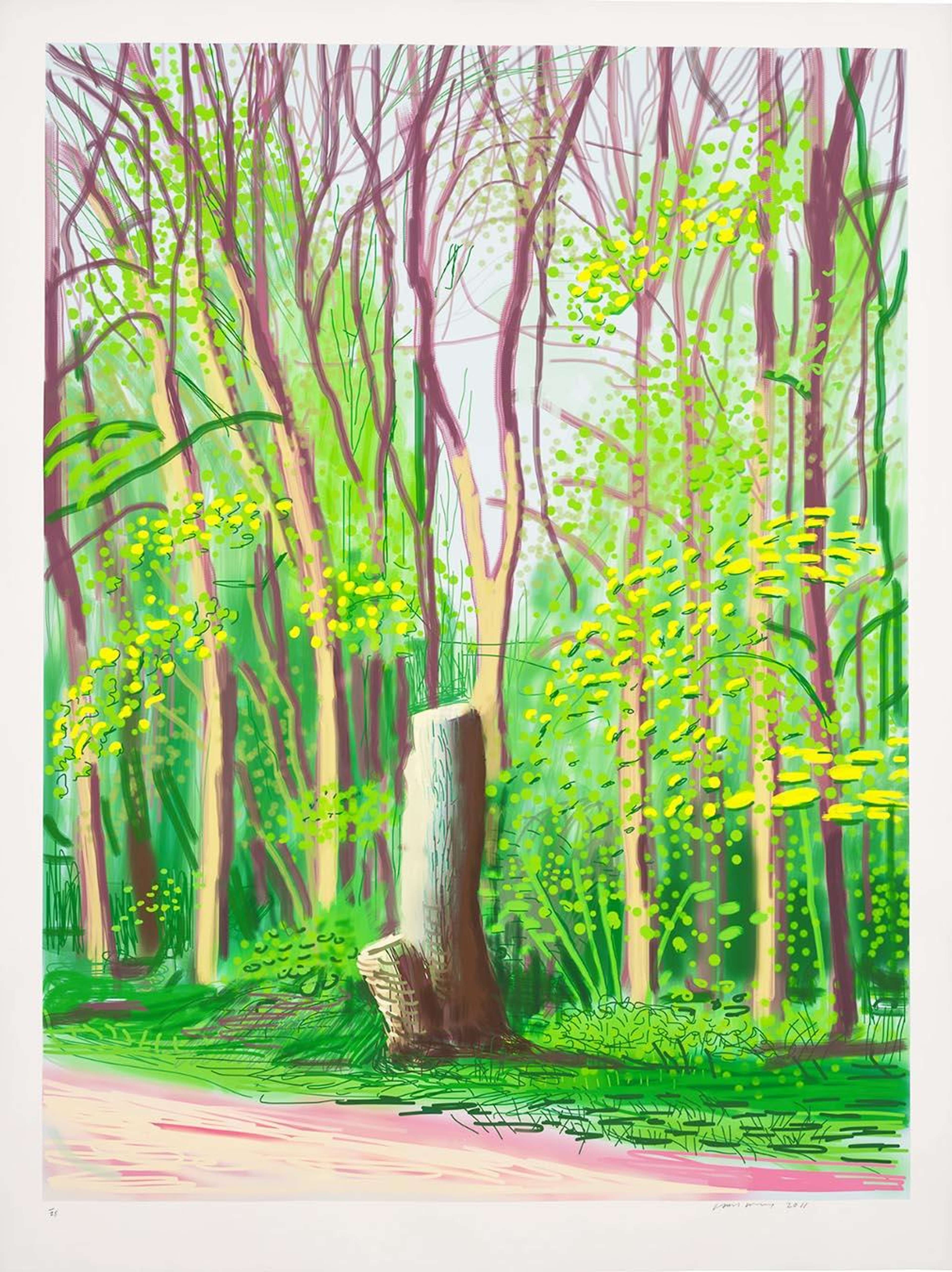
Hockney’s digital printmaking reaches a new level of ambition with The Arrival Of Spring In Woldgate, East Yorkshire In 2011 and The Yosemite Suite. These are not isolated experiments but fully realised series that demonstrate how decisively he had absorbed digital drawing into his graphic practice.
The Arrival Of Spring marks a pivotal moment because it translates Hockney’s long-standing engagement with landscape into a medium capable of speed, repetition and serial observation. This was the culmination of the artist's movement from traditional printmaking into digital image-making, while still retaining the essential logic of editioned art. In formal terms, the series matters because it uses the device not to imitate handmade mark-making, but to generate a new graphic language for seasonal change, light and time.
The Yosemite Suite, made in 2010 and exhibited extensively from 2016 onward, pushes this development further. These works suggest that the digital print didn't replace older techniques, but allowed Hockney to revisit one of the oldest printmaking questions – how an image can be scaled, repeated and distributed – under new technical conditions.
2020–2026: Normandy, New Editions & The Continued Expansion of The Digital Graphic Field
The most substantial recent development in Hockney’s printmaking comes with the Normandy works. Although the Normandy project is often discussed primarily in relation to painting and immersive installation, it is also central to Hockney’s late graphic thinking. The works are iPad paintings, but the exhibition history around them demonstrates their close relationship to reproducible, editionable image-making.
This is especially visible in the small-scale print projects of the same period. 220 for 2020 (Complete Set), for example, is a series of four iPad drawings in colours, printed as inkjet prints on archival paper in an edition of 100. By 2020, Hockney was operating at two related scales at once: monumental digital environments such as A Year in Normandie and smaller, explicitly editioned digital print sets such as 220 for 2020.
As of March 2026, Hockney has staged David Hockney: A Year in Normandie and Some Other Thoughts about Painting at Serpentine North Gallery in London, indicating that the Normandy cycle continues to shape how his recent work is being framed publicly. Hockney's late career remains organised around the same core question that has defined his printmaking for decades – how new technologies can alter, sharpen and disseminate ways of seeing.
Hockney's lifelong artistic development has been mediated through presses, studios, publishers and printers. Bradford gave him lithography; the Royal College gave him etching; Editions Alecto gave him an early publishing structure; Petersburg Press provided continuity for his great etched portfolios; Gemini G.E.L. opened up the full possibilities of lithography and later hybrid printmaking; Tyler Graphics extended that collaborative field; and the digital era allowed him to rethink the print once again on his own terms.
Over the decades, Hockney’s media might have changed, but his underlying commitment did not: to make images that test both what we see, and how we see them.