Ads (complete set)
Ads (complete set)
Signed Print
Andy Warhol
97 x 97cm, Edition of 190, Screenprint, 1985
£1,650,000-£2,470,000
$3,120,000-$4,670,000 Market Value Indicator
$3,080,000-$4,610,000 Market Value Indicator
¥14,630,000-¥21,900,000 Market Value Indicator
€1,970,000-€2,950,000 Market Value Indicator
$17,220,000-$25,780,000 Market Value Indicator
¥347,300,000-¥519,890,000 Market Value Indicator
$2,190,000-$3,290,000 Market Value Indicator
There aren't enough data points on this work for a comprehensive result. Please speak to a specialist by making an enquiry.
Track auction value trend
Meaning & Analysis
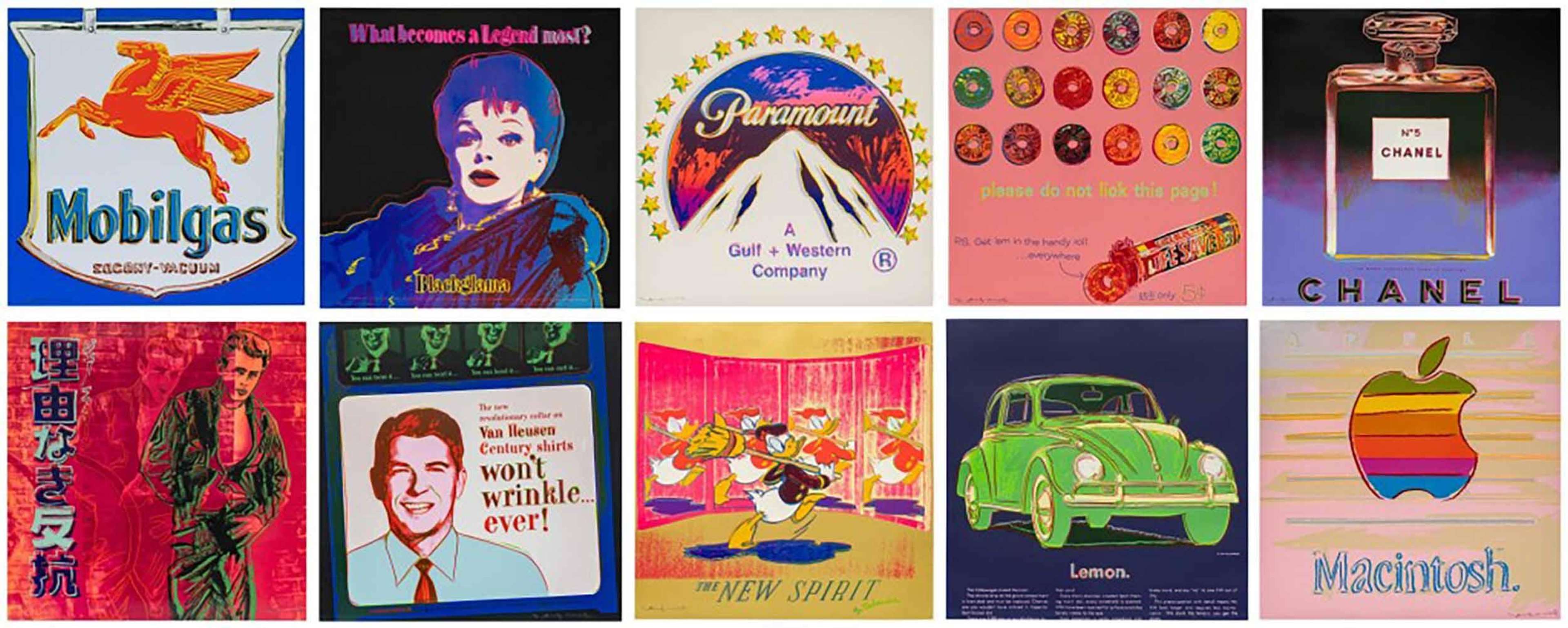
Ads (complete set) is a 1985 screenprint portfolio by Andy Warhol of ten advertisements reworked as prints, including Mobilgas, Blackglama, Paramount, Life Savers, Chanel No. 5, Rebel Without a Cause, Van Heusen, Donald Duck, Volkswagen and Apple Macintosh. The set is signed and published in an edition of 190.
By 1985 Warhol had returned to the commercial world in which he began as an illustrator. The Ads portfolio turns existing advertising into the subject. Each print reproduces an advertisement or a brand mark, with its slogan and lettering, in Warhol’s flat, saturated colour. The portfolio runs from a vintage petrol sign to the logo of a new computer, which gives it a historical range of about fifty years.
The images are varied. The Mobilgas print shows a red Pegasus on a white shield against cobalt blue. The Blackglama print shows a dark-haired woman with the question “What becomes a Legend most?” in magenta lettering. Paramount’s mountain and ring of stars is printed in violet, orange and gold. The Life Savers page is pink with rows of coloured rings and the line “please do not lick this page!”. The Chanel No. 5 bottle is brown and gold against a violet gradient. The Rebel Without a Cause print uses Japanese lettering over a red-toned figure. The Van Heusen print shows a smiling man in a shirt and tie, with the slogan “won’t wrinkle... ever!”. Donald Duck marches in the “New Spirit” print. The Volkswagen Beetle carries the headline “Lemon.”. The Macintosh print shows the rainbow Apple logo.
Taken together, the set reads as a survey of American commercial design and of the dream of the brand. The edition of 190 is among the larger ones for his portfolios of the period.