
As always, the contrasts are more revealing than the headline totals. Across five principal London sales at Phillips, Christie’s and Sotheby’s, 547 works were offered, only slightly fewer than the 558 offered through the equivalent auctions in September 2025. Their combined hammer value increased by approximately 34%, from £6.51 million to £8.72 million.
The comparison is not entirely straightforward. Auction houses are continually changing how and when they present editions, which makes monthly totals increasingly difficult to compare from one year to the next. Phillips doubled the size of its dedicated Hockney auction and replaced last year’s larger Evening & Day Editions format with separate Evening, Online and Modernism sales. Christie’s and Sotheby’s, meanwhile, placed substantial groups of higher-value works into online auctions.
Estate collections added another layer. Several dispersals continued online through the end of September, meaning that some of the month’s supply and value will fall outside the principal sales considered here. Their timing partly reflects the longer bidding periods of online auctions, but their growing presence also points to a wider change in how material is reaching the market. Rather than feeding individual works into general editions auctions, houses are increasingly using collection provenance to organise and distinguish larger groups of prints.
The 34% increase should therefore not be read as a simple like-for-like rise in the market. It reflects stronger results, but also larger catalogues, new sale formats and a calendar that is becoming more fragmented. What can be compared more clearly is how buyers behaved within those auctions. They concentrated their spending around works that were fresh to market, difficult to find or priced to provoke competition, while passing over equally recognisable images when the estimates offered little room for movement.
September closed with a further test in Hong Kong, where all eight Yayoi Kusama editions offered by Phillips found buyers. Following an unusually quiet period of supply, the results provided the first indication of how her print market is responding after her death.
Phillips Doubled Its David Hockney Offering
The main story from Phillips’ David Hockney auction was not one exceptional result, but the amount of material the market was prepared to absorb.
Phillips expanded the sale from 38 works in September 2025 to 77 this year. Despite that 103% increase in supply, 75 lots found buyers and the hammer total rose from £667,500 to £1.58 million. The average hammer price also increased, from approximately £18,500 to just over £21,000.
Some of the strongest competition came from works that had rarely, or never, appeared at auction. Montcalm Interior, making its first recorded appearance, achieved £116,100 with fees against an estimate of £40,000–60,000. The work belongs to Hockney’s early iPad practice and depicts his Los Angeles home, combining the familiar appeal of his interiors with a medium whose place in his output is becoming more established.
Another technological experiment, 40 Pix of My House with a Video (Still) Camera (40 Snaps of My House in August 1990), reached £11,610 against a £3,000 high estimate. Created using a still-video camera and colour laser printer, it sits between Hockney’s photographic collages and the iPhone and iPad works that followed. Its result suggests that buyers are looking beyond the finished image and paying more attention to how individual works fit into the development of his digital practice.
Hockney’s pool imagery remained the most reliable part of the sale. Pool Made with Paper and Blue Ink for Book sold within expectations at £54,180, while Lithographic Water Made of Lines, Crayon, and a Blue Wash achieved £154,800. The latter has appeared several times in recent seasons, but this was the highest auction result recorded for any of Hockney’s Lithographic Water prints since 2023.
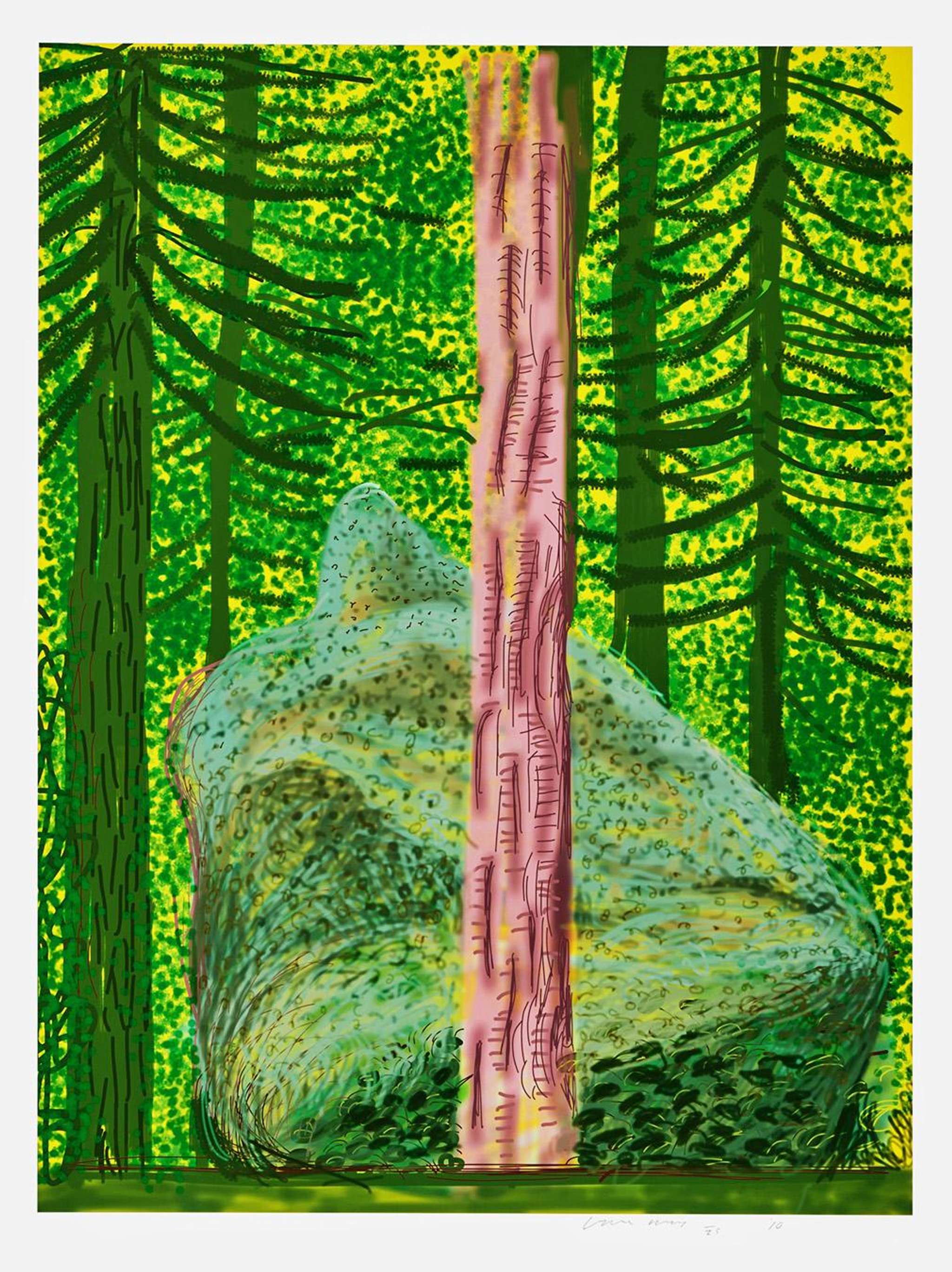
Elsewhere, the semi-abstract colour compositions from Some New Prints performed well above estimate, while works associated with A Bigger Book, My Window and the Yosemite series confirmed interest in Hockney’s broader digital production. Untitled No. 19 from The Yosemite Suite made its auction debut at £77,400 against £30,000–50,000, giving an early indication of how collectors may value these tightly editioned iPad landscapes as more enter the secondary market.
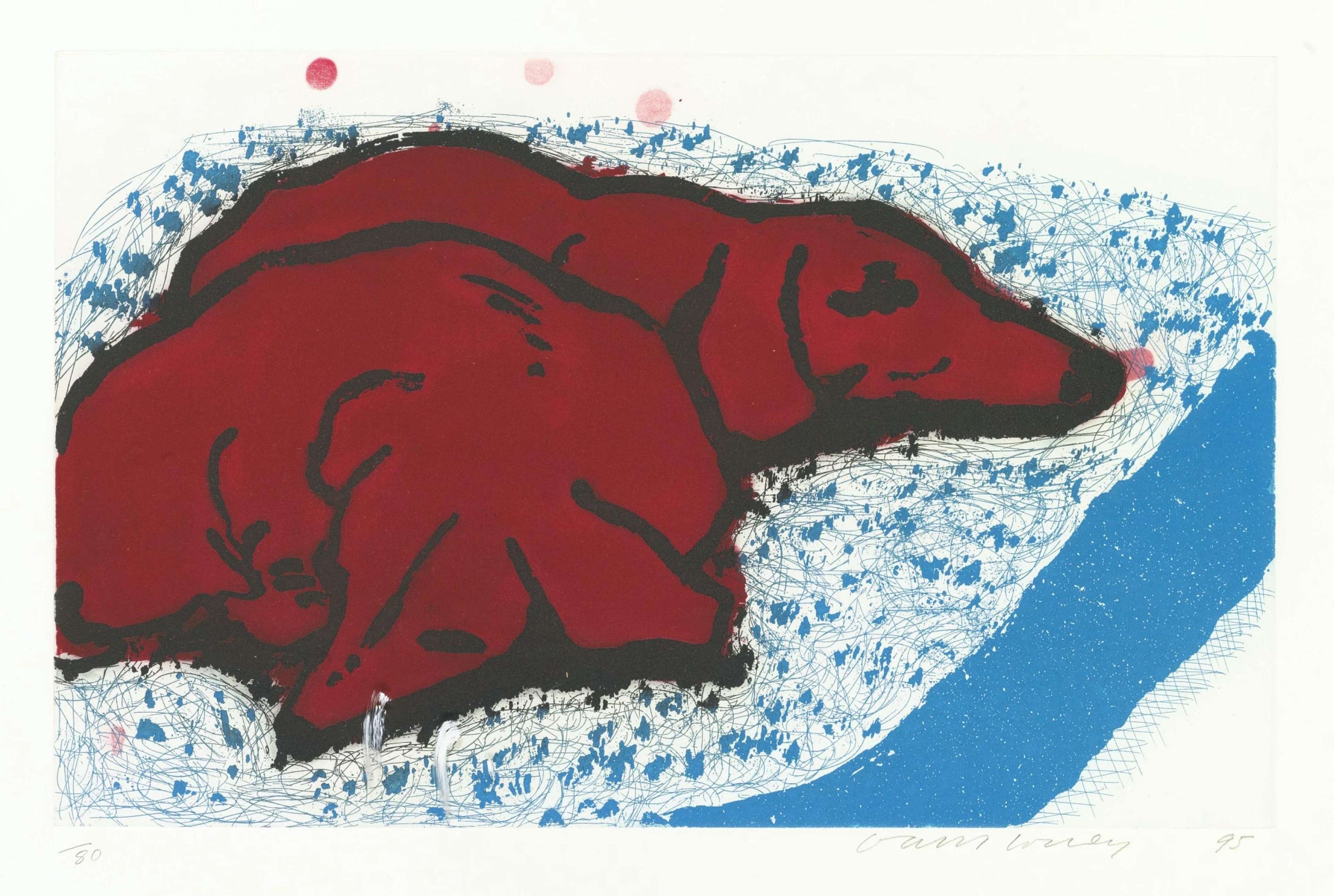
Records for An Image of Gregory and Tyler Dining Room, both from Moving Focus, showed demand extending into Hockney’s more complex portraits and interiors. His dog editions were similarly competitive, which will add context when Christie’s offers a painting of Stanley during the London October auctions.
At the other end of the price range, exhibition posters and smaller editions gave buyers access to Hockney without requiring a five- or six-figure commitment. Their inclusion helped Phillips expand the sale without depending entirely on major consignments, creating a broader price ladder around an artist whose market continues to support a standalone auction.
The top lot, Autour de la maison, été, traced a more complicated price trajectory. Hockney’s 12-metre panorama of his Normandy home and garden first appeared at auction in 2022, when it achieved £302,400 against an estimate of £150,000–250,000. The same impression returned at Christie’s in March 2026 with a higher estimate of £200,000–300,000 but failed to sell, before Phillips reoffered it in September at £150,000–200,000.
It sold for £193,500 with fees, at the £150,000 low estimate at hammer and approximately 36% below its 2022 result. The composition anticipates the extended digital landscape of A Year in Normandie, later exhibited at the Musée de l’Orangerie and the Serpentine. The sequence illustrates the difficulty of returning a distinctive work to public auction soon after a failed attempt, when buyers have already seen both the work and its expectations. For large, high-value editions with a narrower buyer pool, a private sale may sometimes offer greater control over timing and price positioning. In this case, Phillips secured a buyer by returning the estimate to its original 2022 level, although the result remained well below the price established at its auction debut.

Phillips Is Separating the Editions Market into Smaller Markets
The Hockney auction was part of a wider change in Phillips’ September programme. Last year, the house offered 279 works through one two-part Evening & Day Editions auction. This year, it divided the material between an Evening Sale, an online auction and a new dedicated Modernism sale, alongside Hockney.
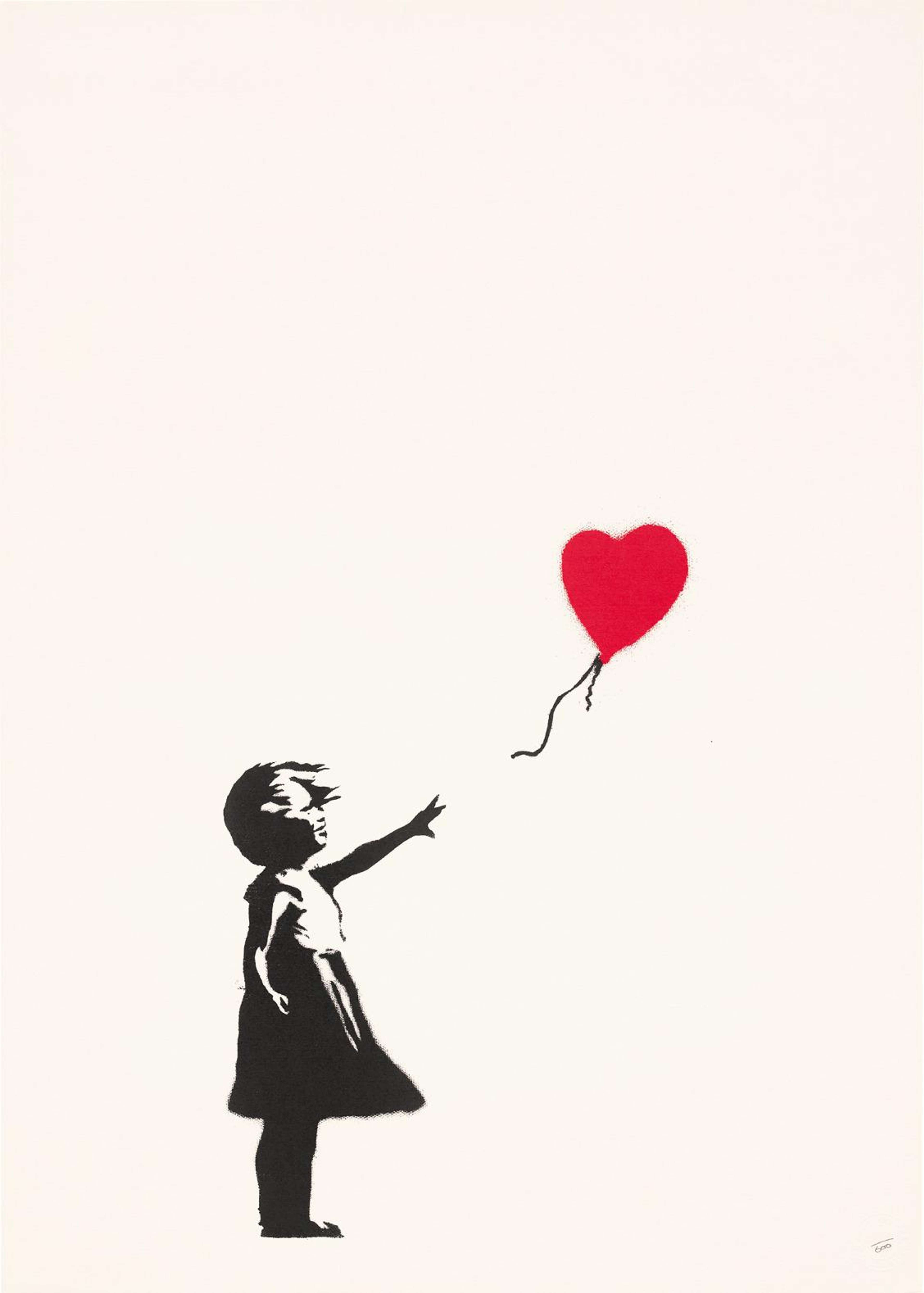
The 67-lot Evening Sale generated a hammer total of £1.59 million, with 59 works sold. Banksy’s Girl with Balloon was among its strongest performers, reaching £109,650 with fees against an estimate of £60,000–80,000. The result contributed to a broader pattern across September in which the strongest Banksy editions sold consistently across the major houses.
That consistency is important after the correction that followed the 2020–21 peak. It does not mean that every Banksy print is rising again, but it does suggest that the market has found firmer levels for recognisable works.
Phillips’ inaugural Modernism sale was smaller, producing £562,500 at hammer from 44 lots, but its significance lies in the format. Separating Modernist prints from the larger Post War and Contemporary category gave the material its own context and allowed Phillips to address a different collecting audience, which is a modest but revealing change for the house, which has notoriously specialised in contemporary works. Auction houses are increasingly organising editions around recognisable periods, artists and collections rather than relying on a single large chronological sale. Dedicated formats can also make specialist material easier to navigate, create clearer price comparisons and give lower-value works more visibility.
Christie's Produced the Month's Strongest Main Editions Total
Christie’s 174-lot online Prints and Multiples auction generated £2.82 million at hammer, compared with £1.64 million from 110 works in September 2025. Of the works offered, 156 sold.
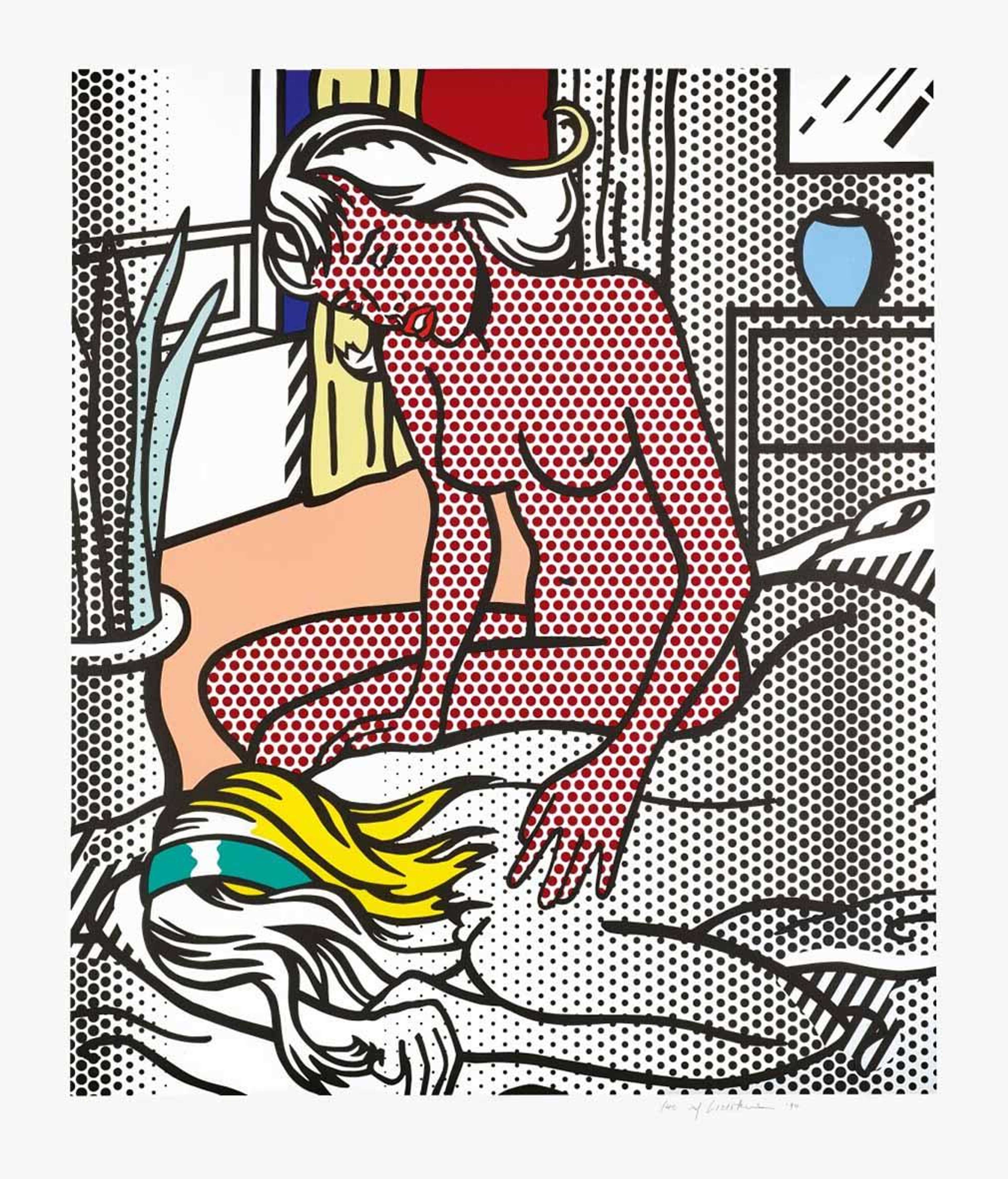
Lichtenstein’s Two Nudes was one of the clearest indications of where buyers were prepared to stretch. It achieved approximately £222,000 at hammer against an estimate of £150,000–200,000, establishing a new auction high for a standard impression without provenance from the artist’s estate.
Provenance from the Collection of Dorothy and Roy Lichtenstein has added a premium to recent sales, making it difficult to separate demand for the work from demand for its ownership history. The Christie’s result shows that competition for the Nudes series is not dependent on an estate connection. It also supports the broader rise in Lichtenstein’s later prints, particularly works whose scale and visual impact bring them closer to his paintings. Download our Roy Lichtenstein 2026 Report for the latest market analysis.
Christie’s also produced several strong Banksy results and sold Hockney’s Pool Made with Paper and Blue Ink for Book for £48,640, nine days before another impression reached £54,180 at Phillips. The proximity of the two sales usually provides useful tests of whether buyer interest arrives at broadly consistent valuations across different houses.
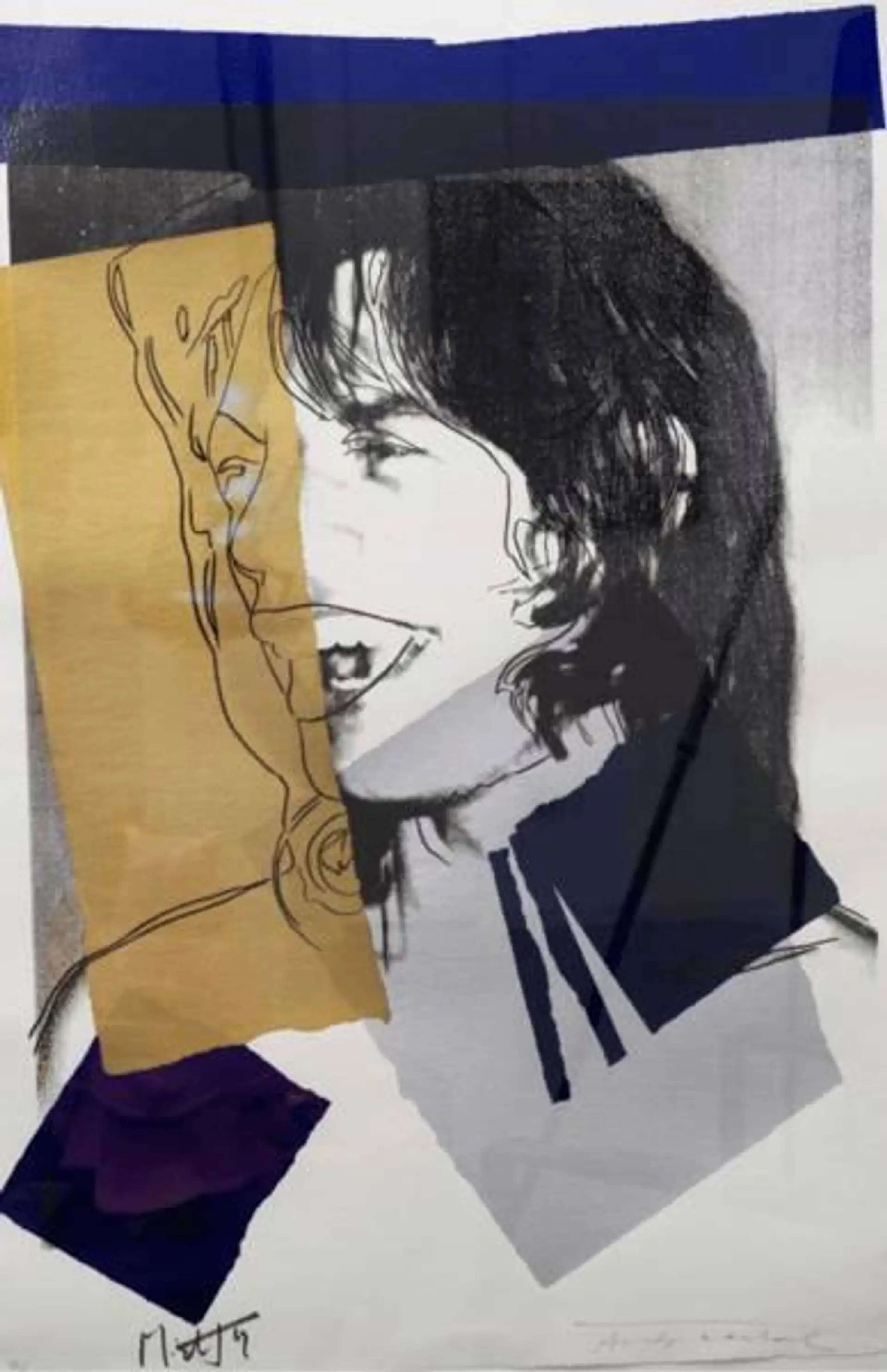
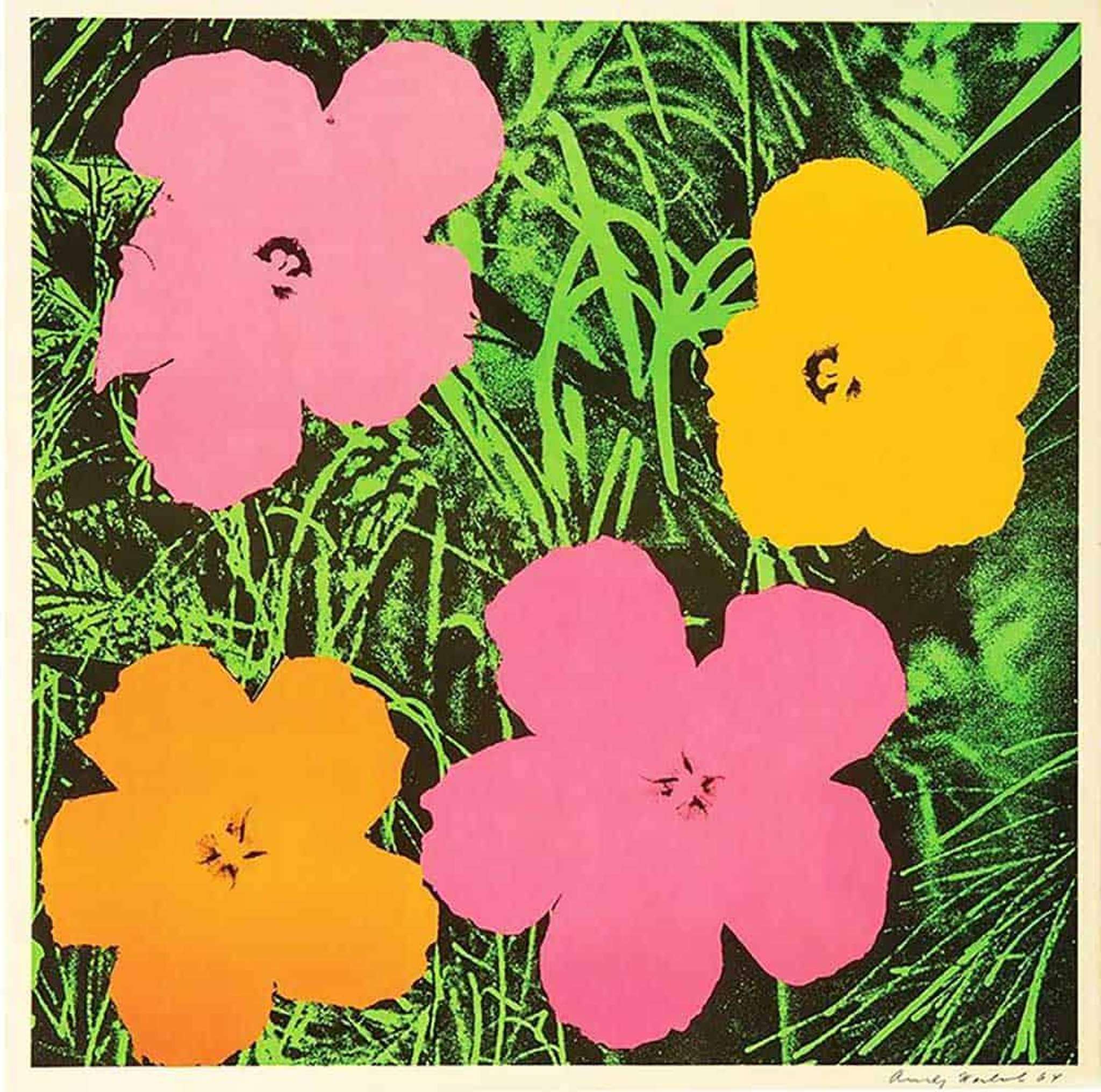
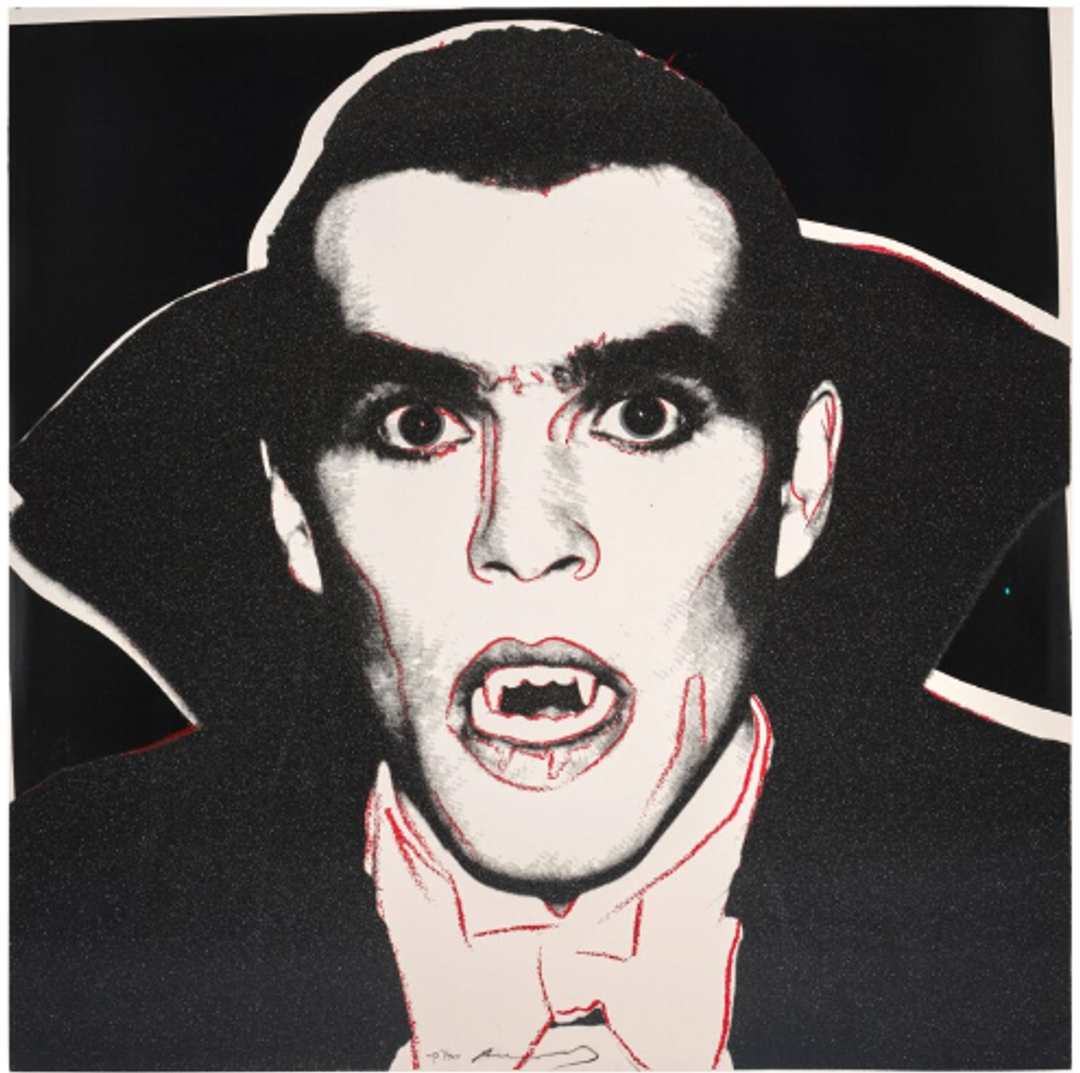
Warhol delivered the counterargument. A Marilyn Monroe, carrying an estimate of £100,000–150,000, failed to sell, while other works – Mickey Mouse, Sunset, Ingrid Bergman, Rebel Without A Cause – either sold below their low estimates or attracted limited competition. These are established images with active secondary markets, but their familiarity gives buyers access to more comparables and less reason to compete at auction. For sellers, the results show that liquidity depends increasingly on price, timing and finding the right buyer – not simply bringing a recognisable Warhol image to the public market.
Sotheby's Confirmed the Divide Between Liquidity and Competition
Sotheby’s presented the largest offering of the month, with 185 lots generating £2.17 million at hammer. Seventeen works remained unsold, giving the auction a sell-through rate of approximately 91%.
Its opening group placed Warhol directly against the market, but the results were more nuanced than those at Christie’s. Sotheby’s pink Marilyn, one of the most desirable colour combinations from the 1967 portfolio, achieved £204,800 with fees against an estimate of £180,000–250,000. The work was backed by a guarantee, reducing the seller’s exposure, but it nevertheless found a buyer at a substantial price in the same week that two other Marilyn works failed to sell at Christie’s.
A complete artist’s-proof set of ten Ladies and Gentlemen prints also sold at its £80,000 low estimate at hammer. Its sale, alongside the pink Marilyn, shows that demand for Warhol remains active when the colourway, format or completeness distinguishes the work from more familiar supply.
Other results were less convincing, including an unsold Martha Graham. The difference between them reinforces the wider September pattern: buyers were not moving away from Warhol, but distinguishing more sharply between works that felt difficult to replace and those they believed they could encounter again.
Banksy behaved differently. Sotheby’s group included Girl with Balloon, I Fought the Law (AP), Flying Copper, Barely Legal, Happy Chopper and Golf Sale, giving buyers access across several price points. The results reinforced the sense that demand has returned to the most established Banksy editions, provided estimates acknowledge the correction that has already taken place.
Estate Collections Are Becoming a Larger Source of Print Supply
September’s principal editions auctions do not contain the full picture. Several collection and estate sales continued online through the end of the month, with others extending into October. Their timing partly reflects the longer bidding periods of online auctions, but their growing presence also points to a wider change in how auction houses organise and present supply.
This is not limited to conventional estate dispersals. Sotheby’s dedicated The David Hockney Sale: The Arrival of Spring to one tightly defined body of work in March, while works from the Collection of Dorothy and Roy Lichtenstein have been released gradually since November 2024. After appearing across several auctions, the material was brought together in its first dedicated live sale in September 2025; the current online auction is the second dedicated sale in that continuing programme. Haring’s House, an online auction of works from the Collection of Kermit Oswald, follows a related model by using a personal connection to the artist as the organising narrative.
For buyers, these sales can provide access to works that have remained outside the auction market for decades, including less familiar examples retained by artists, publishers and important early collectors. That history can support confidence and, when the association is particularly strong, produce a provenance premium.
The implications for sellers are more complicated. A dedicated collection can focus attention on an artist, but it can also place numerous comparable works on the market at once. If several impressions from the same series appear together – or are released across consecutive seasons – the additional supply may limit competition for material without the same provenance. However, public auction is only one route to sale. It would not be surprising to see private sales become more popular during major estate releases, as they give sellers greater control over the timing and outcome of a sale.
How auction houses manage that volume will therefore matter. Carefully phased sales can broaden an artist’s market, establish prices for overlooked works and bring new buyers into lower price brackets. The growth of collection-led auctions reflects both the timing of the autumn calendar and a longer process of generational turnover, as collections assembled over several decades return to the market. The question for the coming seasons is how much additional supply this produces, and whether the focused presentation of that material can attract enough new buyers to absorb it.
Kusama's Posthumous Market Faces Its First Concentrated Test
Kusama’s print market has done something unusual since her death on 26 August: almost nothing.
Part of that is timing. August is traditionally quiet for print auctions, and the market is only now emerging from its summer lull. Even so, only four Kusama works had been priced at auction in September before the Hong Kong sales, compared with a monthly range of eight to 38 works over the previous twelve months.
The return of concentrated supply on 30 September produced a clear response. All eight Kusama editions offered by Phillips sold, generating a combined HK$2.21 million at hammer against an aggregate estimate of HK$1.48–2.32 million. None sold below its low estimate.
Three Pumpkins hammered at HK$330,000 against an estimate of HK$180,000–280,000, while Pumpkin Army reached HK$220,000 against HK$120,000–200,000. Pumpkin (Yellow-T), one of the most closely watched works in the group, met its HK$500,000 high estimate at hammer. The remaining five prints sold within expectations.
Strong results are noteworthy nonetheless, but Kusama’s Pumpkin market was already strengthening before her death. Our records show that the series median rose by 21% over the preceding twelve months to £31,606. Phillips did not establish a uniform posthumous premium, but it did show that buyers were prepared to absorb a concentrated group across several price points – and to compete when estimates left room against recent comparable sales.
One auction cannot determine where Kusama’s posthumous market will settle, particularly if more owners bring works forward during the autumn and spring seasons. It does, however, provide the first useful reference point of supply returning, every print found a buyer and the strongest competition remained around recognisable Pumpkin editions.

The timing is important because Kusama’s Pumpkin market was already strengthening before her death. Our records show that the median price for the series rose by 21% over the preceding twelve months to £31,606. The Hong Kong sale will show whether that trajectory continues as supply returns, and whether estimates below recent comparables are sufficient to draw bidders back into competition.
It will also begin to answer a larger question. A death can initially restrict supply as owners wait for the market to settle, but the pause is often followed by more works coming to auction. If Phillips performs strongly, it may encourage further consignments across the autumn and spring seasons. The real test will not be whether one group sells, but how the market responds if posthumous supply begins to build.
What September's Print Auction Results Mean
September was stronger than the same group of London auctions last year, but it was not a general rebound in which every major name moved upwards together. The increase came from more Hockney material, a larger Christie’s auction and strong competition around selected Banksy and Lichtenstein works.
Three changes stand out.
First, estimates are becoming more realistic. Banksy’s results suggest that pricing has adjusted to the post-peak market, while the successful reoffering of Hockney’s Autour de la maison, été shows what can happen when an earlier valuation is revised.
Second, auction houses are becoming more deliberate about format. Phillips’ separate Hockney and Modernism sales turned one broad editions programme into several clearly defined propositions, while estate-led online sales use provenance and collection history to organise growing volumes of material.
Third, liquidity and price growth are no longer the same thing. Warhol remains highly tradable, but repeated supply is giving buyers more choice and less reason to compete for every impression. Scarcer Hockney and Lichtenstein works, meanwhile, are being reassessed as collectors move beyond the best-known images.
The print market moved forward in September, but selectively. Buyers spent where rarity, relevance and price aligned – and walked away when a famous name was the strongest argument the lot could offer.