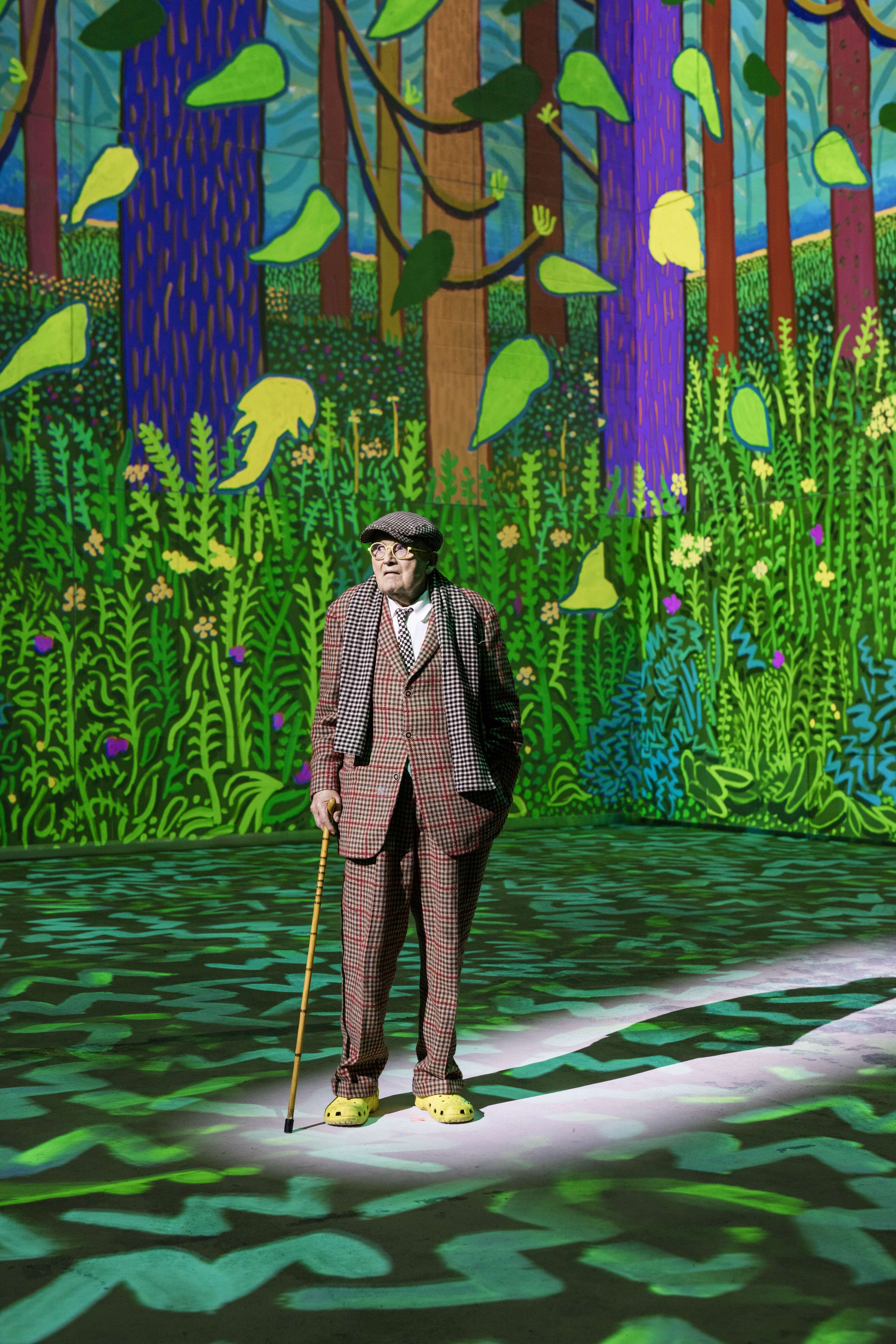

The two artists provide very different tests. Hockney entered this period after a record year at auction and a succession of major results. Kusama’s print market had contracted from its 2021–22 peak, although the average price of the works sold improved during 2026.
The belief that an artist’s death automatically increases prices has persisted for decades. Yet the reality is far more context-dependent. A death can produce renewed attention and immediate changes in buyer and seller behaviour, but long-term performance is usually determined by what follows: the supply brought to market, the works buyers favour and how the artist’s legacy is authenticated, managed, exhibited and positioned for future collectors.
David Hockney: The First 48 Hours
Hockney’s passing has provided an immediate example of how collectors respond to the death of a major artists. Within two days of the news, MyArtBroker recorded a significant increase in private-market activity relating to Hockney’s editions. While such reactions are not unusual following the death of a major artist, they illustrate how quickly sentiment can move through the market.
Importantly, this activity should not be confused with fair market value. Public auction results often take months to reflect changing sentiment, whereas private-market activity tends to respond immediately. Hockney entered this period with one of the most established print markets in contemporary art. His editions span early etchings and lithographs, celebrated swimming pool imagery, photographic experiments, fax works, and the iPad drawings that defined the later stages of his career. In 2025 alone, his print market generated more than £15 million in public auction sales, making it the strongest year on record.
The question facing collectors is therefore not whether demand exists, but how the market responds once the artist is no longer actively shaping their career and public profile.
Yayoi Kusama: A Different Posthumous Market Test
Kusama died of multiple organ failure at a hospital in Tokyo on 14 August 2026, aged 97. Her death was announced publicly by her studio, museum and foundation on 27 August. Like Hockney, Kusama entered the posthumous market with substantial institutional recognition and an established international collector base. However, the recent direction and structure of her print market are different.
Between 2019 and 2025, 2,090 Kusama prints and complete sets generated £49.3 million at hammer. Annual value reached its peak in 2022, when 368 lots produced £11.24 million. Activity subsequently contracted for three consecutive years. By 2025, 240 lots generated £4.91 million – 56% below the 2022 peak.
The picture in 2026 was more nuanced before her death was announced. A further 130 prints and sets had generated £3.30 million at hammer, while the average price rose to approximately £25,400 from £20,400 in 2025. Fewer works were trading than at the market’s peak, but those reaching auction were achieving a stronger average level.
Kusama’s market will therefore test whether posthumous attention can strengthen demand following a period of declining turnover. It will also show whether that attention encourages more owners to sell. Her editioned output is substantial, meaning an increase in consignments could give buyers more choice and intensify the distinctions between her most desirable works and more frequently available images.
Geography creates another difference. Kusama’s secondary market is distributed across Japan, Hong Kong, South Korea and Western auction centres. Its initial response may emerge through numerous regional sales rather than one concentrated auction in London or New York.
The first record following Kusama’s death would not establish a new level for her wider print market. More significant evidence will come from repeat sales, auction volume, sell-through and whether demand remains strong as supply changes. As with Hockney, the effects will need to be measured over successive auction seasons rather than inferred from the immediate reaction.
What Happens Immediately After an Artist’s Death?
In art markets, the so-called “death effect” has long been associated with dramatic posthumous price increases. Yet, research by economists Robert B. Ekelund and John D. Jackson challenges the idea of an automatic market uplift, suggesting that collectors often begin pricing in future scarcity during an artist’s later years, before death occurs. In other words, some of the anticipated value associated with finite supply may already be reflected in the market by the time an artist dies.
What follows is typically not a straightforward increase in value, but a period of reassessment. Collectors, institutions, dealers, and auction houses begin to reconsider the artist’s place within art history, while buyers and sellers seek to understand whether the existing market accurately reflects their significance.
Does Death Increase The Value Of Their Art?
The answer is sometimes, but not always.
While 19th century modern artists such as Vincent van Gogh and Paul Gauguin demonstrate how cultural reappraisal can transform an artist’s reputation after death, they also emerged in a fundamentally different art market. Van Gogh and Gauguin died before the development of the global auction infrastructure, museum networks, and collector ecosystems that shape contemporary markets today. Their posthumous success was driven by decades of critical reassessment rather than an immediate market response.
Contemporary artists present a different challenge. Their careers have already been documented through exhibitions, scholarship, auction records, and museum collections, leaving the market with far more information from which to assess their long-term significance. Yet, these responses vary significantly from artist to artist, making broad assumptions difficult.
The experiences of Andy Warhol, Jean-Michel Basquiat, and Keith Haring demonstrate that there is no single posthumous trajectory.
Andy Warhol (1987)
Warhol’s death in February 1987 marked the loss of an artist who had fundamentally changed the relationship between art, commerce, and mass production. Unlike many artists whose markets expanded after their deaths, Warhol had already spent decades establishing prints and multiples as a central part of his practice.
The long-term success of Warhol’s market owes as much to stewardship as it does to the strength of the work itself. The Andy Warhol Foundation played a critical role in shaping his legacy through museum partnerships, scholarship, philanthropy, and controlled market participation. Rather than allowing attention to dissipate, it helped maintain Warhol’s visibility across both the art world and popular culture.
Today, Warhol’s prints are some of the most recognisable works and occupy one of the strongest positions in the global editions market. Complete sets, individual prints, and rare proofs continue to achieve record prices despite the substantial volume of works available. More than three decades after his death, demand has continued to absorb supply across multiple collecting categories. Few artists demonstrate market depth on Warhol’s scale, with collectors continuing to compete across multiple price levels, mediums, and collecting categories more than three decades after his death.
Death Doesn’t Always Mean The Artist
Warhol’s market also reveals that death-related price movements are not always tied to the artist themselves. His Marilyn screenprints were created in 1967, five years after Marilyn Monroe’s death in 1962, and originally sold for as little as $250. Their most dramatic appreciation came decades later as Monroe’s cultural significance continued to grow. In 2026, as institutions and collectors marked what would have been Monroe’s 100th birthday, demand for the series intensified once again, reinforcing the relationship between cultural memory and market value.
By contrast, Warhol’s Reigning Queens series experienced a far more immediate reaction following the death of Queen Elizabeth II in 2022. Prints that had previously traded in the £150,000–£200,000 range surged in value, with one example exceeding £500,000 at auction shortly after her passing. The artist had not died, the supply of works had not changed, and the editions remained exactly as scarce as they had been before. What changed was the cultural significance of the subject.
The contrast between Marilyn and the late monarch illustrates why the so-called “death bump” is often misunderstood. Markets do not simply respond to loss. Sometimes value emerges gradually through decades of cultural reinforcement; sometimes it appears almost overnight when a historical moment reshapes the way collectors view an image. In both cases, the catalyst is not death itself, but the intersection of scarcity, sentiment, and collective memory.
Jean‑Michel Basquiat (1988)
Basquiat’s death at age 27 in August 1988 cut short one of the most influential artistic careers of the late twentieth century. Unlike Warhol and Haring, whose practices embraced printmaking and multiples, Basquiat left behind a remarkably small body of editioned work. The Anatomy series remains the only complete signed print collection he personally oversaw, while individual prints such as Untitled (1983) and Back Of The Neck (1983) appear only rarely at auction.
The performance of Basquiat’s print market offers an important distinction: scarcity alone does not automatically create value. While lifetime editions remain highly sought after, their growth has largely reflected the broader rise of Basquiat’s market rather than a posthumous repricing of prints themselves. As demand for the artist’s paintings has intensified, reaching tens of millions of dollars at auction, collectors have increasingly looked to works on paper and editions as more accessible entry points into his market.
For the Basquiat estate, the challenge has been how to steward the legacy of an artist with a limited editions catalogue. Institutional exhibitions, licensing partnerships, fashion collaborations, and carefully managed posthumous releases have helped maintain cultural visibility without materially increasing the supply of lifetime works. As a result, the strongest Basquiat prints derive their value not from the circumstances of the artist’s death, but from a combination of rarity, market prestige, and the continued strength of demand for his wider body of work.
Keith Haring (1990)
When Haring died in February 1990 at the age of 31, he left behind a body of work built on accessibility. Through public murals, the Pop Shop, and an extensive printmaking practice, Haring had already established a broad collector base that extended far beyond traditional contemporary art audiences.
What followed offers one of the clearest examples of how an artist’s market can evolve after death. Rather than restricting access to the work, the Keith Haring Foundation continued to expand the artist’s visibility through exhibitions, education programmes, licensing partnerships, and charitable initiatives. Haring’s imagery remained culturally present, helping to introduce new generations of collectors to his work.
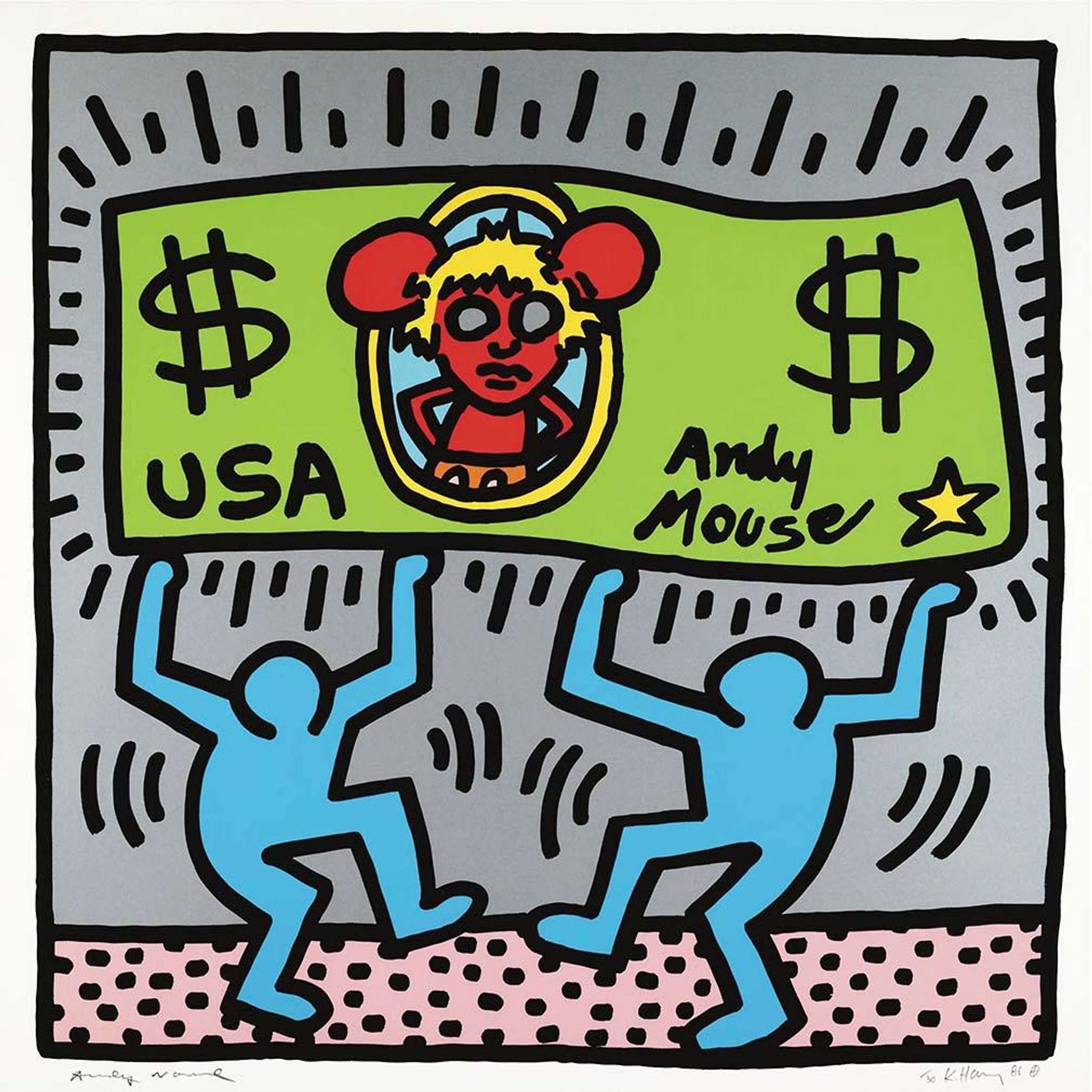
At the same time, the supply of the most desirable editions remained finite. Complete Andy Mouse sets, Dog Cutouts, and signed Pop Shop works continued to trade infrequently, creating scarcity within an otherwise accessible market. As demand broadened, competition increasingly concentrated around these rarer works.
Haring’s print market demonstrates that posthumous success is not necessarily driven by scarcity alone. Thirty-five years after his death, his editions remain widely recognised and actively collected because the infrastructure supporting his legacy has continued to grow. The result is a market that has remained accessible at entry level while establishing significant value at the top end.
What Collectors Should Do After an Artist Dies
For sellers, periods of heightened attention can create opportunities, but attention should not be mistaken for value. While an artist’s passing often brings renewed focus to their market, the factors that ultimately determine value remain unchanged: rarity, provenance, condition, collector demand, and the strength of comparable sales. Understanding how a specific work fits within the wider market is often more important than reacting to the news cycle itself.
For buyers, moments like these can provide useful insight into which works collectors consider most desirable. Markets rarely move uniformly. Demand tends to concentrate around iconic images and rare editions, while other areas of an artist’s market may see little change at all. Looking beyond the headlines can often reveal a more differentiated picture of where collector interest is genuinely strengthening.
For Hockney and Kusama collectors, the coming auction seasons will provide more meaningful evidence than the initial reaction to either death. Immediate enquiries reveal attention and sentiment; they do not establish fair market value.
The two markets should also be assessed differently. Hockney’s autumn test begins with a dedicated Phillips auction and exact repeat works that can be compared with their 2025 prices. Kusama’s response is likely to be more geographically dispersed, making changes in total supply, sell-through and performance across different auction centres especially important.
Markets rarely move uniformly after an artist dies. Demand usually concentrates around the works that already occupy strong positions within the artist’s market, while more routinely available material may see little change or face additional competition from new consignments. The long-term outcome depends less on the news itself than on the quality of the work, the depth of the collector base and the stewardship of the artist’s legacy.