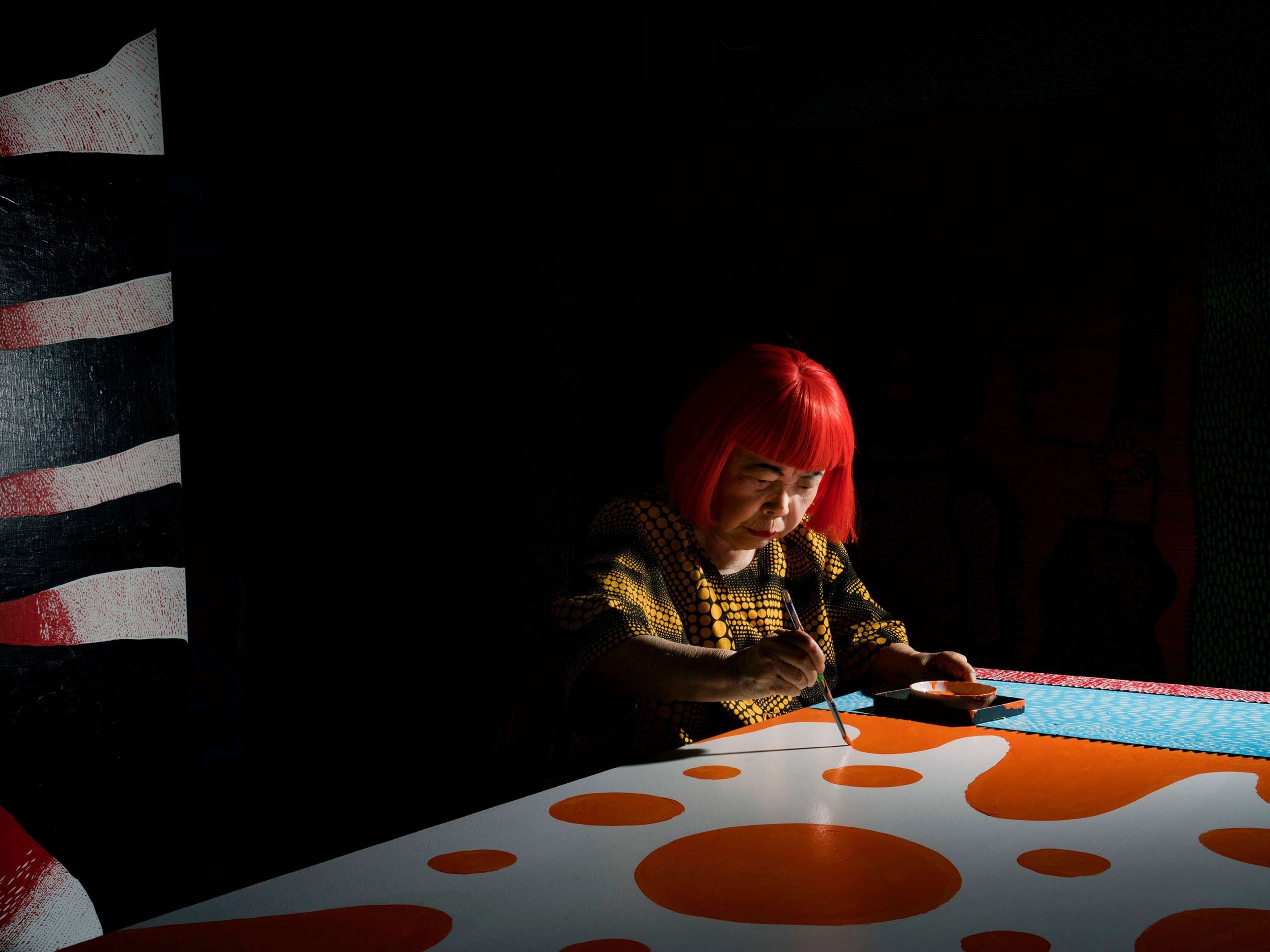


Over a career spanning more than seven decades, Kusama worked across painting, printmaking, sculpture, installation, performance, film, fashion, poetry and fiction. Her art could occupy a sheet of paper or surround the viewer completely, but its central concerns remained remarkably consistent towards repetition, accumulation, infinity and the unstable boundary between the individual and the world around them. Her dots became famous, but what made Kusama consequential was everything she asked them to contain.
Who Was Yayoi Kusama?
Born in Matsumoto, Japan, on 22 March 1929, Kusama began drawing and painting as a child. She described experiencing visual and auditory hallucinations from an early age, including fields of dots and patterns that appeared to spread across her surroundings.
Rather than treating these experiences simply as biographical explanation, Kusama developed them into a formal language. Dots multiplied across paper, canvas, bodies, furniture, rooms and landscapes. Nets expanded until they seemed to exceed the edges of the picture. Repetition became both the subject of the work and the method through which it was made.
Kusama called this idea “self-obliteration”: the dissolution of the individual into a larger field of repeated forms. It would connect the apparently different stages of her career, from early works on paper and the Infinity Net paintings to performances, mirrored environments and monumental public sculptures.
Her practice was never confined to one movement. It intersected with abstraction, Minimalism, Pop art, performance, feminism and institutional critique, yet Kusama resisted being contained by any of them. She constructed a visual and philosophical world that remained distinctly her own.
From Matsumoto to the New York Avant-Garde
Kusama studied traditional Japanese painting in Kyoto before moving to the United States in 1957. She settled in New York the following year, entering an art world in which women – and particularly Japanese women – faced significant barriers to recognition.
Her early New York paintings were radically restrained. The large, monochromatic Infinity Nets were covered with repeated loops of paint, creating surfaces that appeared to continue beyond the canvas. They drew critical attention while departing from the dramatic gestures associated with Abstract Expressionism.
Kusama rapidly expanded her practice. Her Accumulation sculptures covered furniture and everyday objects with repeated soft forms. In 1965, she created Infinity Mirror Room—Phalli’s Field, her first mirrored environment. Reflections multiplied its handmade forms until they appeared limitless, converting physical repetition into an immersive experience.
She also staged public happenings, body-painting events and anti-war performances, produced films and fashion, and used photography and the press as active components of her work. Kusama understood that an artist could shape not only an object but the conditions through which it entered public consciousness.
Her visibility did not translate into consistent institutional support. Although she worked alongside leading figures in the New York avant-garde and received serious critical attention, her contribution was not accorded the recognition given to many of her male contemporaries.
Yayoi Kusama’s Infinity Mirror Rooms
Kusama’s Infinity Mirror Rooms eventually became her best-known works, but they were not late inventions designed for the age of social media. They developed from experiments with mirrors, light and repetition that began in New York during the 1960s.
Inside them, lights, forms and the viewer’s own reflection appear to continue without end. The visitor becomes part of the composition but also disappears within it. The experience gives physical form to Kusama’s idea of self-obliteration, where the individual is present and reflected repeatedly, yet absorbed into an apparently boundless environment.
Their later popularity changed how large audiences encountered contemporary art. Visitors queued for limited periods inside rooms that could feel spectacular, intimate and disorientating at once. Photographs circulated widely, but the works retained a sensation experience of breifly entering a space without a visible boundry.
That accessibility sometimes overshadowed the historical importance of the rooms. Their visual immediacy did not make them intellectually simple. They emerged from the same sustained investigation of repetition, perception and psychological space that shaped Kusama’s paintings and works on paper.
Returning To Japan
Kusama returned permanently to Japan in 1973. In 1977, she voluntarily entered a psychiatric hospital in Tokyo, where she lived for the remainder of her life while continuing to work from a nearby studio.
Her decision has frequently been used to frame her career through illness. Kusama herself spoke openly about the relationship between her mental health and her art, but the work should not be reduced to a symptom or therapeutic record. It was produced through discipline, technical experimentation and an acute understanding of how images operate across different contexts.
After returning to Japan, she continued to make paintings, sculptures, prints and installations while also developing a substantial literary career. She wrote novels, poetry and short stories, extending many of her artistic concerns into language.
International recognition grew gradually. Her presentation in the Japanese Pavilion at the 1993 Venice Biennale marked an important moment in her re-emergence. Major retrospectives and museum exhibitions followed, revisiting the significance of her early New York work while introducing her installations to new audiences.
The opening of the Yayoi Kusama Museum in Tokyo in 2017 gave her work a permanent institutional home. In 2026, Museum Ludwig in Cologne presented more than 300 works spanning her career, including a newly commissioned Infinity Mirror Room. She remained actively engaged with making art into the final year of her life. Her studio’s announcement said that she “continued to paint until her final days.”
More Than Polka Dots and Pumpkins
Kusama’s pumpkins became emblems of her work because they combined familiarity with strangeness. Their rounded forms could appear comic, comforting or imposing, while their patterned surfaces connected them to her wider vocabulary of dots and repetition.
Yet reducing Kusama to pumpkins and polka dots obscures the range of her achievement. She made austere abstract paintings, psychologically charged collages, sexually confrontational sculptures, political performances, experimental films, novels and environments that altered the viewer’s perception of space.
Her motifs were repeated, but they were not static. A dot could suggest a cell, a planet, a body or an act of disappearance. A net could be painted through hundreds of individual gestures while appearing to have no beginning or end. A mirrored room could magnify a small number of lights into an apparently infinite universe.
Repetition allowed Kusama to move between intimacy and spectacle without abandoning the central logic of her work. The same visual language could operate in a print held close to the body, a painting stretching across a wall or an installation surrounding thousands of visitors.
Yayoi Kusama’s Prints and the Reach of Her Art
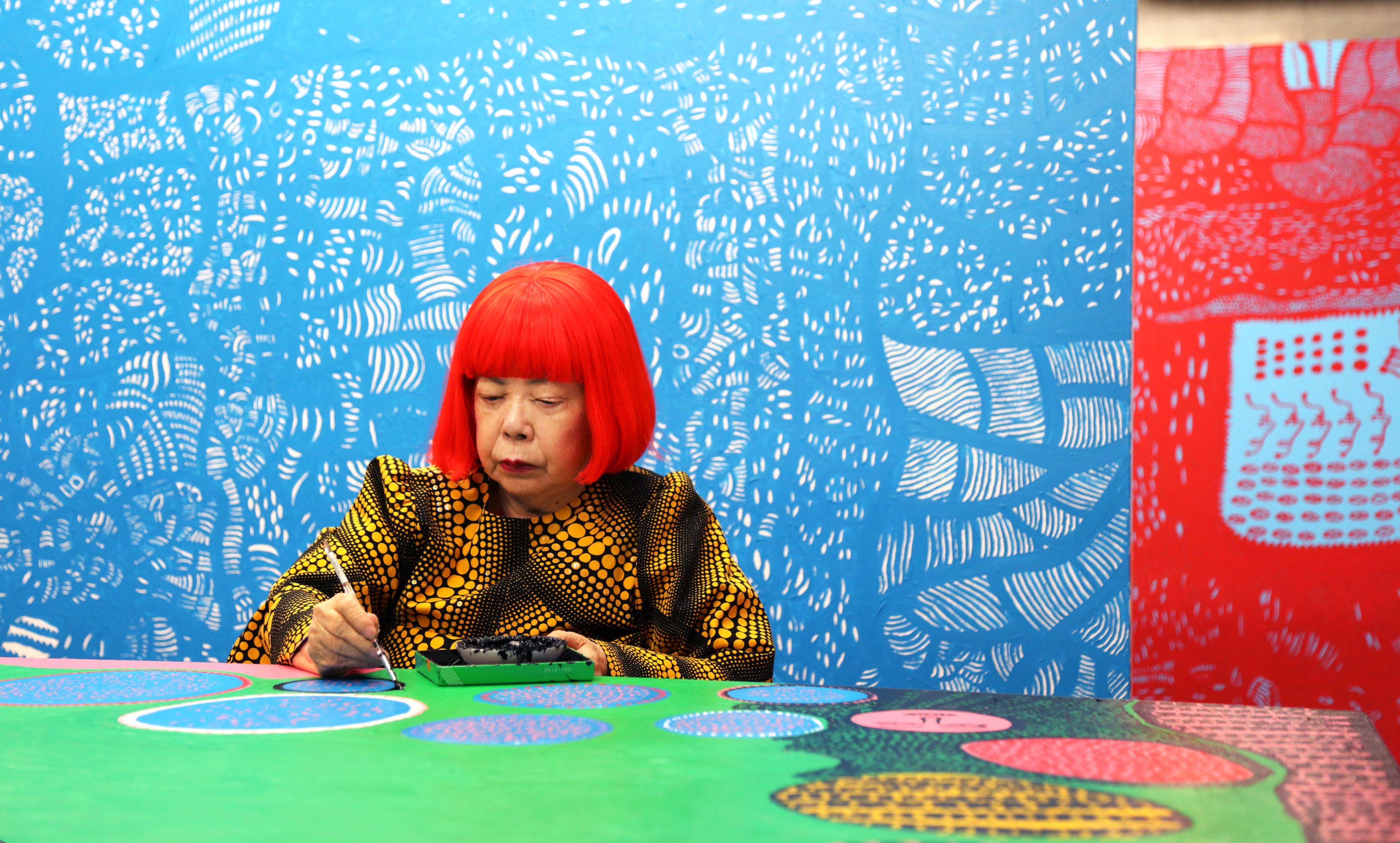
Printmaking played an important role in extending Kusama’s imagery beyond paintings and installations. Across screenprints, lithographs, etchings and other editions, she returned to pumpkins, flowers, waves, nets and organic forms in carefully differentiated compositions.
These works were not reproductions of a famous brand. Printmaking suited Kusama’s long investigation of repetition, whereas one image could exist in multiple impressions while still remaining part of a controlled edition. Variations in colour, scale and technique allowed familiar motifs to be reconsidered rather than merely repeated.
Her editions also helped create an unusually broad international market. Individual prints provided access to her work at different price levels, while rare impressions and complete sets attracted competition from established collectors. Japan, Hong Kong and South Korea became particularly important centres for this activity, giving Kusama a secondary market whose depth was not dependent on London and New York alone.
There will be time to assess how that market responds to her death. Immediate records, if they occur, should not be mistaken for the repricing of every Kusama edition. Her print market is large and internally varied, and its future will depend on supply, condition, scarcity and demand for particular works – not on her name alone.
Yayoi Kusama’s Legacy
Kusama’s late global fame can make her recognition appear inevitable. But It was not. She built her career across different countries, periods of financial insecurity, changing critical attitudes and decades in which her contribution to the New York avant-garde was insufficiently acknowledged. When institutions returned to her work, they found not a recently invented phenomenon but an artist who had pursued the same fundamental questions with unusual consistency.
Her influence can be measured through art history: in immersive installation, performance, sculpture, abstraction and the use of the artist’s public image. It can also be measured through the vast international audiences who encountered contemporary art through her work and discovered that conceptual ambition did not have to exclude visual pleasure.
Kusama understood scale in both directions. She could reduce the self to one dot among innumerable others, then use that dot to fill a canvas, a body, a building or an imagined universe.
That may be the most fitting way to remember her. Not simply as the artist of infinity, but as an artist who reached it through accumulation: one loop, one mark, one reflected light and one repeated act of creation at a time.