Flash - November 22 (complete set)
Flash - November 22 (complete set)
Signed Print
Andy Warhol
53 x 53cm, Edition of 200, Screenprint, 1968
£60,000-£100,000
$110,000-$190,000 Market Value Indicator
$110,000-$190,000 Market Value Indicator
¥550,000-¥910,000 Market Value Indicator
€70,000-€120,000 Market Value Indicator
$640,000-$1,060,000 Market Value Indicator
¥12,530,000-¥20,890,000 Market Value Indicator
$80,000-$140,000 Market Value Indicator
There aren't enough data points on this work for a comprehensive result. Please speak to a specialist by making an enquiry.
Track auction value trend
Meaning & Analysis
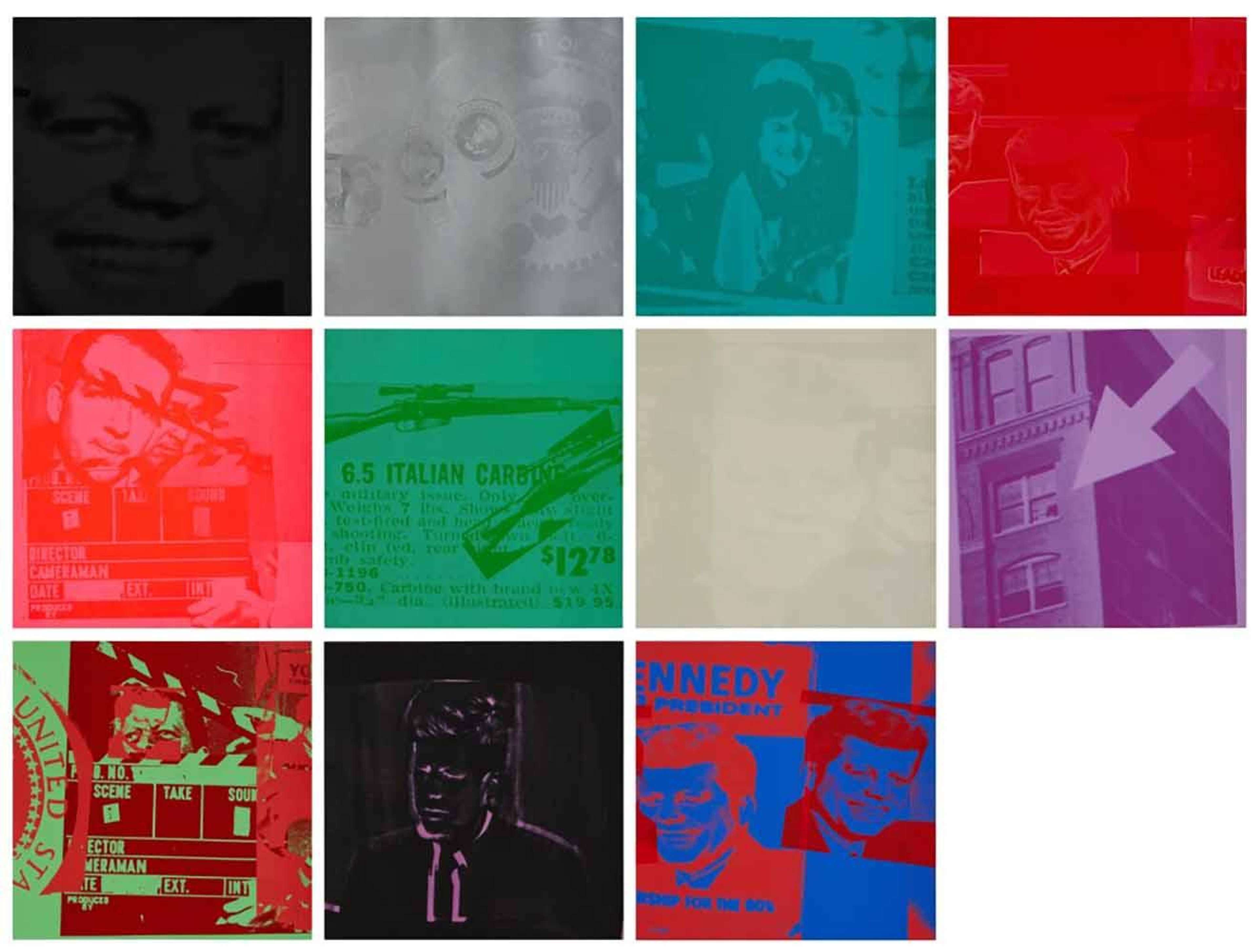
Flash – November 22 (complete set) is a portfolio of 11 screenprints documenting the assassination of President John F. Kennedy on 22 November 1963. Produced in 1968 – five years after the event – in a signed edition of 200, the set combines photographic and archival imagery across a range of colourways, accompanied by a separate portfolio of original Teletype news dispatches from the day itself.
Warhol assembled Flash – November 22 from the visual detritus surrounding a defining moment of 20th century American history: press photographs, broadcast stills, a weapons advertisement, a campaign image, a blank white field, a building exterior. The eleven prints move through this material without narrative ordering – a near-black portrait of Kennedy, the presidential seal in cold silver, Jackie Kennedy in a teal car interior, a red motorcade, a film production slate that makes the violence feel constructed, a newspaper advertisement for the 6.5 Italian Carbine at $12.78, a purple building with a white arrow pointing to the place of impact, and a 'Kennedy for President' campaign image at the close that collapses chronology entirely.
The portfolio's accompanying Teletype text – wire-service dispatches from the day itself – grounds the images in the speed and fragmentation of breaking news. Together, the two elements produce something more diagnostic than commemorative: an examination of how a catastrophic event is processed and distributed through the media systems of its time. Flash sits within Warhol's sustained engagement with trauma, celebrity and documentation, and is directly related to the Death and Disaster paintings, which also asked what it means to look repeatedly at something terrible.