Uran
Uran
Signed Print
Gerhard Richter
100 x 70cm, Edition of 50, Photographic print, 1989
£18,000-£28,000
$35,000-$50,000 Market Value Indicator
$35,000-$50,000 Market Value Indicator
¥160,000-¥250,000 Market Value Indicator
€21,000-€35,000 Market Value Indicator
$190,000-$300,000 Market Value Indicator
¥3,760,000-¥5,850,000 Market Value Indicator
$24,000-$40,000 Market Value Indicator
There aren't enough data points on this work for a comprehensive result. Please speak to a specialist by making an enquiry.
Track auction value trend
Meaning & Analysis
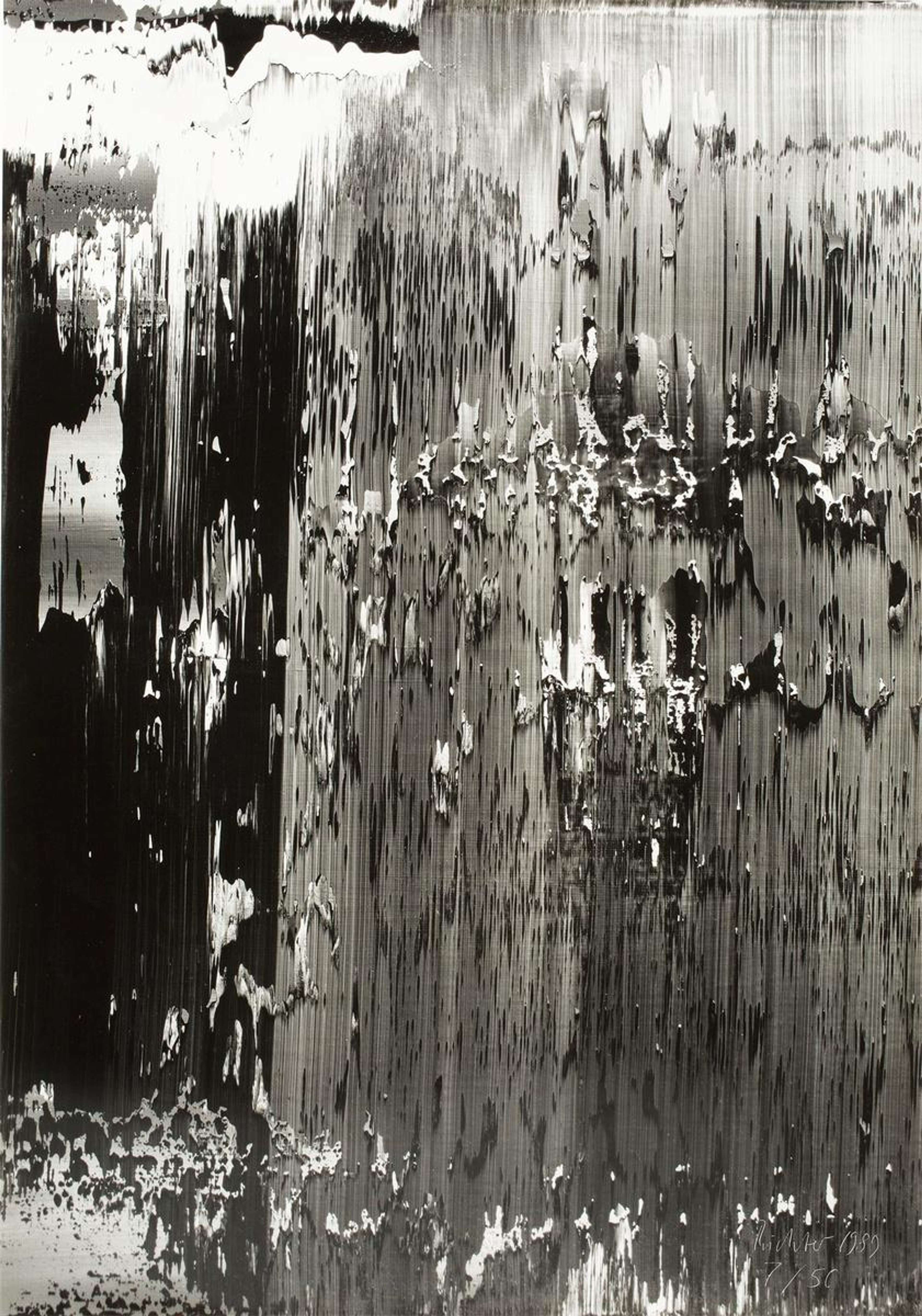
Uran (Uranium) is a photographic print by Gerhard Richter, made in 1989. The work reproduces one of Richter's abstract paintings in a signed edition of 50: a vertical composition of cascading black and white forms – dense drips, vertical streaks, and ragged eruptions of white against near-total darkness – in which the painted surface takes on the appearance of something volatile and corrosive. Signed and numbered, the edition of 50 places this among the rarer photographic prints in Richter's catalogue.
By 1989, the Abstrakten Bilder – Richter's large-scale abstract canvases produced by dragging and scraping paint with a squeegee across the surface – had become one of the defining bodies of work in contemporary painting. Uran photographs one of these works in a way that renders the painted surface as an environment rather than a picture: the deep black mass at left, the cascading vertical drips and torn white edges, the sense throughout of some volatile process in suspension.
The title does significant work. Uranium – radioactive, unstable, the material at the centre of Cold War nuclear arsenals and the Soviet-directed mining operations that scarred the landscape of East Germany across four decades – inflects the abstract image with a specific weight. In 1989, as the GDR began to collapse, the Wismut uranium operation in Saxony and Thuringia, which had employed hundreds of thousands in near-total secrecy, was becoming visible for the first time. Whether the title is a direct reference or a resonance Richter allowed to stand, the pairing of image and word – a painting that looks like material melt, issued in the year the Wall fell – gives Uran a particular charge among his abstract print editions.