Farbfelder. 6 Anordnungen Von 1260 Farben (complete set)
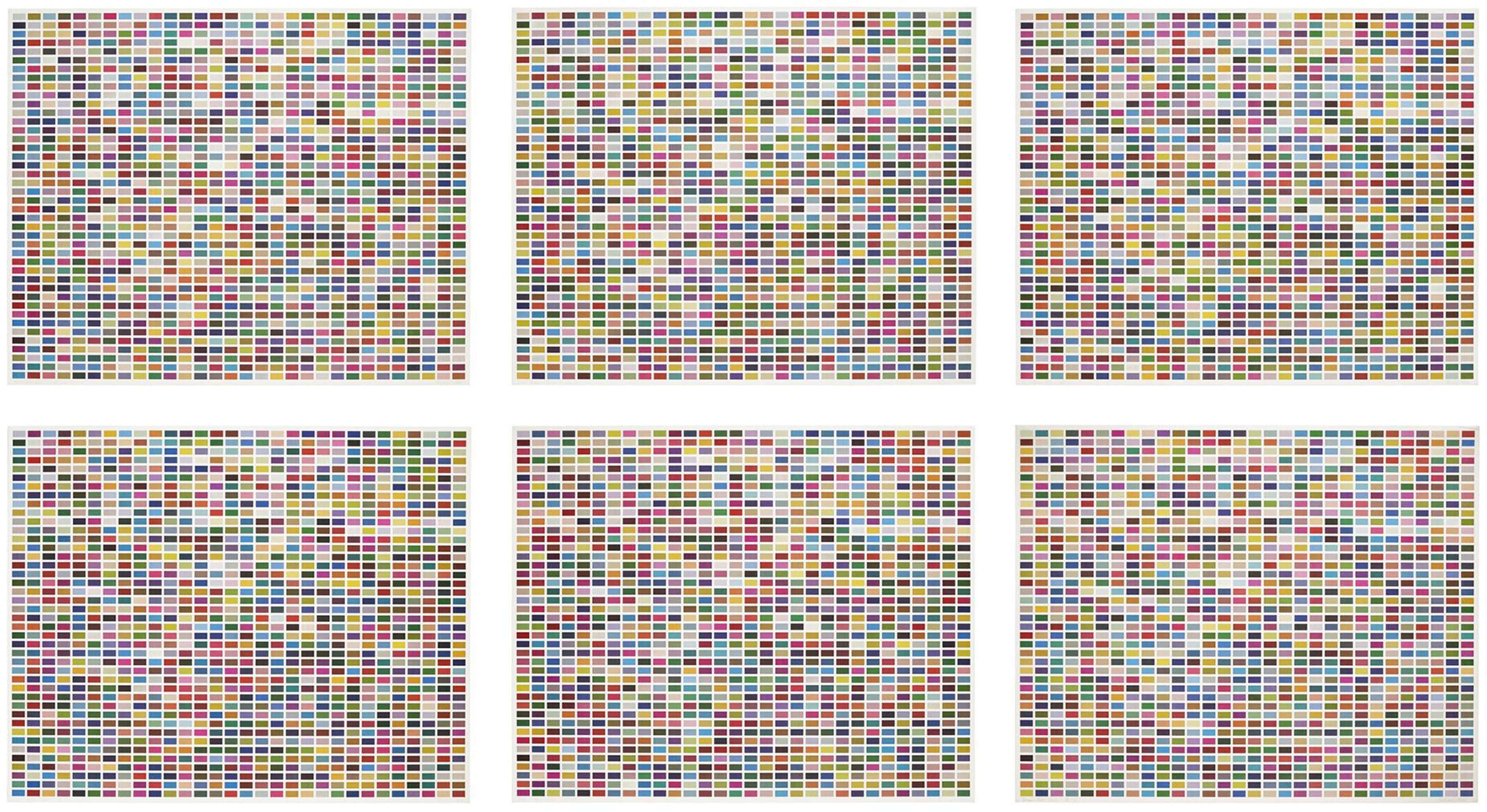
Farbfelder. 6 Anordnungen Von 1260 Farben (complete set)
Signed Print
Gerhard Richter
65 x 79cm, Edition of 32, Lithograph, 1974
£60,000-£90,000
$110,000-$170,000 Market Value Indicator
$110,000-$170,000 Market Value Indicator
¥540,000-¥820,000 Market Value Indicator
€70,000-€110,000 Market Value Indicator
$640,000-$950,000 Market Value Indicator
¥12,500,000-¥18,750,000 Market Value Indicator
$80,000-$120,000 Market Value Indicator
There aren't enough data points on this work for a comprehensive result. Please speak to a specialist by making an enquiry.
Track auction value trend
Meaning & Analysis
Farbfelder. 6 Anordnungen Von 1260 Farben (complete set) comprises six lithographs, each presenting 1,260 colour squares arranged in a dense grid across the sheet. The same set of 1,260 colours appears in all six prints; the arrangement differs in each, the colours redistributed according to chance. Produced in 1974 and signed in an edition of 32 complete sets, the portfolio is one of the most systematic works in Richter's printmaking catalogue.
Richter began his Colour Chart series – the Farbfelder – in 1966, initially producing paintings in which commercially available paint colours were laid out in grids. The works engage directly with seriality, chance and the question of what it means to compose. Rather than selecting colours for their expressive or relational qualities, Richter adopted a quasi-scientific method: enumerate a defined set of colours, arrange them randomly, and repeat the arrangement under different conditions. The results resist both expressionism and conventional design – the grids are neither beautiful arrangements nor arbitrary noise, but something more diagnostic: a survey of colour itself, stripped of hierarchy.
The 1974 portfolio extends this method into the lithographic edition. Each of the six prints holds 1,260 individual colour squares – the same 1,260 in every print, spanning the full chromatic range from primaries through secondaries to neutrals, earth tones, near-whites and near-blacks. What changes between the six prints is the sequence in which these colours appear. The eye moves across each sheet without finding a stable hierarchy or centre; the colours simply are, arranged, repeated in a different order across the set. Taken together, the six prints constitute a demonstration of how radically the perceived character of a set of colours changes with arrangement, despite the colours themselves remaining constant.