
There is enough happening to play Frieze bingo. Sotheby’s fashionwear? Check. Someone filming themselves walking through the tent? Check. Someone asking whether you are going to Paris? Check. Someone heading home on the Tube with a copy of Frieze magazine in hand? Check. Full house. But, somewhere between the bingo calls, there was also art to look at, and some of it was very good.
Opening day felt busier than I remember last year. “More alive and colourful” was a recurring description among attendees, while confidence – the art market’s favourite word – was reportedly back. Perhaps that was partly what the booths needed. An upbeat mood certainly makes for an easier conversation, but it does not tell us whether collectors are buying indiscriminately.
The assessments were not universally glowing. Philip Hoffman of The Fine Art Group told The Art Newspaper that plenty of works had sold, but questioned the quality on offer. Victoria Kleiner, an adviser at Overstone, gave us a more positive account. She described both fairs as “buzzing”, with dealers at Masters expressing “overall positivity and satisfaction at the rate of sales”.
The contrast between those accounts is telling. Confidence had not swept through the tents in a single wave; it pooled in particular booths. Collectors made substantial commitments where the artist, object or presentation gave them a clear reason to act – and became noticeably bolder when less money was on the line.
A £5 Million Brueghel and a Triceratops Skull at Frieze Masters 2026
Frieze Masters supplied the opening day’s highest reported sale: Jan Brueghel the Elder’s Still Life of Flowers in a Stoneware Vase, circa 1607–08, sold by Hauser & Wirth for around £5 million. The gallery also led reported sales in 2025. Modest in scale yet exquisite in detail, the Brueghel was a reminder that, amid all the talk of newness, the fair’s biggest reported cheque was written for a painting more than four centuries old.
At the opposite booth, David Aaron offered a change in scale with a mature Triceratops skull carrying an asking price of £675,000, which we thought quite modest considering the interest surrounding fossils. A Camarasaurus supremus skull was offered at £1 million, with an Allosaurus tooth still lodged in its lower jaw. Clearly, things didn’t end well for someone.
The gallery confirmed interest from private collectors and institutions in both skulls, although neither had sold when we spoke. A sabre cat skull, offered at £45,000, had found a buyer. David Aaron described the fair as “positive but considered”, with buyers focused on “quality, condition and provenance”, the same priorities driving collectors elsewhere in the tent.
Fossils now compete for the attention of buyers accustomed to art, antiquities and design, but curiosity does not automatically become a sale at the top end. The smallest and least expensive skull was the first to go.
Prints at Frieze Masters 2026: Hockney, Haring and Warhol
For print collectors, Archeus/Post-Modern reliably brings a strong blue chip presentation. On the front display was David Hockney’s The Arrival of Spring, 29th of January, from an edition of 25. Somewhat surprisingly, it was the only work from The Arrival of Spring series that we saw at either fair.
We could not secure an asking price, but we'd assume the offer to be north of £350,000. Its appearance mattered because the series has become one of the most closely watched areas of Hockney’s print market, with recent dedicated sales testing how far prices established within highly curated auction settings can carry into subsequent public and private transactions.
Also on offer were two Keith Haring works, a unique work on newspaper and an orange printer’s proof of Andy Mouse. More examples from Andy Mouse have reached the market this year, but these works occupied a different position from standard numbered editions.
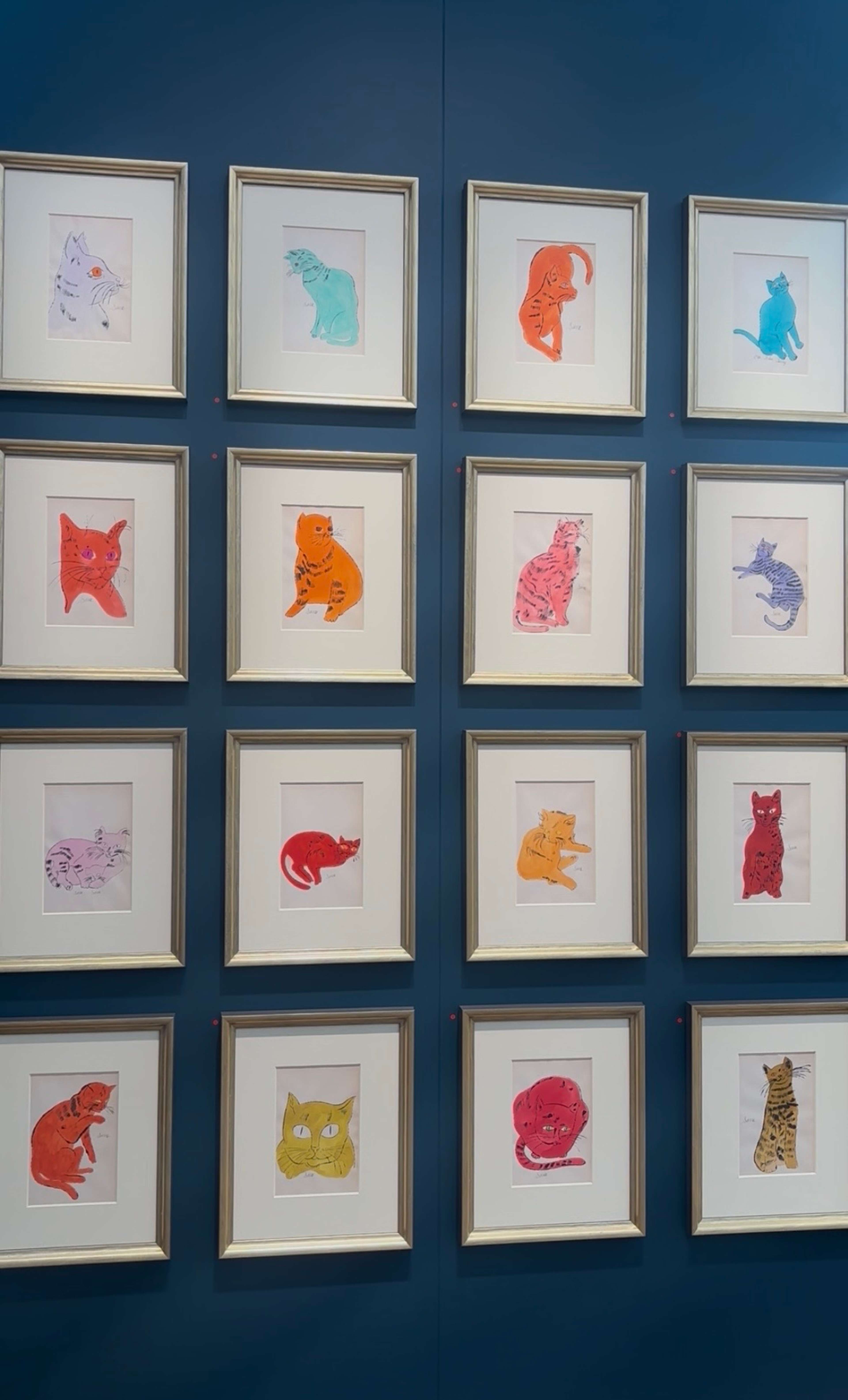
At Shapero Modern, the American Pop selection included Andy Warhol’s portraits of Ingrid Bergman and Grace Kelly, reflecting the interest we have seen in his portraits of women within the private market. A complete set of Warhol’s cat prints was also attracting admirers, although it remained available when we visited.
At a commercial fair, in a sea of new work, even familiar names can’t lean on reputation alone. A closely watched series, a printer’s proof that pops with orange or a rare complete set gives collectors a reason to stop and look again.
The wider mood at Masters remained positive. Victor Custot, director of Waddington Custot, described it as “serious and engaged”, with knowledgeable collectors visiting from Europe, North America and Asia. He highlighted interest in Chillida, Miró and Flanagan, as well as the gallery’s 1958 Soulages and a sculpture by Venet.
Custot expected activity to remain strong through the weekend as collectors arrived for the London–Paris October circuit, “creating ever more links between the two cities”. That circuit brings international collectors to London, but it also creates competition for their time and spending. Frieze’s energy therefore matters, although the works still have to justify a commitment before buyers move on to Paris.
Colour, Surrealism and Lower-Priced Risks at Frieze London 2026
Frieze London leaned on solo booths this year, and the Focus section was more experimental and interactive than usual. Fewer names per stand meant collectors got a fuller picture of each artist, and in a selective market that clarity can sell better than a crowded group hang.
Colour hit you first, and it may well have lifted the mood. Gagosian moved away from its recent sculptural presentations with six paintings by Albert Oehlen. All six reportedly sold, at prices understood to exceed $1 million each.
Pace also concentrated its booth around colour with five paintings by Marina Perez Simão. The gallery reported that nearly all had sold, at up to $250,000 each, by the end of preview day. The booth was not technically sold out when we visited on Thursday, but the results showed that a tightly focused presentation could generate serious spending around a single artist.
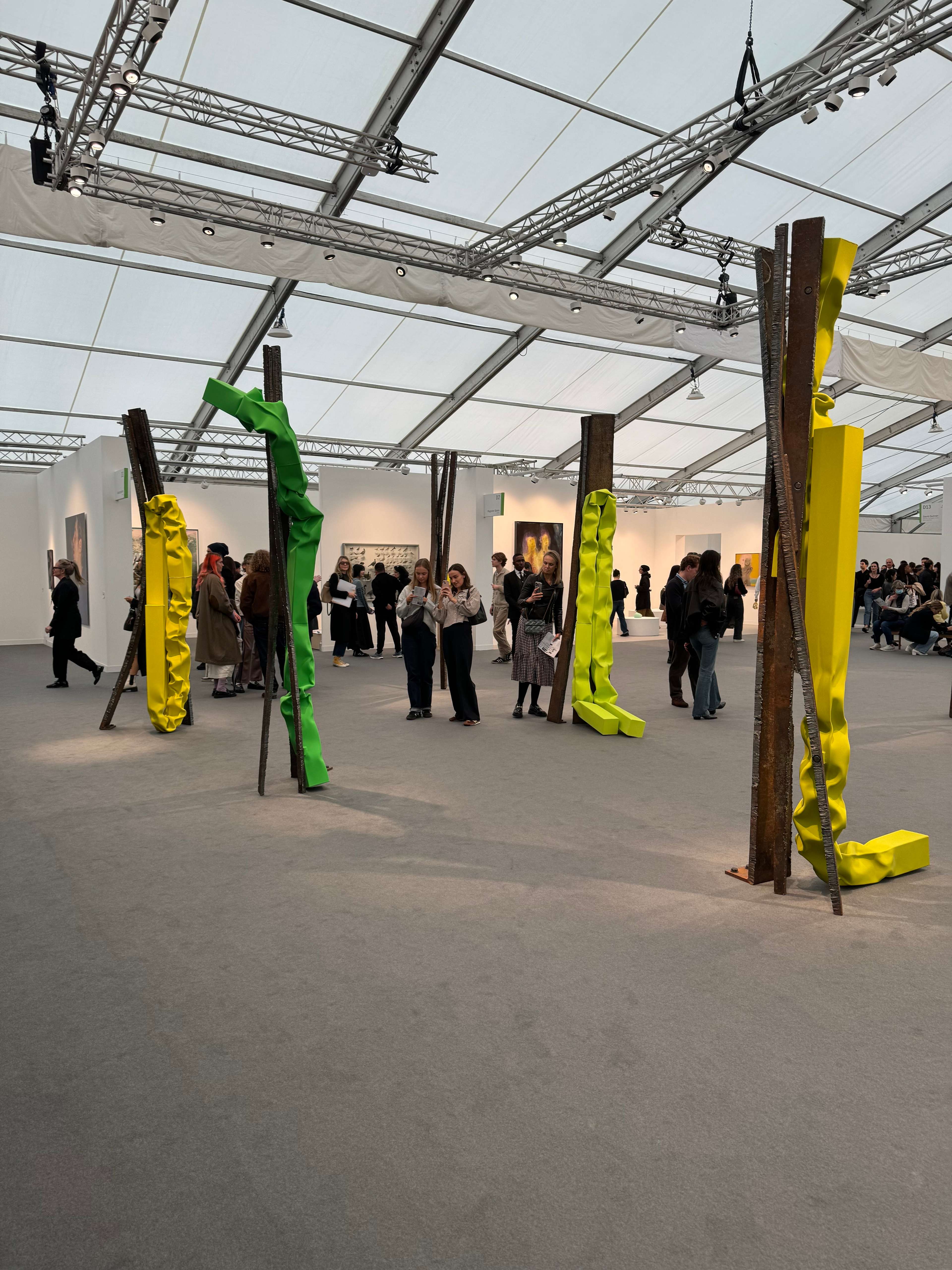
Sadie Coles HQ supplied one of the fair’s most photographed installations with Alex Da Corte’s brightly coloured, large-scale sculpture. Sadie Coles HQ supplied one of the fair’s most photographed installations with Alex Da Corte’s brightly coloured, large-scale sculpture. It was made for Instagram, but its exuberance also reflected the colour and energy seen across the tent. After several years of talk about correction and caution, the fair felt unmistakably lively.
Surrealist influences remained visible, with several booths offering something spooky in a good way. At Esther Schipper, Karolina Jabłońska’s rotting apples gave the familiar still life an unsettling edge, while a head submerged in a preserving jar took that unease further. Alongside Issy Wood’s self-portrait at Carlos/Ishikawa, these works suggested a continuing appetite for figurative painting where something feels slightly off.
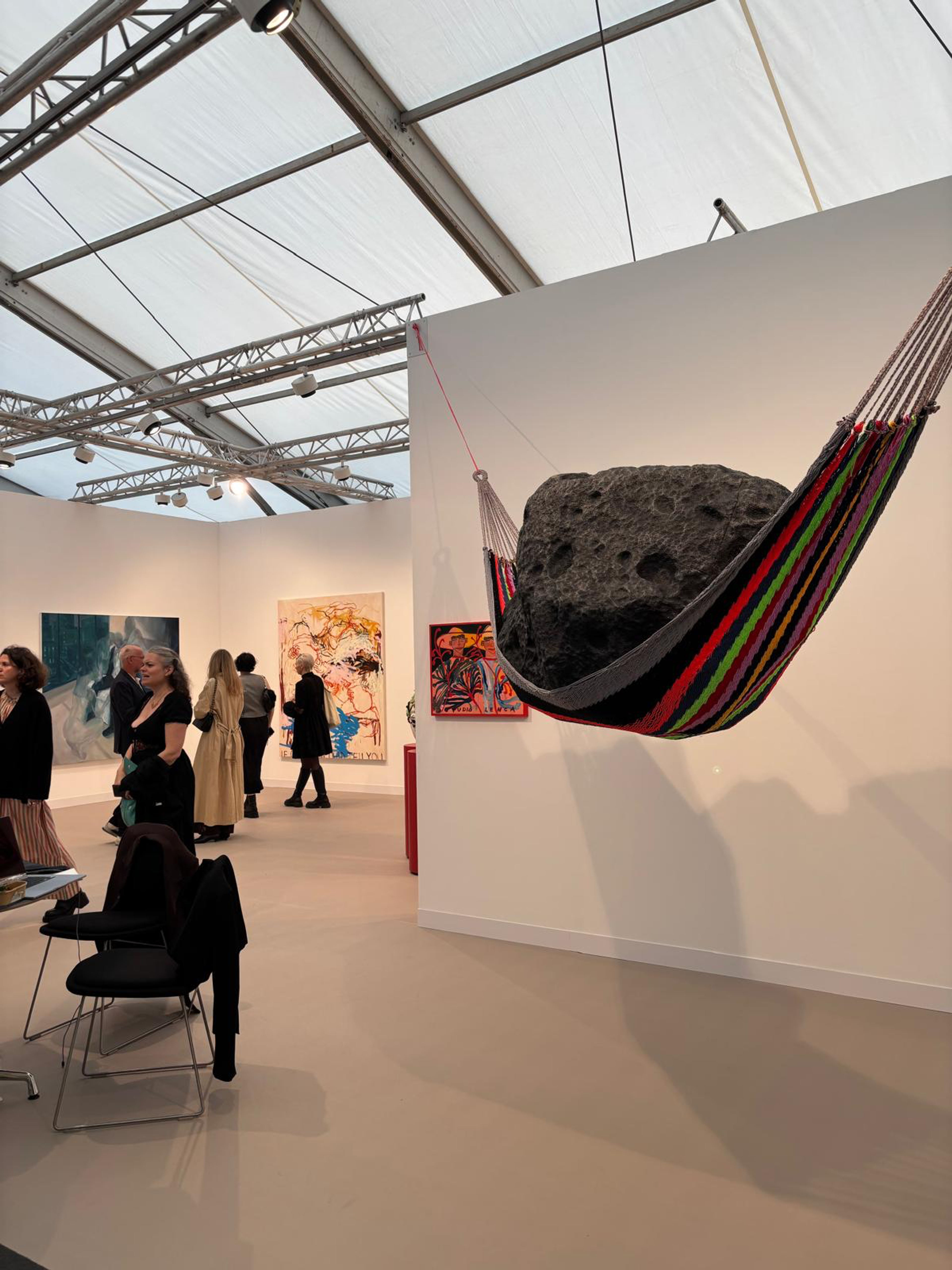
At Herald St, Nicole Wermers’ purple faux-fur tail wound around a reel, giving a piece of ordinary equipment an animalistic presence, with perhaps a little S&M in the association. At Carl Freedman Gallery, Studio Lenca’s rock suspended in a hammock made an object associated with weight appear precariously relaxed.
Studio Lenca also turned up in the Deutsche Bank lounge, so the artist appeared on a gallery stand and in the sponsor’s hospitality programme at the same time. That kind of double exposure is how a fair builds a profile, well beyond what is for sale on the stand.
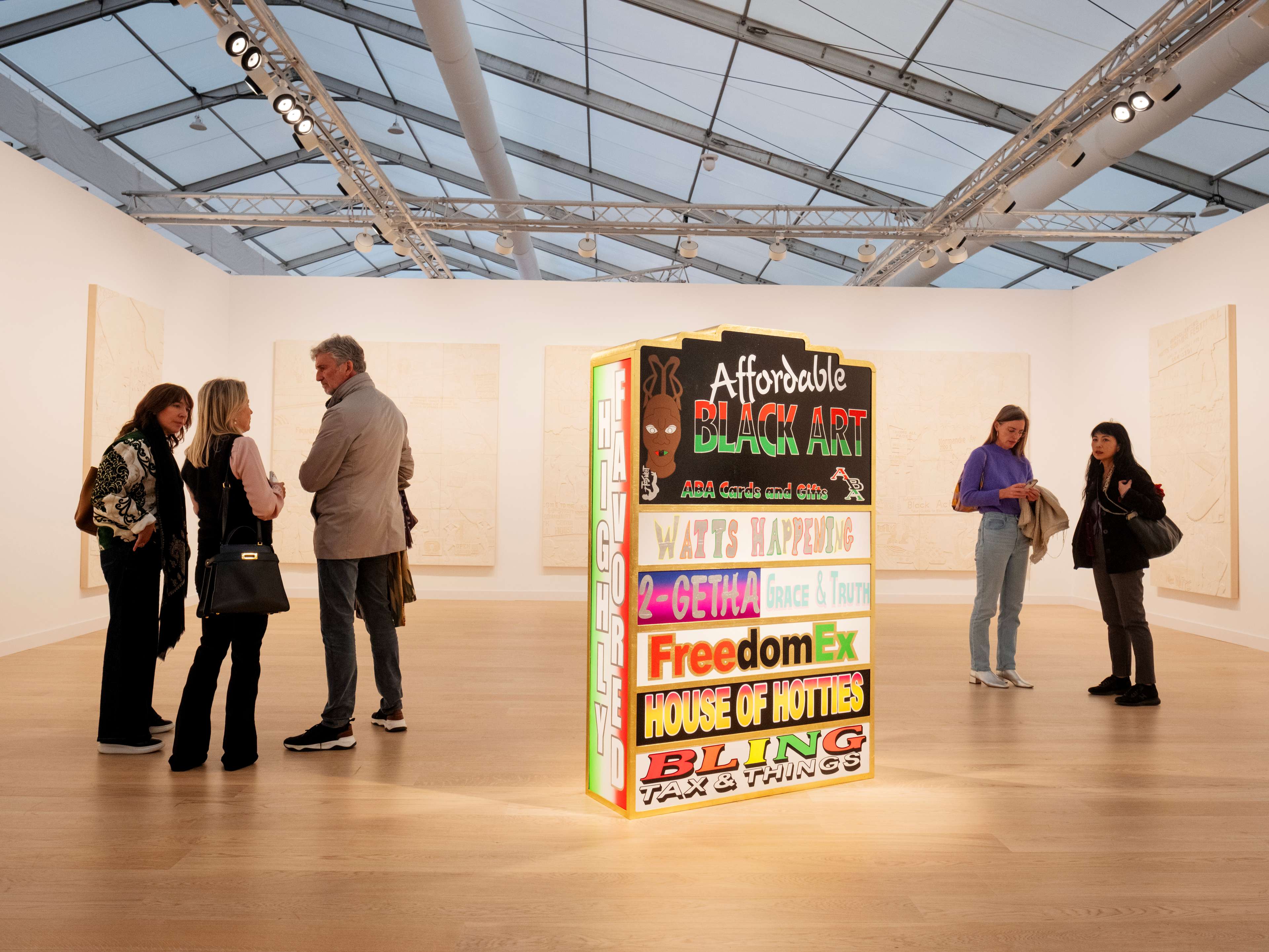
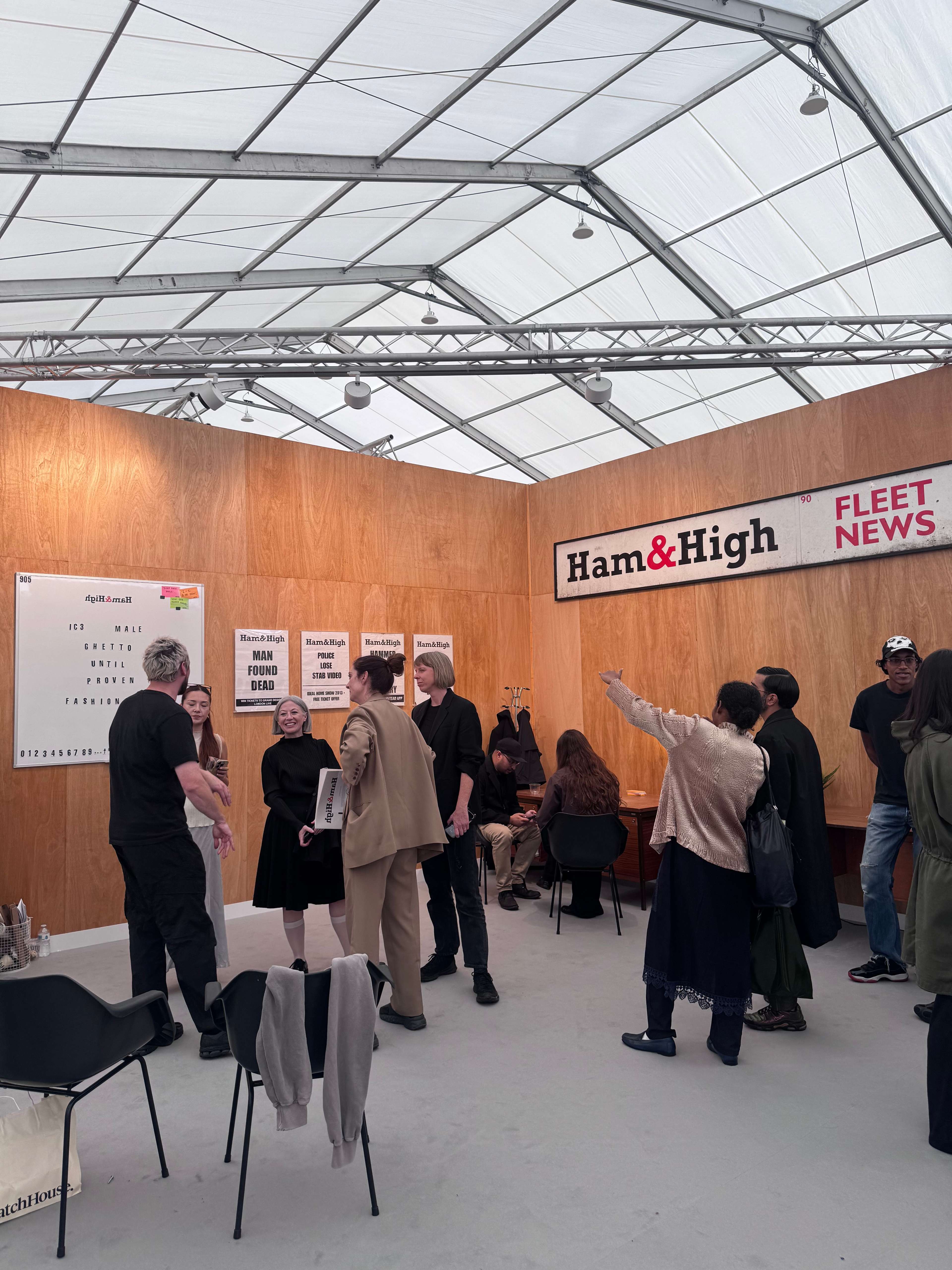
Less conventional presentations also found buyers at considerably lower prices. Harlesden High Street reimagined its booth as a market stall for Marcus Jefferson’s satirical The Exchange, with framed newspaper headlines from his Ham & High project forming part of the environment. According to The Art Newspaper, his framed found headlines and street-sign works were priced from £2,000, and the entire stand had sold by the end of VIP day.
The booth broke the usual fair format without asking anyone for a six-figure commitment. Caution about spending did not mean conservative taste. At these prices, buyers could take a punt on work that was less familiar and harder to categorise.
Participation and Art-Historical Echoes in the Frieze London Artist Award 2026
Participation provided another thread. Theo Triantafyllidis, winner of the 2026 Frieze London Artist Award, presented Feral Metaverse (Spider), a giant climbable spider wired into a multiplayer game. Visitors clambered on and played, turning a fair encounter into something physical and shared. Louise Bourgeois is the obvious (and named) reference, but sculpture, gaming and a crowd of strangers made for a very different experience.
That balance between recognition and novelty appeared elsewhere. At STPI, Aaron Curry’s brightly coloured shaped works projected from the wall, their cartoon exuberance bringing Murakami to mind. At OMR, José Dávila’s cut-outs revisited Roy Lichtenstein’s brushstrokes, interrupting familiar Pop imagery through the sections removed from the composition. For print collectors, both presentations extended the conversation beyond the conventional framed sheet.
Familiar references ran through some of the fair’s stranger works. Collectors may be looking for recognised names, but newer work also offered something they knew, whether through Pop imagery, Surrealism or a nod to an established artist.
Overall the booths were adventurous, but the buying remained selective. Established artists attracted substantial commitments, while Harlesden’s reported sell-out showed an audience for experimental work at lower prices. For print collectors, the interest extended from rare examples by familiar names to artists pushing the medium into different forms. Frieze offered reasons to look beyond the usual choices, even if collectors still wanted to choose carefull.