
Key Takeaways
The April 2026 New York print sales at Sotheby’s, Christie’s, and Phillips produced new auction records for Warhol’s Silverspot Butterfly, Marilyn (II.26), and Haring’s Andy Mouse – but also notable buy-ins including three Warhol Campbell’s Soup Cans, a complete Ed Ruscha Gas Station set, and a Warhol Mobilgas trial proof. Conservative estimate-setting inflated above-estimate percentages at Sotheby’s. The sub-$50,000 tier outperformed again, with Sotheby’s online sale clearing its low estimate by 39%. The unsold lots share a pattern: narrow buyer profiles and considered decisions that may be better served by private placement than public auction.
Sotheby’s Prints & Photographs April 2026: Conservative Estimates, Strong Hammers
Total: $4.3m hammer/16% below low presale estimate
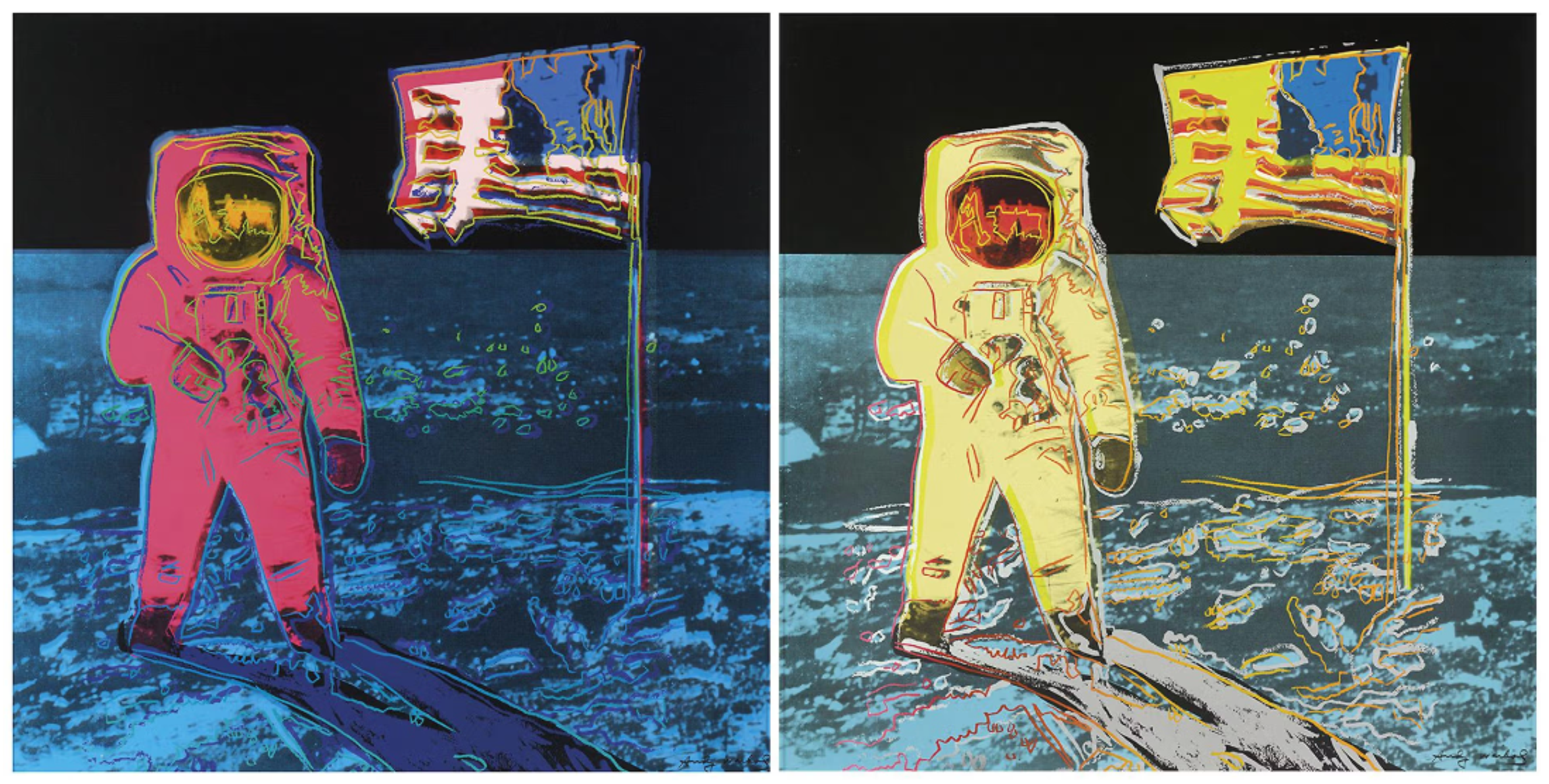
The headline number undersells what actually happened in the room. Several of the sale’s marquee lots carried estimates below recent market levels – a strategy designed to draw competitive bidding, and one that worked. Andy Warhol’s Silverspot Butterfly, estimated at $80,000–$120,000 against recent comparable results closer to $240,000, set a new record at $130,000. Marilyn (II.26), estimated at $80,000–$120,000 when comparable results have averaged north of $255,000, reached $170,000 – also a new record and the sale’s top performer. Pink Moonwalk (II.405) pushed to $280,000 against a $250,000 high estimate, the second-highest price for this colourway.
Roy Lichtenstein 1960s screenprints outperformed across the board. Crak! made $38,000 against a $25,000 high estimate, and Explosion – a guaranteed lot – reached $65,000, more than double its ceiling.
The sale fell short of its aggregate estimate, but the lots that mattered most came in well above. When estimates are set conservatively – and several here were significantly below where the market has been trading – percentage-above-estimate becomes a less useful metric. What matters is where the hammers landed relative to recent transactional data, and on that basis, the top end of this sale performed.
Christie’s Prints & Multiples April 2026: Haring Record, Warhol Campbell’s Soup Unsold
Total: $7.5m/12% above low presale estimate
Christie’s delivered the strongest total of the week and the only live sale to clear its low estimate comfortably.
Keith Haring’s orange Andy Mouse reached $280,000 at the upper end of estimates – a new record. Warhol’s African Elephant from the Endangered Species portfolio hit $170,000 against a $120,000 high estimate, the second-highest result for the main edition. Lichtenstein’s Nude With Blue Hair made $600,000 at high estimate – a solid result, particularly after million-dollar outcomes for the work last year. Marilyns were mixed: Marilyn (II.24) cleared its high estimate at $320,000, while Marilyn (II.31) landed at $300,000, right on the line.
The notable setback was Campbell’s Soup. Three individual cans – Cream of Mushroom, Black Bean, and Onion – each estimated at $50,000–$70,000, all went unsold. Tomato Soup, estimated at $100,000–$150,000, scraped through at $80,000. Campbell’s Soup is one of the most recognisable series in post-war printmaking, the estimates were within range, and all three unsold cans were in very good condition and from the same edition number – the kind of coherence that might typically attract a collector looking to build a considered grouping. The demand simply wasn’t there this time. Whether that reflects shifting appetite for individual cans outside the complete set, supply concentration in a single session, or something more specific to the room, it’s difficult to say. But the result is notable: three strong lots from a proven series, properly estimated and well-conditioned, passing in a sale that otherwise cleared its low estimate by 12%.
Prints Under $50,000: Why the Sub-$50k Market Keeps Outperforming
Sotheby’s Prints Part II (Online): $2.8m / 39% above low presale estimate
The standout performance of the week. Lichtenstein was particularly strong, led by works from the artists' estate – a collection that has carried significant momentum since first reaching the public market in 2024. Bull VII reached $75,000 against a $20,000–$30,000 estimate, Nude in the Woods (Black State) hit $50,000 from $12,000–$18,000, and Rain Forest made $40,000 against $15,000–$25,000. The Sower, Yellow Brushstroke, and Reflections On Expressionist Painting all doubled or exceeded their high estimates. Haring's Pop Shop prints, estimated between $15,000 and $35,000, all came in within or above estimates.
This continues the pattern we identified in last month's analysis: the core market for accessible blue chip editions is outperforming on a relative basis more consistently than the upper end. Recent reporting on the sub-$50k market shows growing confidence in this tier, with auction transaction volumes below $5,000 tripling since the pandemic. Much of that data covers living contemporary artists, but blue-chip prints under $50,000 arguably occupy the strongest position within this tier – the same accessibility advantages, plus the transparent pricing and deep auction histories the broader market lacks.
The question is whether this consistent outperformance is partly a function of conservative estimate-setting – or genuine structural demand. Likely both. But the consistency, sale after sale, suggests something more durable than tactical pricing alone.
Phillips Editions April 2026: Mid-Tier Strength, Resistance at the Top
Still awaiting full results
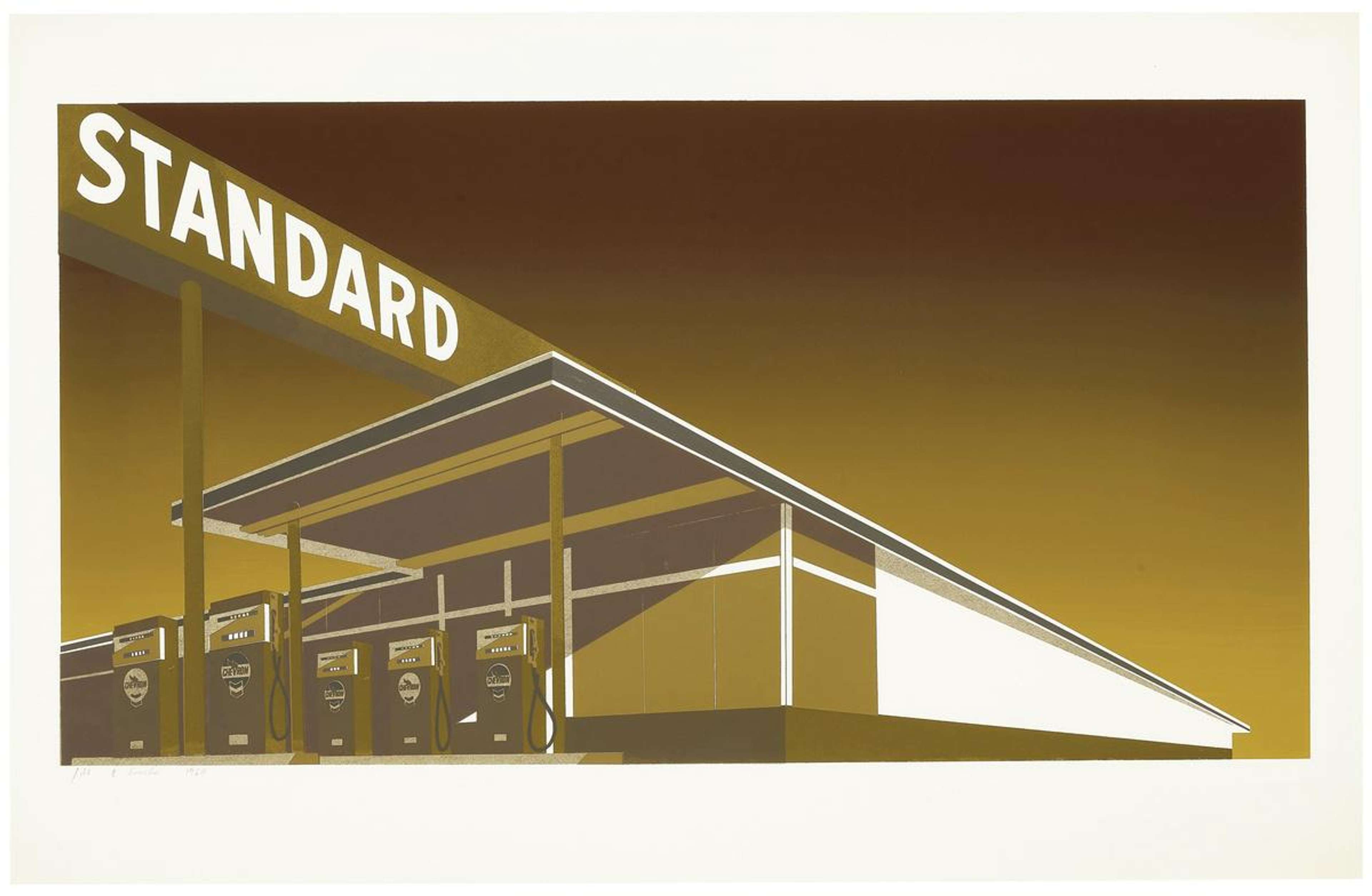
The mid-range performed well. Ed Ruscha’s Mocha Standard, offered as an individual print, sold at $120,000 within estimates. Warhol’s complete set of Martha Graham hit $110,000 above estimates, broadly in line with past results. Grace Kelly reached the high estimate at $150,000 – a work with proven demand and liquidity.
But the sale’s highest-value lots struggled. Ruscha’s complete set of Standard Station works – estimated at $900,000–$1,200,000 as the top lot – went unsold. Warhol’s Mobilgas trial proof, estimated at $120,000–$180,000, also found no buyer. Main edition Mobilgas prints averaged around $61,000 at hammer in 2025 – a trial proof at this estimate asks the market to pay a significant premium for rarity and proximity to Warhol’s process, a value proposition that resonates with the right collector but in this instance, required more context than a catalogue entry in a 200-lot sale could provide.
What the Unsold Lots Tell Us About Route to Market
The works that went unsold this week – three Campbell’s Soup Cans at Christie’s, a complete Ruscha set and a Warhol trial proof at Phillips – are all desirable works from proven series with documented market histories. None of them should struggle to find a buyer.
The pattern though, is that the works that didn’t sell were those where the buyer profile is more specific and the decision more considered. Route to market matters considerably – and it’s one of the reasons the private sales conversation continues to gain traction across the industry. The print market is not one market. The sub-$50,000 tier that drove Sotheby’s online sale 39% above estimate operates on fundamentally different dynamics to a $1 million Ruscha set or a Warhol trial proof. The strongest outcomes come when works are matched to the channel that fits their buyer profile.