

That divergence is difficult to explain through art-historical importance alone. Mao is one of Warhol’s most politically charged print portfolios, held complete by the Museum of Modern Art and closely connected to paintings in major American collections. Individual prints also trade regularly across the United States, the United Kingdom, Europe and Asia, giving the series an active and geographically broad market.
Complete portfolios appear far less frequently. While other major Warhol sets have undergone substantial repricing, Mao has remained within a narrower range, creating a notable gap between the activity surrounding its individual prints and the market’s valuation of the portfolio in its most complete form.
Why Did Andy Warhol Depict Mao?
Warhol’s choice of Mao was inseparable from the politics of 1972, although it should not be read as a straightforward ideological endorsement. With President Richard Nixon preparing for the first visit to China by a sitting American president, Warhol’s dealer Bruno Bischofberger suggested Albert Einstein as the most important figure of the twentieth century. Warhol countered that the most famous person in the world was Chairman Mao.
His source was the official portrait by Zhang Zhenshi, reproduced as the frontispiece to Quotations from Chairman Mao Tse-tung, better known as the Little Red Book. Already one of the most widely circulated images of the twentieth century, the portrait offered Warhol a subject whose political authority depended partly on the scale and consistency of its reproduction.
Warhol approached Mao as he had soup cans, Marilyn Monroe and other mass-media subjects, focusing not only on the individual but on the machinery that had made his face ubiquitous. By 1972, the portrait of the most powerful man in the Communist world circulated with something approaching the visual consistency of a consumer brand, creating an uncomfortable parallel between political propaganda, celebrity and commercial imagery. That tension gave Warhol both a subject through which to examine the manufacture of public identity and a route back into painting.
Andy Warhol’s Mao Prints and His Return to Painting
The Mao series marked a turning point in Warhol’s career, becoming the first major body of paintings he produced after several years in which film and other projects had taken precedence over painting. Beginning in 1972, it returned him to large-scale serial portraiture while introducing the more visibly painterly treatment that would shape much of his work during the following decade.
The prints register that change through the interaction between mechanical reproduction and visible intervention. Loose, hand-drawn lines cross areas of flat screenprinted colour, while cosmetic blues, pinks and yellows give way to harsher combinations of red, black and green. The artist’s hand, suppressed in much of Warhol’s 1960s production, returns to the surface without displacing the reproduced image beneath it.
The wider Mao series subsequently entered both institutional and commercial history. Paintings from the body of work are held by the Art Institute of Chicago, the Whitney Museum of American Art and The Broad, while examples at auction have achieved prices ranging from several million dollars into the tens of millions.
Its political charge has remained equally visible. In 1974, the Musée Galliera in Paris exhibited the paintings alongside the prints and surrounded them with Warhol’s repeated Mao wallpaper, presenting the image as an immersive field of political and visual reproduction. Almost four decades later, the Mao works were excluded when a major Warhol retrospective toured China in 2013, demonstrating how the subject’s political sensitivity has continued to shape the way the series is displayed and received.
How Many Andy Warhol Mao Prints Are in the Complete Set?
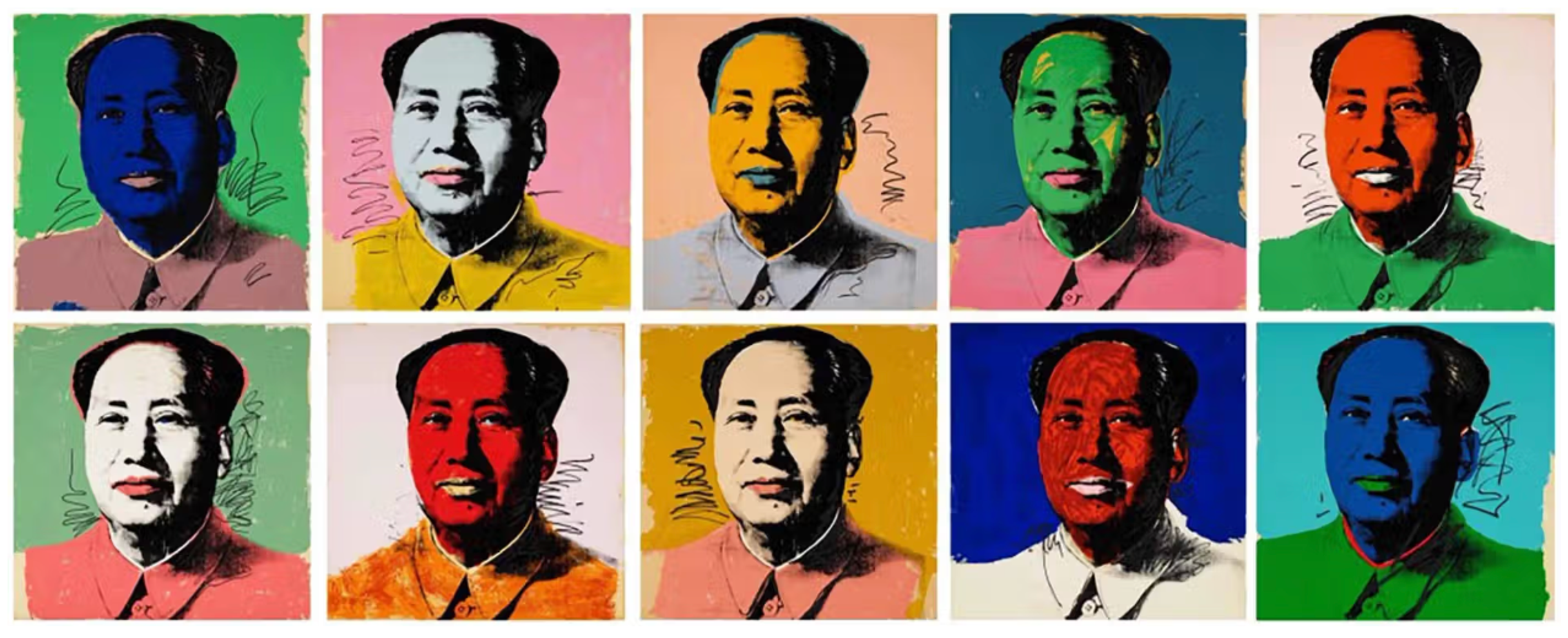
Warhol’s complete Mao portfolio consists of ten screenprints, each measuring 36 by 36 inches. Castelli Graphics and Multiples, Inc. co-published the series in 1972 in an edition of 250, with an additional 50 artist’s proofs.
Although every print begins with the same official portrait, Warhol’s shifting colour treatments alter its character from one sheet to the next. Some combinations give Mao an almost cosmetic surface, while others obscure or harden his features, making the authority projected by the original image appear less stable.
An individual print captures one of these transformations, but the complete set reveals the larger artistic argument. Through repetition, a political leader becomes an icon, and an official portrait begins to function like a product, a celebrity image and a vehicle for endless stylistic variation.
The portfolio’s serial structure is therefore essential to its meaning, which helps explain why institutions preserve the ten prints together and why the market treats a complete set as a distinct work rather than simply as ten individual impressions.
How Mao Compares With Other Andy Warhol Complete Sets
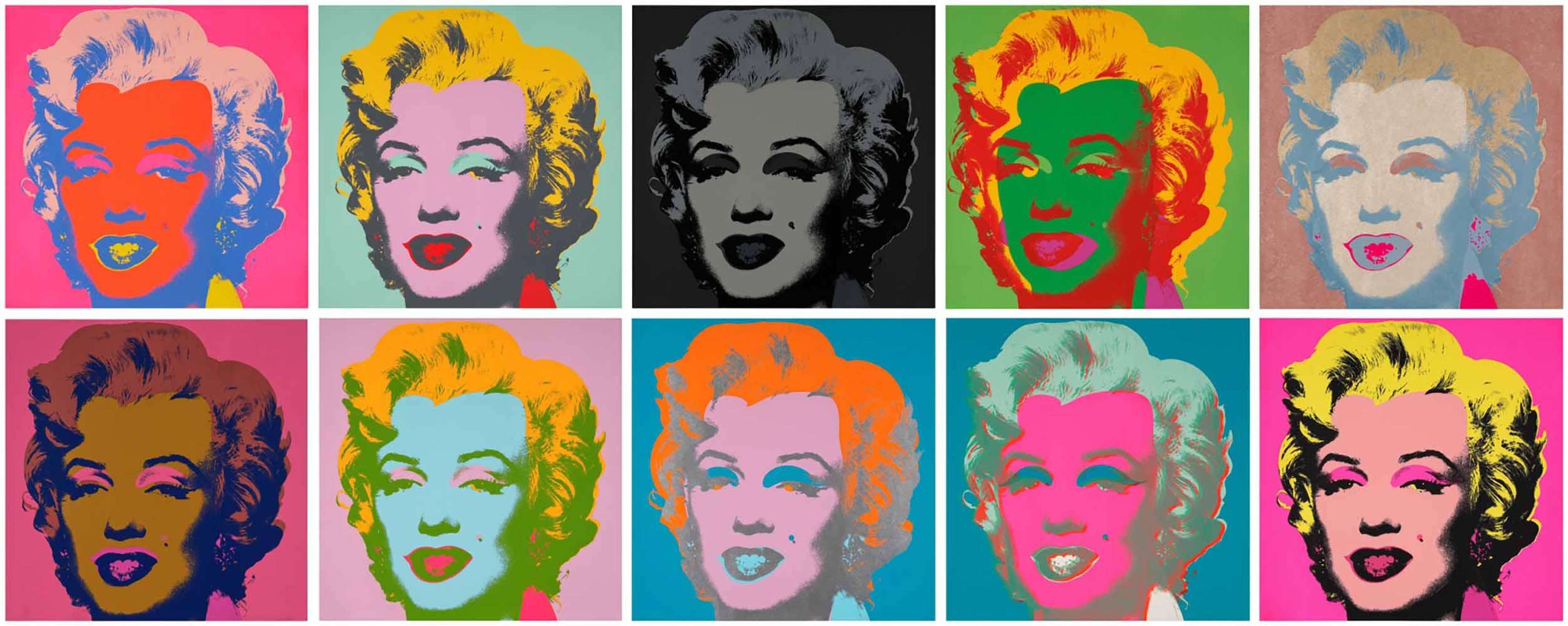
Warhol’s major print portfolios have followed different trajectories over the past decade. Complete sets of Marilyn, Ads and Cowboys and Indians have all experienced substantial repricing, supported by competition for particularly strong examples and, in some cases, artist’s proofs or sets with notable provenance.
Marilyn
Marilyn remains at the top of Warhol’s complete-set market. Its ten images are among the most recognisable in Post-War printmaking, and competition for complete portfolios has continued to move the series into a different price category from much of Warhol's graphic output.
Ads
Ads has shown some of the clearest recent strength. Standard and artist’s-proof sets have both attracted substantial prices, providing evidence that collectors are reassessing the portfolio at the upper end of Warhol’s print market.
Cowboys and Indians
The appreciation of Cowboys and Indians has been more consistent. Its complete-set market has strengthened considerably since 2016, with recent auction results and estimates reflecting the extent to which the portfolio’s position has changed.
The next test will come at Sotheby’s New York on 8 October 2026, where a complete Cowboys and Indians set is estimated at $700,000–1 million. Whatever the outcome, the estimate itself reflects how substantially the portfolio’s position has changed since 2016.
Mao
Mao has remained more stable by comparison. Its recent public results have not repeated the high point established in 2016, but complete sets also appear much less frequently than individual colourways, leaving the category with relatively few current reference points.
The distinction does not place Mao outside Warhol’s established print market; individual impressions remain actively traded across several regions. Instead, it shows that regular demand for the image has not yet been fully reflected in the pricing of the complete ten-print portfolio.
How Liquid Is the Market for Andy Warhol Mao Prints?
Warhol’s Mao prints support one of the most active markets within his graphic output, with 44 priced auction sales recorded in 2025.
Much of that activity arrived in concentrated groups. Of the 44 individual prints sold, 32 appeared across eight auctions in which three to six colourways were offered on the same day. Buyers therefore demonstrated an ability to absorb several Mao prints at once, rather than demand depending on isolated appearances throughout the year.
The market is also geographically broad. Individual impressions trade through major auction houses across the United States, the United Kingdom, Europe and Asia, giving the series a buyer base that does not depend on one saleroom, country or occasional high-value result.
Complete portfolios occupy a smaller and less frequently tested part of that market. Individual colourways provide regular evidence of international demand for the image, while an intact set offers all ten prints as Warhol conceived the portfolio, without requiring a collector to assemble compatible impressions over time.
Because complete sets appear infrequently, each result carries considerable weight but provides less annual data from which to judge the category. Their scarcity also means that the market for intact portfolios cannot be assessed in the same way as the more frequently traded individual prints.
How Does The Complete Mao Set Compare?
MyArtBroker’s print-collection framework in The Most Investable Print Series assesses markets through liquidity, price trajectory, market breadth and visibility. Applied to Mao, these measures reveal an internationally established series supported by regular transactions, broad geographic demand and strong institutional recognition.
The complete portfolio is a distinct proposition within that market. Its infrequent appearance makes its trajectory more difficult to assess through annual figures alone, while the volume of individual sales demonstrates sustained familiarity with – and demand for – the image.
Recent public pricing for complete sets has not moved in step with the activity surrounding individual colourways or the repricing of several other Warhol portfolios. That difference creates the central opportunity within the series: the complete set retains the institutional standing, international recognition and liquidity of the wider Mao market while remaining one of the less frequently available ways to acquire Warhol’s serial argument in full.
The forthcoming Christie’s sale will provide a significant new reference point. On 20 October, a complete portfolio from the Collection of Antonio Homem Sonnabend will appear in a dedicated New York prints auction, giving the public market its first autumn test of the complete set.
Why Mao Belongs in a Serious Collection
Warhol’s Mao belongs naturally within a collection concerned with Post-War art, political imagery and the manufacture of public identity.
It can sit alongside Warhol’s Vote McGovern from the same year, or within a wider group containing his later representations of authority in Lenin and Reigning Queens. In each case, Warhol took a public image already loaded with political meaning and examined what happened when it was repeated, recoloured and circulated as an art object.
The complete Mao portfolio develops that argument more fully than any individual impression. Across ten versions of the same official portrait, shifts in colour and drawn intervention alternately embellish, obscure and destabilise the face, revealing how repetition can transform a political leader into a reproducible icon.
Its significance therefore extends beyond the price history of individual auction results. The set offers the fullest expression of a series that marked Warhol’s return to sustained painting, occupies major institutional collections and continues to support an active international market for its individual images.
Buying an Andy Warhol Mao Complete Set
The next public test for a complete Mao portfolio will come at Christie’s New York on 20 October, when a set is offered in the dedicated sale of prints from the Collection of Antonio Homem Sonnabend.
Its provenance is particularly significant. Antonio Homem was the adopted son of the influential dealer Ileana Sonnabend and worked closely with her for decades, while the Sonnabend Gallery played an important role in the development of the international Post-War art market. The association may attract buyers beyond the established market for Warhol prints and could add a collection premium to the result.
The sale will nevertheless provide the first new public reference point for a complete Mao set this autumn. It will show how buyers respond to the portfolio after a period in which individual colourways have traded regularly but intact sets have appeared much less frequently. Any comparison will need to account for the Sonnabend provenance, which distinguishes the Christie’s portfolio from a standard market offering.
MyArtBroker is also handling an intact Andy Warhol Mao portfolio privately. Our specialists can provide detailed information about its condition, provenance and edition, alongside the market evidence needed to assess its position against previous complete-set sales and the forthcoming Christie’s auction.
Collectors interested in the available portfolio, or seeking further information about the market for Andy Warhol’s Mao prints, can contact our team directly.
All market figures are hammer prices in GBP, excluding buyer’s premium, from MyArtBroker’s auction database as of its latest daily refresh. Complete-set results are identified from catalogue records and lot titles and exclude artist’s-proof and trial-proof sets unless stated. Painting results are quoted in USD from published auction records.No complete Mao set currently appears in the autumn auction calendar, limiting the public market’s opportunity to establish a new reference point for the portfolio.