Neuschwanstein (F. & S. II.372)
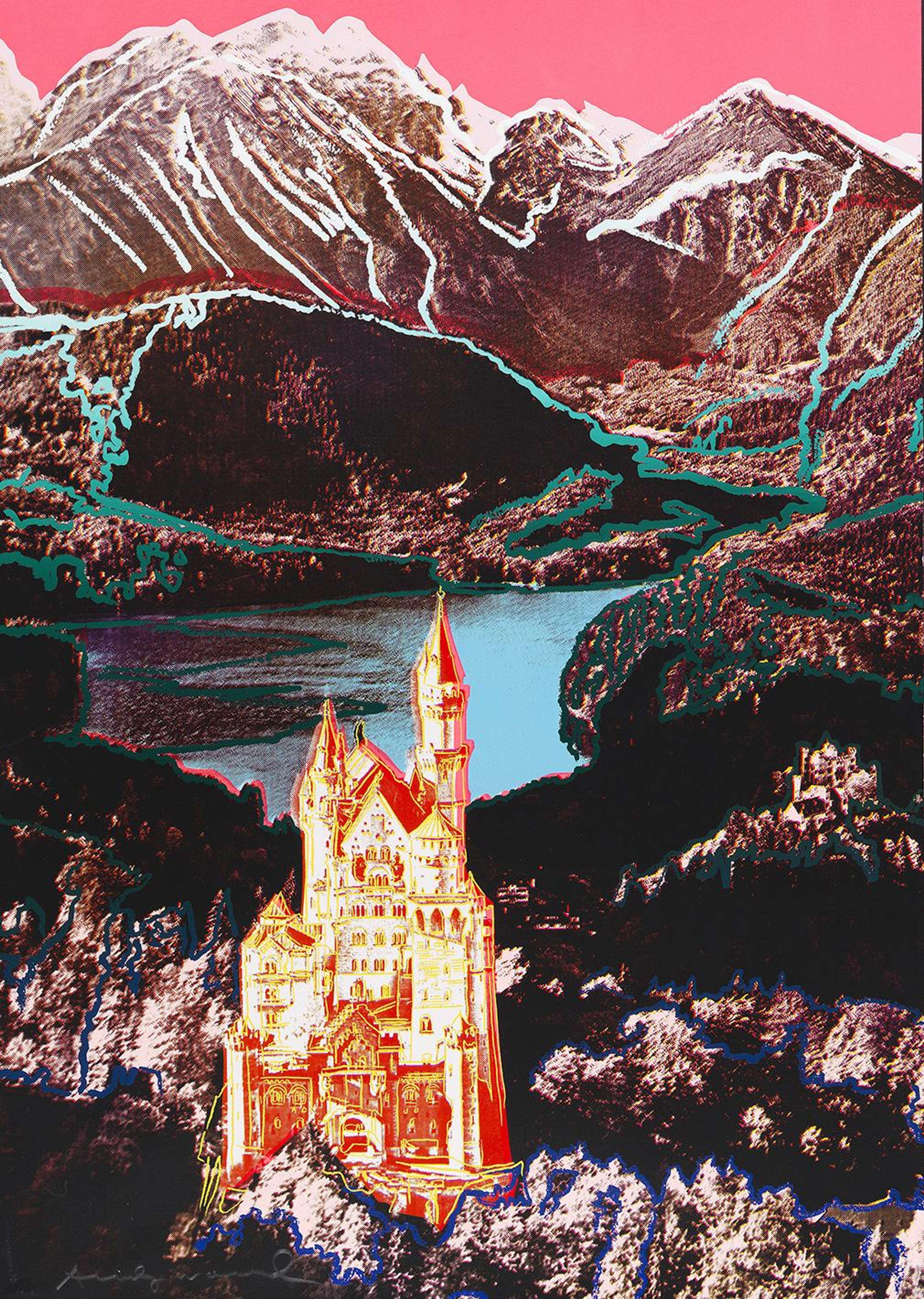
Neuschwanstein (F. & S. II.372)
Signed Print
Andy Warhol
85 x 60cm, Edition of 100, Screenprint, 1987
£24,000-£35,000
$45,000-$70,000 Market Value Indicator
$45,000-$70,000 Market Value Indicator
¥210,000-¥310,000 Market Value Indicator
€29,000-€40,000 Market Value Indicator
$250,000-$370,000 Market Value Indicator
¥5,080,000-¥7,410,000 Market Value Indicator
$30,000-$45,000 Market Value Indicator
There aren't enough data points on this work for a comprehensive result. Please speak to a specialist by making an enquiry.
Track auction value trend
Meaning & Analysis
Neuschwanstein (F. & S. II.372) is a screenprint depicting Neuschwanstein Castle, Bavaria, set within an Alpine landscape under a flat hot-pink sky. Produced in 1987 in a signed edition of 100, it applies Warhol's characteristic screenprint process to one of the most reproduced tourist images in the world, pushing the photograph's already saturated commercial palette to chromatic extremes.
Neuschwanstein Castle, commissioned by King Ludwig II of Bavaria in 1869 and never completed in his lifetime, had by the late twentieth century become one of the most photographed buildings in existence – a Romanesque Revival fantasy that directly inspired the Disney castle and had been thoroughly absorbed into the visual language of tourism, souvenir imagery and popular culture. Warhol's source was a standard elevated tourist photograph: castle centred in the lower half of the image, dark forest hillside rising behind, an Alpine lake in the middle ground, and mountain peaks above.
In the print, the castle is rendered in blazing red-orange and yellow, outlined in electric blue, and set against steep dark forest, a pale blue lake, and mountain ridges edged in teal. The sky above the peaks is a flat, uninflected hot pink. The photographic detail of the mountain slopes survives in the darker areas of the image, while the castle itself is almost incandescent – as though lit from within rather than illuminated from above.
This treatment is consistent with Warhol's broader late-career interest in images already exhausted by commercial reproduction. He does not restore Neuschwanstein to sublimity; he takes a subject already saturated with tourist intent and saturates it further. The result occupies the characteristic Warhol position between celebration and irony – formally decisive, interpretively non-committal.