Goethe (complete set)
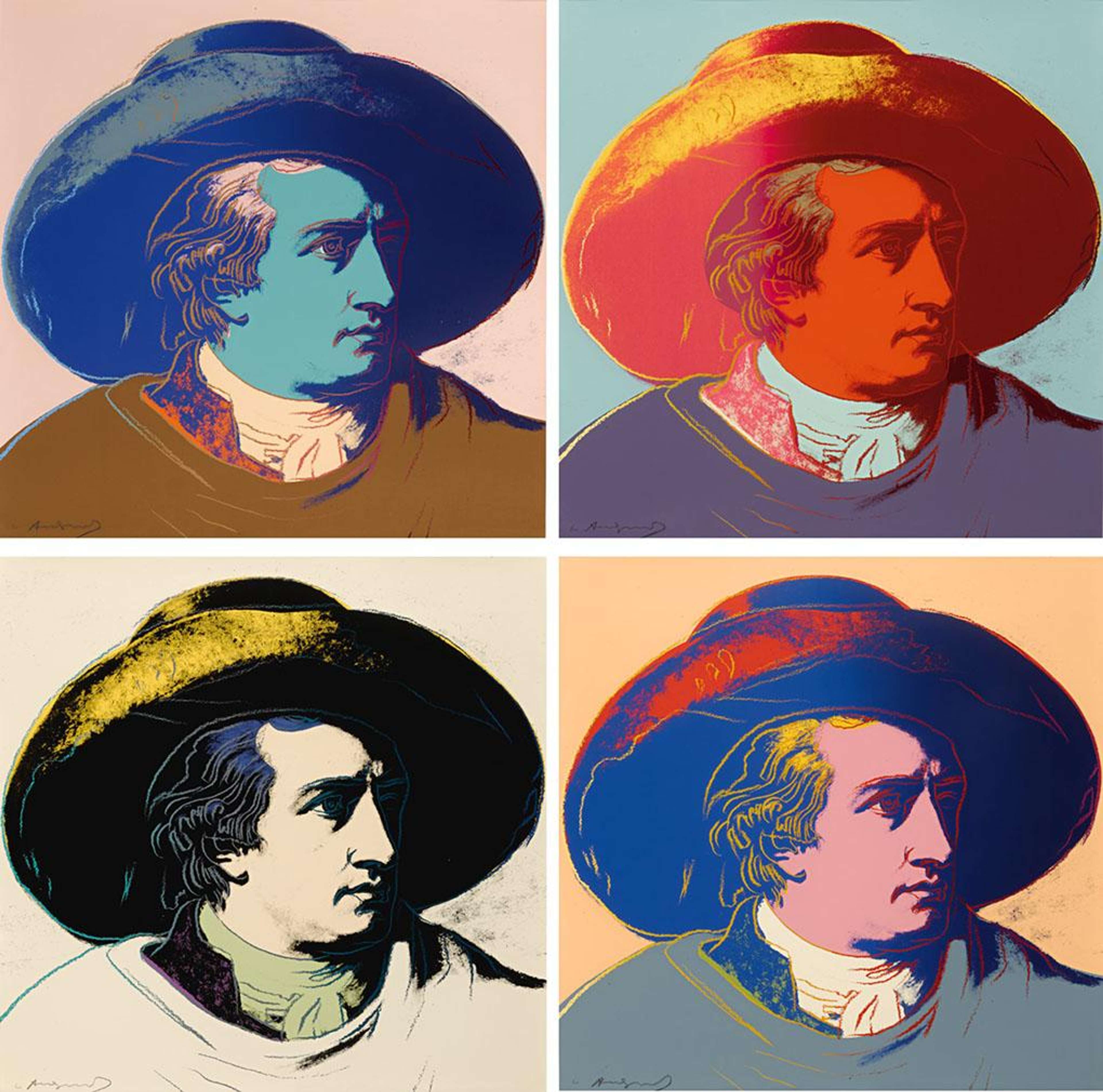
Goethe (complete set)
Signed Print
Andy Warhol
96 x 96cm, Edition of 100, Screenprint, 1982
£220,000-£330,000
$410,000-$620,000 Market Value Indicator
$410,000-$620,000 Market Value Indicator
¥2,000,000-¥3,000,000 Market Value Indicator
€260,000-€380,000 Market Value Indicator
$2,340,000-$3,500,000 Market Value Indicator
¥46,000,000-¥68,990,000 Market Value Indicator
$300,000-$450,000 Market Value Indicator
There aren't enough data points on this work for a comprehensive result. Please speak to a specialist by making an enquiry.
Track auction value trend
Meaning & Analysis
Goethe is a complete set of four screenprints made in 1982. Each print reproduces the same three-quarter portrait of Johann Wolfgang von Goethe – identifiable by his characteristic wide-brimmed hat and cravat – in four colourways: blue hat on pink, orange hat on blue, black hat on cream, and blue hat on peach. Signed and numbered from an edition of 100.
The Goethe series was produced in 1982 to mark the 150th anniversary of the poet's death, commissioned for the Frankfurt commemorations of that year. It represents one of Warhol's more direct engagements with European cultural heritage – and one of the clearest demonstrations that his serial portrait method was as applicable to canonical literary figures as to living celebrities.
The source image draws on the Romantic portrait tradition surrounding Goethe, dominated by the wide-brimmed hat associated with his Italian journey and immortalised by Tischbein and others. Warhol's version lifts the composition from this established iconography and subjects it to his standard chromatic transformation – the same face, same hat, same aristocratic three-quarter turn, shifted across four entirely different registers.
The blue-and-pink variant has a decorative refinement; the orange-and-red version saturates the figure in heat. The black-and-cream colourway is the most graphic, reducing Goethe to a near-monochrome silhouette edged in fine coloured line. In the peach-and-blue version, the face takes on a warmth absent from the others. Goethe the canonical European genius is accorded exactly the same treatment as Mao or Marilyn – a celebrity portrait, a face reproduced until it becomes an image as ubiquitous as a commercial advert.