Hammer and Sickle (complete set)
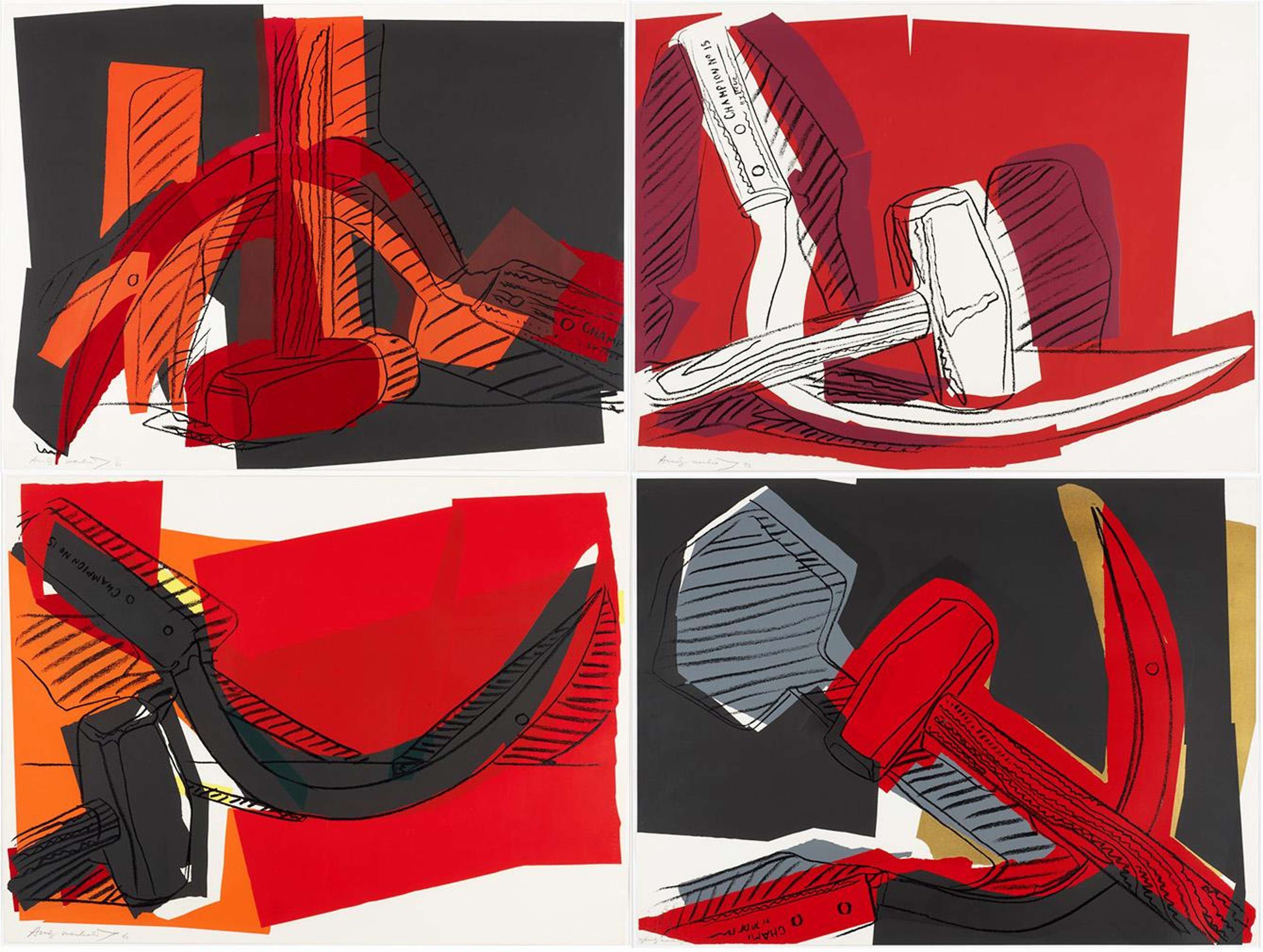
Hammer and Sickle (complete set)
Signed Print
Andy Warhol
76 x 102cm, Edition of 50, Screenprint, 1977
£35,000-£50,000
$70,000-$90,000 Market Value Indicator
$70,000-$90,000 Market Value Indicator
¥320,000-¥450,000 Market Value Indicator
€40,000-€60,000 Market Value Indicator
$370,000-$530,000 Market Value Indicator
¥7,310,000-¥10,440,000 Market Value Indicator
$45,000-$70,000 Market Value Indicator
There aren't enough data points on this work for a comprehensive result. Please speak to a specialist by making an enquiry.
Track auction value trend
Meaning & Analysis
Hammer and Sickle is a complete set of four screenprints made in 1977. Each print depicts a hammer and sickle in close-up, abstracted by tight cropping and overlapping colour planes of red, black, orange, and grey. The objects were photographed directly by Warhol – a real Champion-brand hammer and a real sickle – rather than appropriated from Soviet iconography. Signed and numbered from an edition of 50.
Warhol began the Hammer and Sickle series in 1976 after encountering graffiti of the Soviet emblem on a visit to Rome – a charged image given the Italian Communist Party's prominence at the time. Rather than reproducing the established icon, he purchased a hammer and sickle and had them photographed as studio objects, treating them as still-life subjects in the same way he treated flowers or grapes.
The distinction matters. These are not icons appropriated from propaganda; they are objects – a Champion-brand hammer with its printed label still legible in several prints, a curved sickle blade. By beginning from the physical rather than the symbolic, Warhol both engaged and deflected the political charge. The work is characteristically ambiguous: critique, celebration, provocation, or simply the application of his standard method to a particularly loaded found image.
The four prints vary considerably in their legibility. Some compress the objects into near-abstraction, blade and handle becoming diagonal elements within planes of red and black. Others retain more figuration, the tools recognisable even as colour fragmentation pushes towards graphic intensity. The Champion hammer label grounds the work in every variant – insistently American, insistently commercial – against the Soviet symbolism the composition invokes.