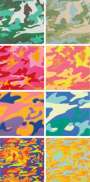
Camouflage (complete set)
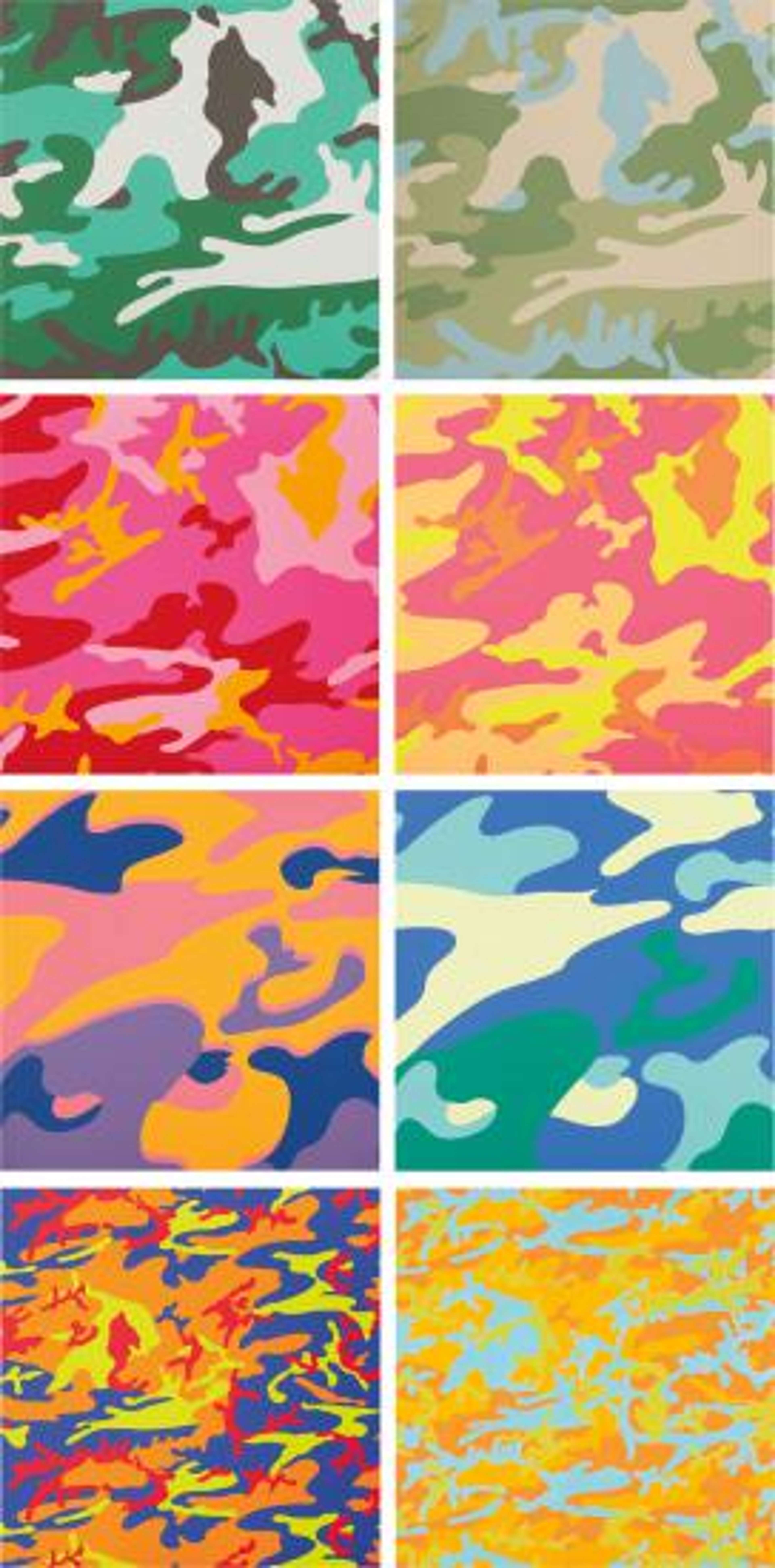
Camouflage (complete set)
Signed Print
Andy Warhol
97 x 97cm, Edition of 80, Screenprint, 1987
£130,000-£200,000
$240,000-$380,000 Market Value Indicator
$240,000-$370,000 Market Value Indicator
¥1,180,000-¥1,820,000 Market Value Indicator
€150,000-€230,000 Market Value Indicator
$1,380,000-$2,120,000 Market Value Indicator
¥27,040,000-¥41,600,000 Market Value Indicator
$180,000-$270,000 Market Value Indicator
There aren't enough data points on this work for a comprehensive result. Please speak to a specialist by making an enquiry.
Track auction value trend
Meaning & Analysis
Camouflage (complete set) is a set of eight screenprints each presenting the standard military camouflage pattern in a different range of colours, from near-realistic khaki and olive tones to candy pink, hot yellow-orange, and vivid royal blue. Made in 1987 in a signed edition of 80 complete sets, the series was produced in the final year of Warhol's life.
The camouflage pattern – a technology of concealment derived from military application – is among the most formally specific motifs Warhol chose in his career. Unlike the commodity objects, celebrity photographs or found press images that populated much of his earlier work, camouflage arrives already pre-designed, anonymous and functional. Its meaning is structural: the pattern exists to disrupt perception and to conceal whatever it covers.
Warhol's intervention is primarily chromatic. Across the eight prints, the same interlocking irregular shapes cycle through combinations that progressively detach the pattern from its military origins: khaki and olive sit close to the original function, while magenta and candy pink, orange and blue, or cyan and yellow move it into a register that reads as decorative – fashion, interior design, pop iconography. By applying serial logic to a pre-existing design language rather than to a photographic image, Warhol raises the same question he had been asking since the early 1960s: what happens to meaning when context is removed? The Camouflage set was produced alongside the Beethoven series and the late Last Supper canvases, in a period marked by a sustained return to questions of image, reproduction and cultural authority. The pattern designed to make things invisible becomes, in Warhol's hands, impossible to miss.