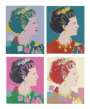
Queen Margrethe of Denmark (F. & S. II.342-345) (complete set)

Queen Margrethe of Denmark (F. & S. II.342-345) (complete set)
Signed Print
Andy Warhol
100 x 80cm, Edition of 40, Screenprint, 1985
£140,000-£210,000
$270,000-$400,000 Market Value Indicator
$260,000-$400,000 Market Value Indicator
¥1,240,000-¥1,860,000 Market Value Indicator
€170,000-€250,000 Market Value Indicator
$1,450,000-$2,180,000 Market Value Indicator
¥29,330,000-¥43,990,000 Market Value Indicator
$190,000-$280,000 Market Value Indicator
There aren't enough data points on this work for a comprehensive result. Please speak to a specialist by making an enquiry.
Track Auction Value Trend
Meaning & Analysis
Andy Warhol's Queen Margrethe Of Denmark (F. & S. II.342–345) from 1985 is a complete set of four signed screenprints from his Reigning Queens series, produced in an edition of 40. Depicting Queen Margrethe II of Denmark in four distinct colourways, the portraits combine vibrant pinks, blues, yellows and reds with bold graphic outlines. Warhol transforms the conventions of formal royal portraiture through his distinctive Pop Art aesthetic, presenting the Danish monarch as a recognisable public icon.
Created in 1985, Andy Warhol's Queen Margrethe Of Denmark (F. & S. II.342–345) comprises four screenprints depicting the Danish monarch, forming part of his wider Reigning Queens series. The portfolio features four female sovereigns who ruled in their own right, including Queen Elizabeth II of the United Kingdom, Queen Beatrix of the Netherlands and Queen Ntombi Twala of Swaziland.
Margrethe II ascended to the Danish throne in 1972, becoming Denmark's first reigning queen since Margrethe I in the 14th century. Warhol depicts the monarch wearing a crown and formal jewellery, retaining the traditional symbols of royal authority while introducing his characteristic use of saturated colour. Across the four prints, her pose and expression remain unchanged, while contrasting colour combinations give each portrait a distinct visual character.
Warhol's repetition of a single image recalls his celebrated portraits of Marilyn Monroe and Elizabeth Taylor, placing royalty within the same visual culture as Hollywood celebrity. Printed on Lenox Museum Board, the standard edition of 40 differs from the diamond-dusted Royal Edition of 30. Together, the four portraits examine how public identity is constructed through repetition, colour and the circulation of recognisable imagery.