

Key Takeaways
How To Find Out What Your Bridget Riley Artwork Is Worth
Valuing a Riley print depends on a series of careful checks. Is the work signed, dated, titled and numbered? Does the edition information correspond with the catalogue raisonné? Is the sheet size correct? Is there clear provenance? Has the work been framed correctly? Are the colours still strong? Is it an early monochrome optical work, a vertical stripe composition, a later colour work, or part of a wider portfolio?
Unlike Banksy, Riley prints do not typically come with a centralised Certificate of Authenticity. Instead, confidence is built through a combination of physical details, edition records, provenance, gallery history, and consistency with known examples.
As Grace Brown, Bridget Riley specialist at MyArtBroker, explains,
That starting point is crucial. Riley’s prints are highly precise objects, and the valuation process has to reflect that precision.
Use our Instant Valuation tool to explore the value of your Bridget Riley print at a glance.
What Information Do You Need For A Bridget Riley Valuation?
A strong Riley valuation begins with images and documentation. The more complete the initial submission, the more accurately a specialist can assess the work.
The ideal valuation submission includes:
- A full image of the front of the work
- A full image of the reverse
- Close-ups of the signature
- Close-ups of the date
- Close-ups of the title
- Close-ups of the edition number
- Images of all four corners
- Images of the full sheet edges
- Details of whether the work is framed or unframed
- Any original invoices, gallery receipts or purchase documentation
- Any known provenance or exhibition history
- Any details of previous conservation, framing or restoration
- Accurate dimensions of the sheet or object
For Grace, the perfect Riley valuation client would ideally provide “the work unframed” so the full sheet can be reviewed front and back, alongside “close ups of signature, dating, edition numbering” and “full provenance for the work.”
Collectors should not unframe a Riley print themselves unless advised by a professional. However, where the work can be safely reviewed outside its frame, the valuation becomes more precise. This is particularly important for older works, where condition issues may sit beneath the mount, at the sheet edges, or on the reverse.
Do Bridget Riley Prints Have Certificates Of Authenticity?
Bridget Riley prints do not usually operate around Certificates of Authenticity in the way Banksy prints do. Instead, authentication and valuation rely on a combination of catalogue records, signature checks, edition details, provenance and physical inspection.
This makes the catalogue raisonné particularly important. For Riley prints, specialists will usually refer to Bridget Riley: The Complete Prints 1962–2020, as well as earlier print publications associated with Karsten Schubert. These catalogues provide a framework for checking title, date, medium, dimensions, edition size and other essential details.
A specialist valuation will compare the submitted work against these records. The questions are practical and exacting: does the edition number make sense? Is the work signed and dated in the expected way? Do the dimensions correspond? Is the medium correct? Is the paper or surface consistent? Does the condition align with the work’s age and known material vulnerabilities?
With Riley, a signature alone is never enough. It supports the valuation, but it needs to sit within a wider chain of evidence.
Get in touch with Grace to discuss the authenticity of your Bridget Riley print.
Signature, Title, Date And Edition Number
Most Bridget Riley prints should be signed, dated, titled and numbered. This is one of the first things a specialist will check.
While placement can vary, Grace notes that Riley’s prints are often signed and dated on the right, with the title and numbering on the left. This should be treated as a general pattern rather than an absolute rule, because formats can differ across periods and print projects. Even so, any unusual placement or missing information should be checked carefully against known examples.
A complete inscription gives the specialist several points of comparison. The signature can be assessed against Riley’s known hand. The date can be checked against the work’s catalogue entry. The title and edition number can be compared with the recorded edition. The sheet size can then be measured against the expected dimensions.
For sellers, these details are more than formalities. They directly affect buyer confidence. A Riley print with clear, consistent inscription details and strong provenance will usually be easier to value and place than one with gaps, uncertainty or incomplete information.
Why Catalogue Raisonnés Matter In Riley Valuations
The catalogue raisonné is one of the most important tools in a Bridget Riley valuation. Riley’s printmaking career spans from the early 1960s to the present, moving through monochrome optical works, Plexiglas experiments, stripe compositions, curves, lozenges, colour studies and later geometric arrangements. Across that range, accurate catalogue information is essential.
The catalogue allows specialists to confirm:
- Title
- Date
- Medium
- Sheet dimensions
- Edition size
- Publisher or printer, where recorded
- Whether the work forms part of a series
- Whether the impression is a standard edition, proof, or related variant
For early works, catalogue comparison is especially important because condition, edition details and market history can vary substantially. Many early Riley prints have already appeared at auction, creating a public trail that can support valuation. Where provenance is incomplete, this combination of catalogue information and auction history can help establish confidence.
For newer works, catalogue publication may not always be as comprehensive or immediately available, so provenance and gallery documentation may carry greater weight.
Provenance And Gallery History
Provenance is important in the Riley market, particularly because there is no central COA system. A print with an original receipt from a known gallery, a documented acquisition history, or a clear auction trail will usually be easier to value than one with no supporting paperwork.
Certain galleries and publishers are especially relevant to Riley’s market and exhibition history. Documentation from established galleries associated with Riley, including Karsten Schubert, carries weight because it helps support the work’s history and authenticity. Original receipts from reputable London galleries can also be useful, particularly for works acquired closer to the point of release.
Grace notes that “provenance from a strong gallery” is important, especially where a seller has “original receipts from galleries.” That paperwork may not automatically increase value in isolation, but it strengthens buyer confidence and can make a work more straightforward to place.
For sellers, the advice is simple: keep everything. Original invoices, letters, emails, gallery labels, framing labels and auction records should all be retained. Even seemingly minor documents can help build a clearer ownership history.
Condition: The Central Factor In Riley Valuations
Condition is one of the most important drivers of Bridget Riley print value. Riley’s work is built on precision: clean lines, controlled colour, optical balance and exact relationships between form and ground. Because of that, condition issues can be particularly disruptive.
A minor defect that might be less visible in a gestural or heavily worked image can become more obvious in a Riley print. Fading, scratches, foxing, paper discolouration or surface abrasion can interrupt the visual system of the work.
The condition issues a specialist will look for include:
- Fading
- Scratches
- Surface abrasions
- Foxing
- Paper discolouration
- Creases
- Handling marks
- Staining
- Mount burn
- Sheet distortion
- Frame-related damage
- Plexiglas discolouration or scratching in early works
Condition expectations should also be proportionate to age. A work from 1965 is not assessed in exactly the same way as a work from 2009. Some signs of age may be expected, but the key question is whether the issue is visible, stabilised, reversible, treatable, or likely to worsen.
As Grace explains, with older works “it’s not that no condition issues can be present,” but the important question is “whether things are reversible, whether they can be treated by a professional conservator to improve them or at least reduce the appearance.”
Fading And Colour Sensitivity
Fading is one of the most significant condition issues in Riley prints. Some of Riley’s works use vulnerable colours, and where prints have not been protected by UV-filtering glazing, those colours may fade over time. Pinks and reds can be particularly susceptible.
This matters because fading is usually irreversible. A print with faded colours may still be saleable, but it will not be valued in the same way as a strong, well-preserved impression.
For a Riley print, colour is not decorative. It is structural. Riley’s use of colour is part of the optical system of the work, controlling rhythm, perception, movement and depth. If colours have faded, the balance of the composition can be affected.
This is why framing history is so important. A work that has been kept behind museum-grade UV-filtering glass, away from direct sunlight, will usually be more desirable than one that has been exposed to bright conditions for years.
Early Black And White Works
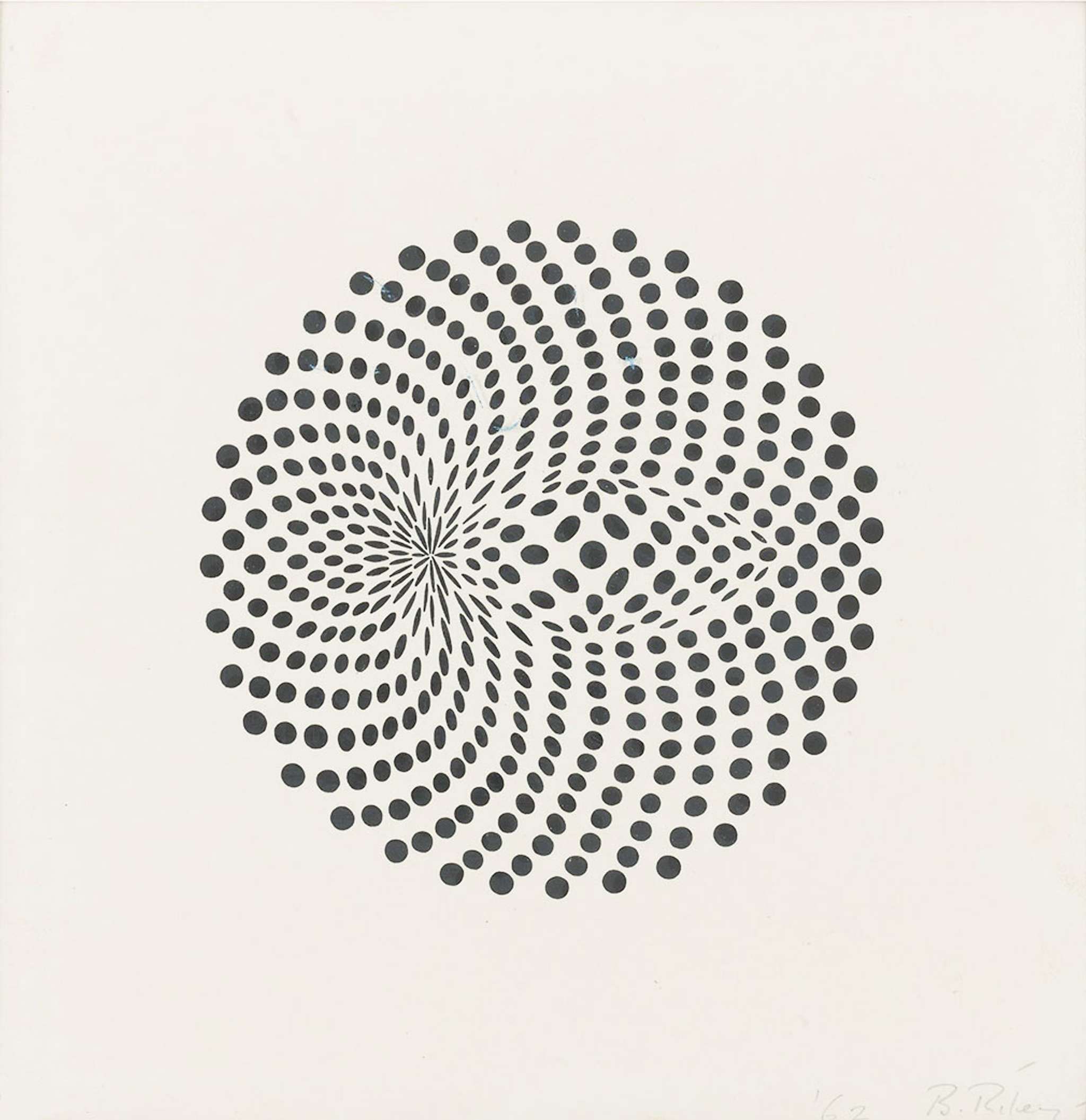
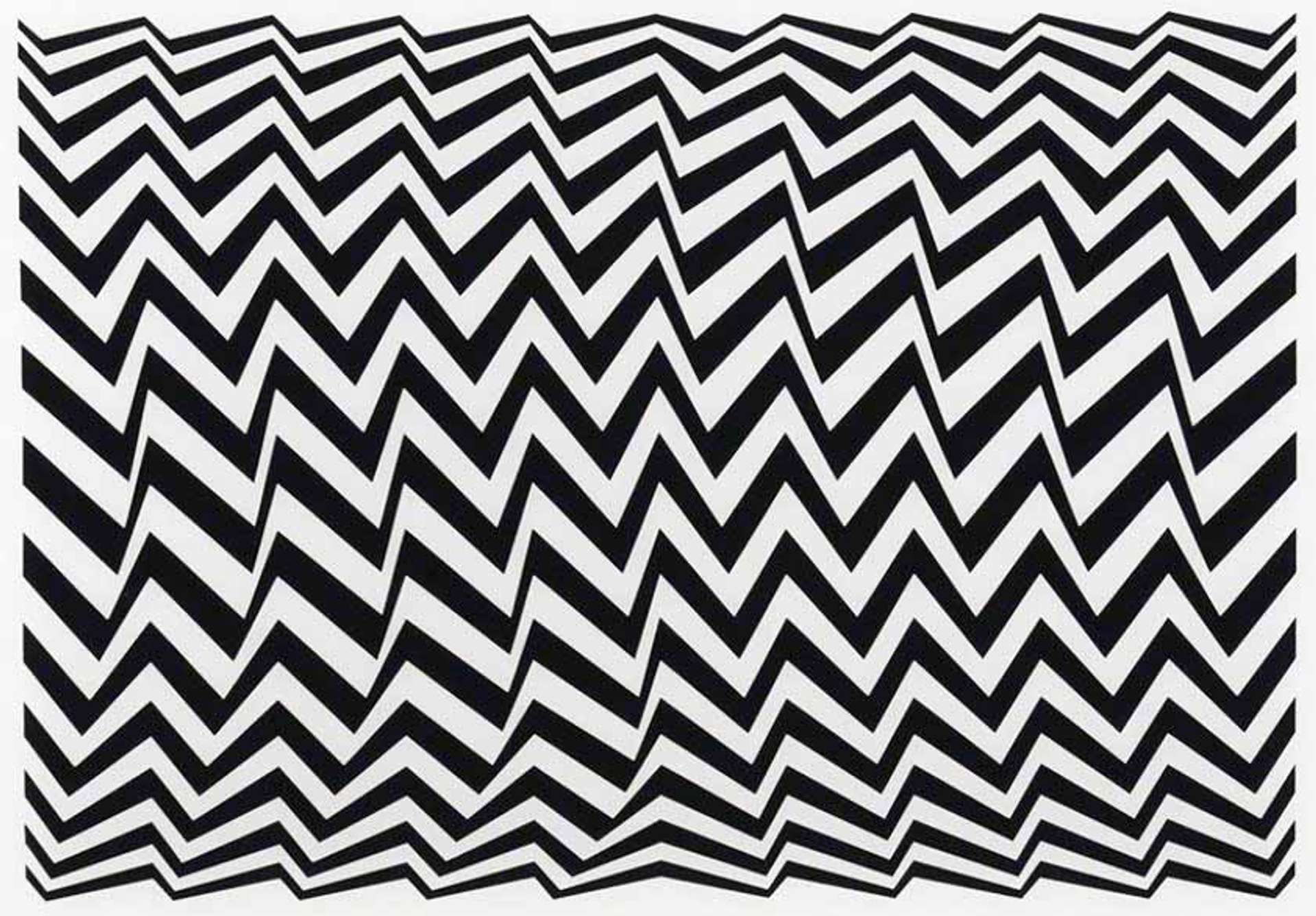
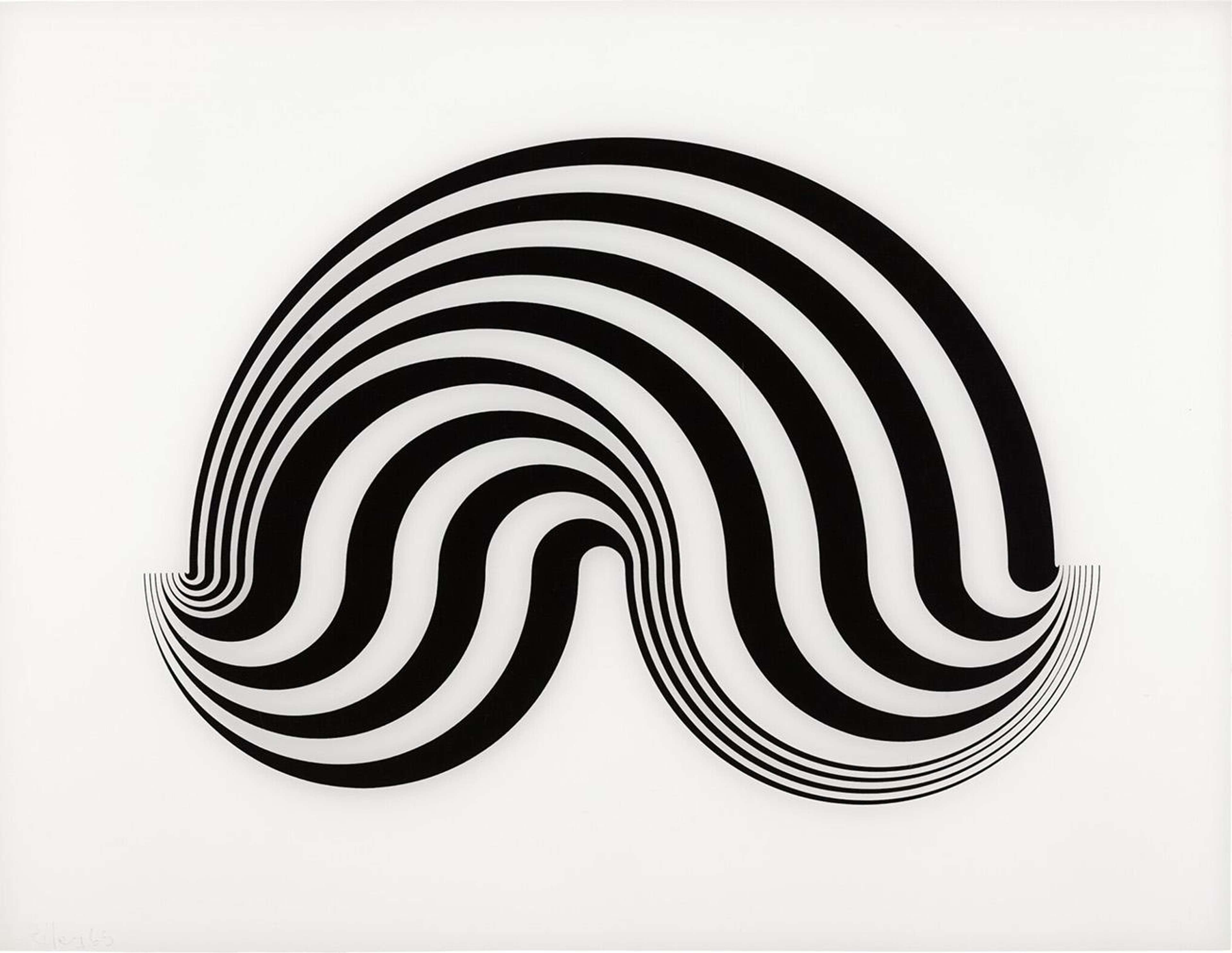
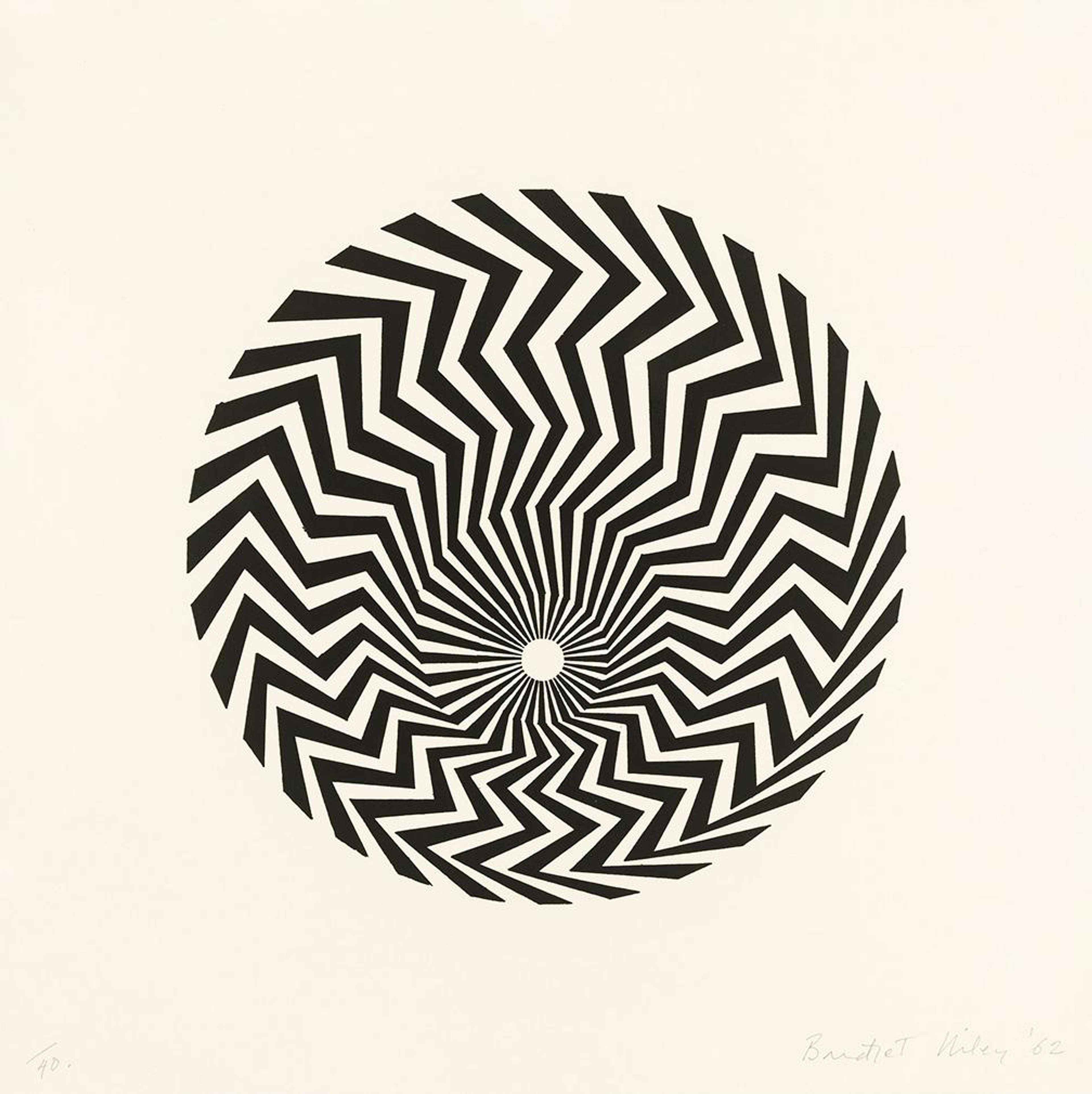
Riley’s early black-and-white works, like Untitled (Based on Primitive Blaze), hold a particularly important place in her market. These works connect directly to the Op Art language with which she first became internationally recognised: vibrating forms, optical movement, visual instability and monochrome intensity.
Collectors often value these works because they sit close to the foundation of Riley’s practice. They are historically important, instantly recognisable and strongly associated with her early contribution to abstraction.
However, early works are also more condition-sensitive. Age alone introduces risk, and some early materials require careful assessment. A pristine early Riley work can command strong interest, but visible defects may have a meaningful effect on value.
Grace describes these early optical works as “quite coveted in her output,” particularly because they are so closely tied to Riley’s early visual language. However, she also notes that they have “a much more particular client base” and are often more prone to condition issues.
That is an important distinction. Early monochrome works are significant, but they do not automatically outperform every later colour work. Their value depends on the specific image, rarity, condition and current buyer demand.
The Fragments Series
Riley’s Fragments series is one of the most important and distinctive areas of her print market. Created in 1965, the series marked a key moment in her early printmaking practice. The works were printed on Plexiglas, a material that gives them a particular visual quality but also introduces condition risks.
The Fragments works are valued for their historical importance and their close relationship to Riley’s early optical investigations. They are monochrome, experimental and immediately connected to the language that established her reputation.
However, Plexiglas is vulnerable. It can scratch, discolour or develop surface issues. Because these works are objects as much as prints, condition assessment differs from standard paper-based screenprints. A specialist will look closely at the surface, edges, reverse, inscriptions and any signs of abrasion or deterioration.
Grace notes that Fragments can command a higher price because they are early, black and white, and “iconic” within Riley’s work. But she is clear that condition is crucial: “They would have to be in good condition.”
For sellers of Fragments, professional review is essential. Small scratches, clouding or discolouration may affect value, particularly because the optical clarity of the surface is central to the experience of the work.
Vertical Stripes And Colour Works
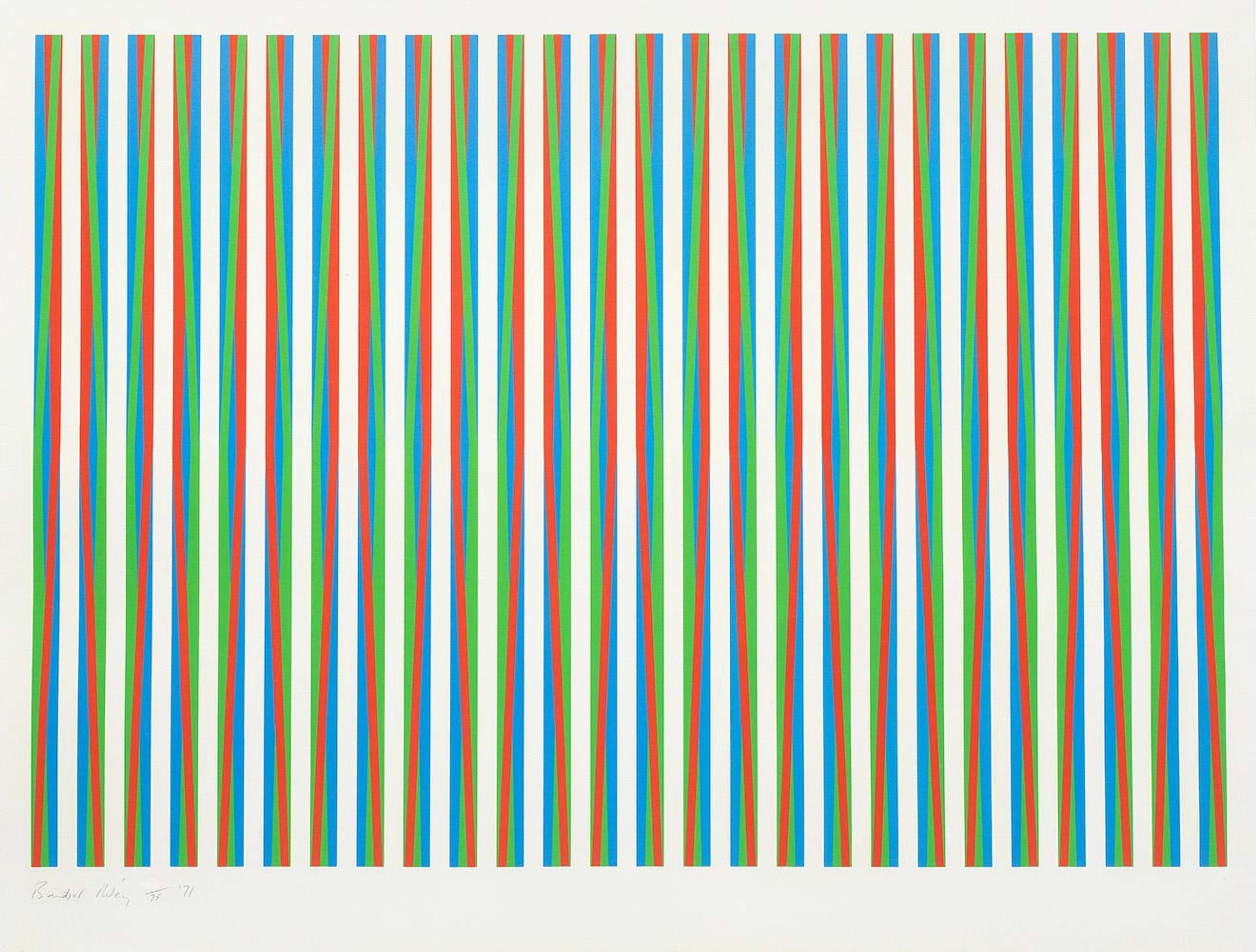
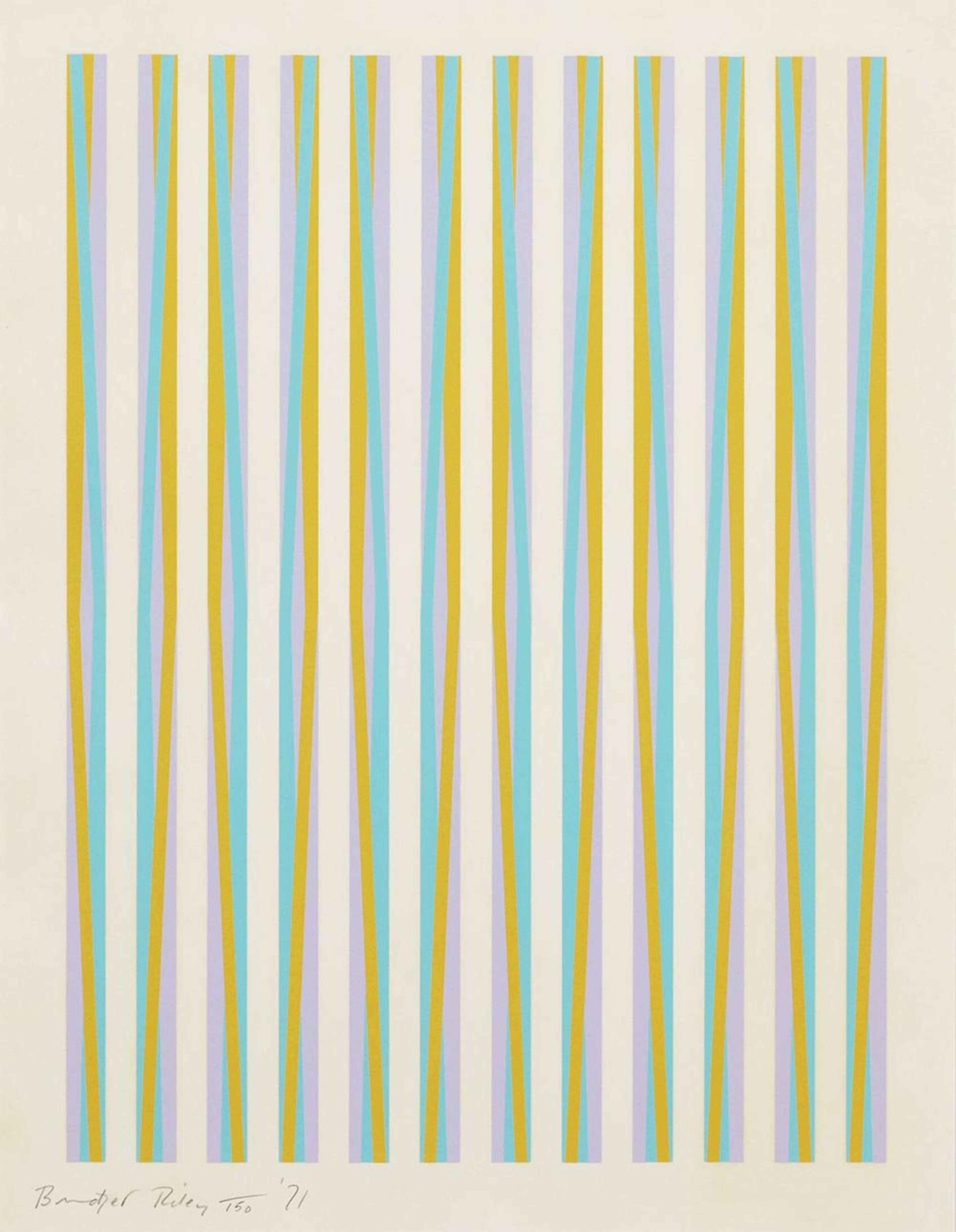
Riley’s vertical stripe works form another important area of the market. These compositions connect strongly to her mature painting practice and institutional presence, particularly where the arrangement of stripes, rhythm and colour recalls larger-scale canvases.
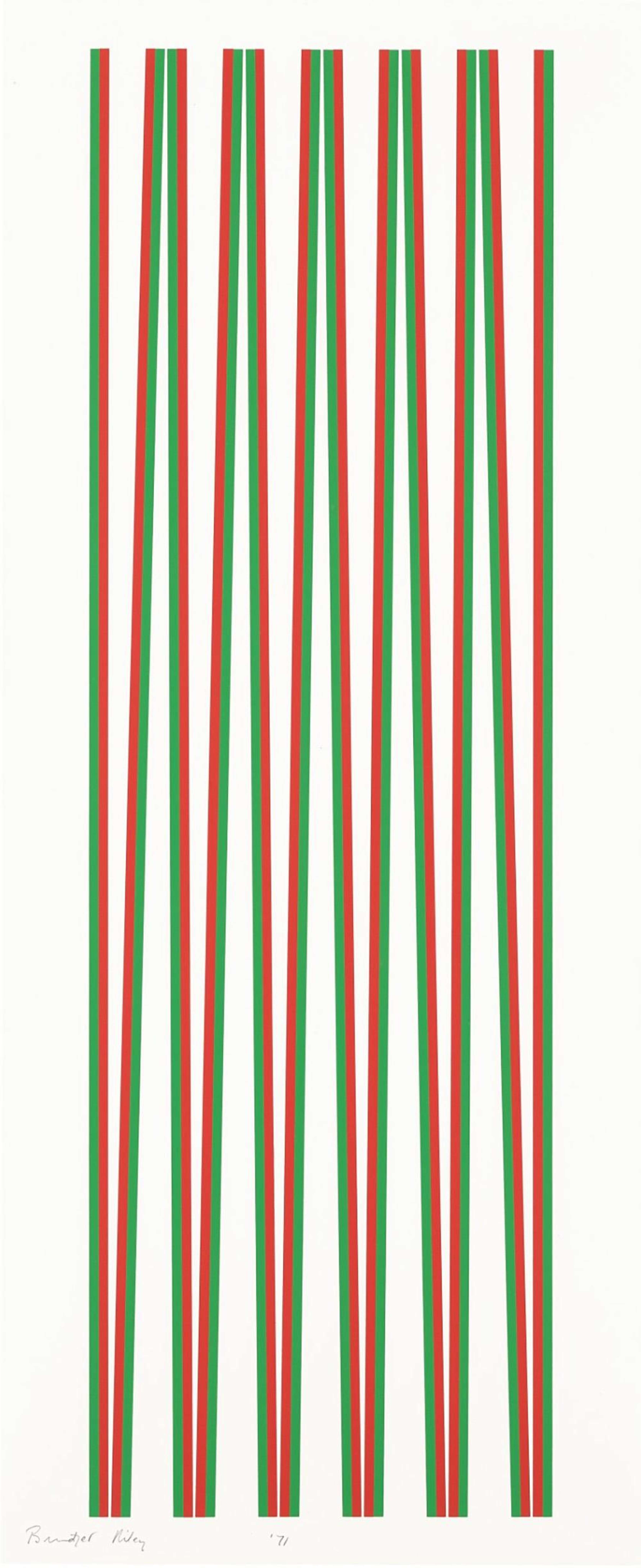
Collectors respond to these works because they are recognisably Riley: disciplined, optical, architectural and immediately connected to her long investigation into perception. Works such as RA (Inverted) and related stripe compositions can be especially desirable where the image is crisp, the colour remains strong, and the work is in excellent condition.
Grace notes that “the vertical stripes” are “quite iconic of her practice,” especially because they are reminiscent of large-scale canvases held in institutional contexts.
Size can matter, but it is not the only factor. Larger works often attract attention because they carry more wall presence, but a smaller early work may still command a premium because of its historical importance. In Riley’s market, scale, period and image type need to be considered together.
Later Colour Works And Portfolio Prints
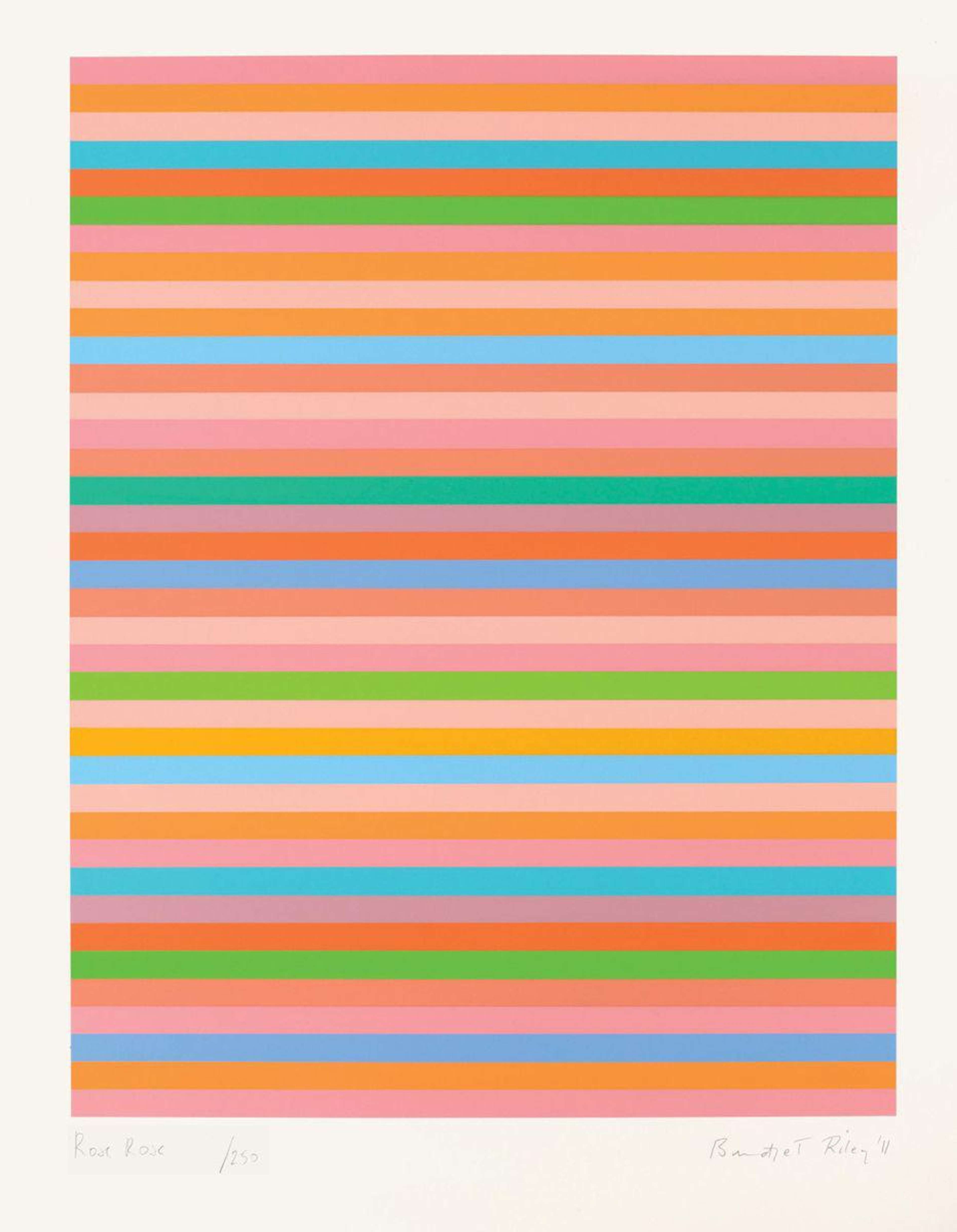
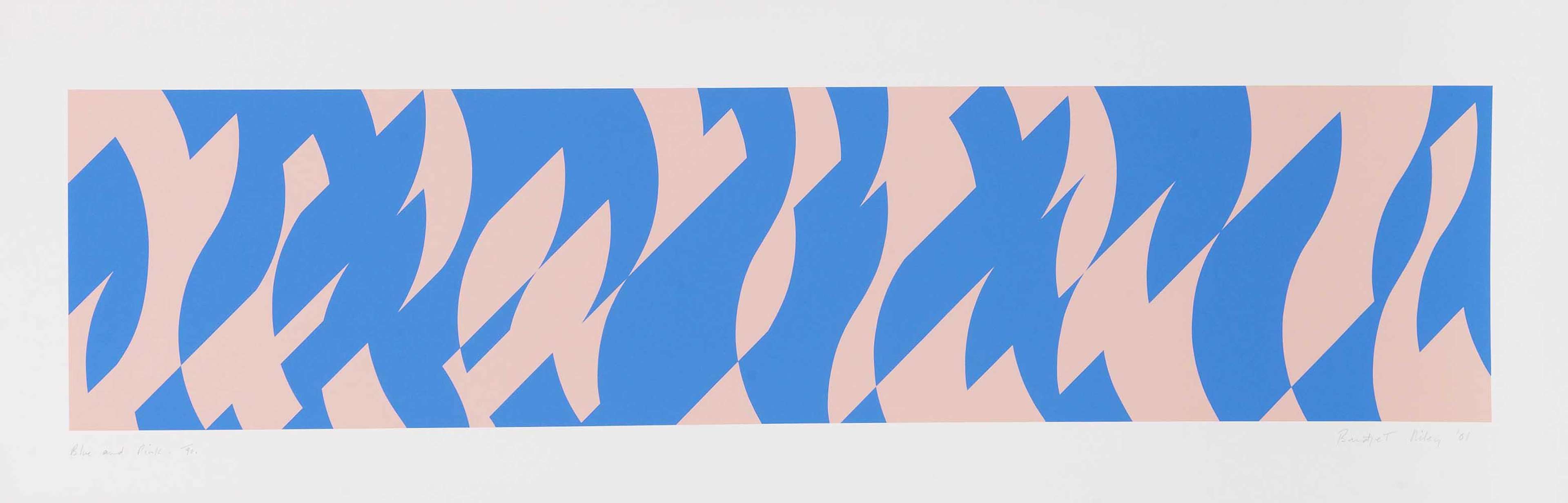
Riley’s later colour works can offer a different kind of value. They are often more accessible than the rare early monochrome works, and in many cases they carry lower condition risk because they are newer, better preserved, and more likely to have been stored carefully.
Some later works have come from wider portfolios, including charity or institutional print projects. These works are often sold separately from the original portfolio context and may represent a more accessible entry point into Riley’s print market.
Condition can be strong in this part of the market, particularly where works have remained in their original boxes or have had limited exposure. However, lower condition risk does not necessarily translate into higher prices. Value still depends on the image, edition size, demand, and how closely the work aligns with Riley’s most recognisable visual systems.
For sellers, later Riley prints should not be dismissed as secondary to the early market. They can be highly liquid where the composition is strong, the colours are desirable, and the price is aligned with current buyer demand.
Edition Size And Scarcity
Edition size affects Riley value, but not in isolation.
Riley’s edition sizes vary considerably, often ranging from around 75 to 125, 250 or more depending on the project. Smaller editions can carry a scarcity premium, but the work still needs to have strong visual appeal, clear condition and active demand.
A low edition size does not automatically make a print more valuable than a larger edition of a more recognisable image. Likewise, a larger edition can still perform well if it is visually strong and consistently sought after.
With Riley, edition size is one element of a broader valuation matrix. A specialist will consider:
- How large the edition is
- How often the work appears at auction
- Whether there are Artist’s Proofs
- Whether complete sets exist
- Whether the image is strongly associated with Riley’s practice
- Whether demand is broad or niche
- Whether condition issues are common for that work
Scarcity becomes most powerful when it combines with historical significance and desirability.
Artist’s Proofs And Proof Prints
Riley does produce Artist’s Proofs, but in her market they do not necessarily command the same premium as unique trial proofs in the Warhol market or hand-finished variants in the Banksy market.
For standard Artist’s Proofs, the premium can be limited. Some collectors like the AP designation, but if the proof is visually identical to the main edition and produced in a relatively normal proof run, it may not substantially alter value.
The exception would be a proof that is materially different: an unusual colourway, a rare variant, or a work that functions almost as a separate object. In those cases, the proof status may matter because the work is not simply another impression from the same edition.
Grace’s view is pragmatic: “If you have a really rare proof that’s a different colourway, it’s almost a different work.” By contrast, a standard Artist’s Proof is often “just the same work.”
This distinction is important for sellers. AP status should be noted, but it should not be overvalued without evidence that buyers are prepared to pay a premium for that specific proof type.
Studies, Gouaches And Works On Paper
Riley’s studies, gouaches and works on paper sit adjacent to the print market but should be valued differently. These works may relate to paintings, compositions or visual systems rather than functioning as editioned prints.
They can command much higher prices than prints because they are unique works, but they require a different valuation process. Medium, date, relationship to a painting, inscriptions, annotations, provenance and exhibition history all become even more important.
Annotated studies can be especially compelling because they reveal Riley’s process: measurement, structure, colour decisions and compositional development. However, these should not be treated as prints unless they are clearly editioned works.
Complete Sets
Complete sets can be valuable in the Riley market, but they must be handled carefully. A complete set may appeal to collectors because it preserves the full visual sequence or conceptual structure of a series. However, set value depends on demand, condition consistency and whether buyers currently want the works together.
The Fragments series is one area where the idea of a complete set is especially relevant, though full sets are rare and condition can be complex. Other series may also benefit from being kept together where the works were conceived as a coherent group.
A complete set is not always simply worth the sum of its parts plus a premium. In some cases, individual works may be easier to place separately. In others, the set itself becomes the strongest selling point.
A specialist valuation will consider both routes: the likely value of the complete set and the potential value of individual works if separated.
Own a complete set of Bridget Riley prints? Request a valuation for your set.
Auction Results And Private Sales Data
Auction results are particularly useful in Riley’s market because many of her prints have appeared publicly over time. This gives specialists a strong base of comparable results, especially for older and regularly traded works.
However, auction data still needs interpretation. A single high result does not automatically reset the market, and a lower result may reflect condition, timing, estimate strategy or limited competition on the day.
Grace notes that auction results are important because buyers use them as a benchmark. Even where private market prices can be stronger, they still need to be grounded in public performance. If comparable works are hammering around the middle of their estimates, it becomes harder to justify a private valuation far above that level without a clear reason.
Private sales data adds another layer. If MyArtBroker has active buyers looking for a particular Riley work, a specialist may be able to price more confidently, especially for good examples in strong condition. Demand within the network matters because it shows where buyers are prepared to act now, not just where they acted at a previous auction.
Why A Specialist Valuation May Differ From An Auction Estimate
An auction estimate and a specialist valuation are not the same thing.
Auction estimates are designed to attract bidding within a public sale environment. They may be conservative, strategic, or shaped by the auction house’s need to generate competition. They also carry the risk of public failure if the work does not sell.
A specialist valuation is designed to reflect what a seller may realistically achieve, based on the specific work, its condition, provenance, current demand and comparable market data.
Market Timing In Bridget Riley’s Print Market
Riley’s print market is steadier than many other blue chip print markets. It is not typically defined by dramatic short-term spikes, social media attention, or speculative buying waves. Instead, it tends to move through long-term collector demand, institutional recognition and gradual price development.
This makes Riley a more consistent market, but also one where accurate pricing matters. Overpricing can make a work sit unsold, particularly if public auction results do not support the ask. Underpricing can leave value behind, especially where the work is rare, in excellent condition, or wanted by active collectors.
Institutional exhibitions can support wider awareness, but they do not always translate directly into secondary market spikes. Riley’s exhibition practice often includes large-scale paintings, wall works and installations, which may not correspond directly to the prints appearing on the secondary market.
The result is a market shaped less by event-driven speculation and more by long-term collector confidence.
What Makes A Bridget Riley Print More Valuable?
The strongest Bridget Riley valuations usually involve a combination of:
- Strong condition
- No fading
- Clear signature, date, title and numbering
- Correct dimensions
- Strong provenance
- Original gallery receipt or proof of purchase
- Catalogue raisonné confirmation
- Early date
- Recognisable optical language
- Black-and-white early works in good condition
- Vertical stripe compositions
- Strong colour combinations
- Manageable edition size
- Complete sets, where relevant
- Active private demand
- Consistent auction comparables
No single factor determines value on its own. A smaller edition may not outperform a stronger image from a larger edition. An early monochrome work may be historically important but vulnerable to condition issues. A later colour work may be less rare but easier to sell if the condition is excellent and the composition is desirable.
The final specialist valuation comes from balancing these factors together.
Request a valuation for your Bridget Riley print from a member of our team today.
What Can Reduce The Value Of A Bridget Riley Print?
Factors that can reduce value include:
- Fading
- Scratches
- Plexiglas discolouration
- Foxing
- Staining
- Paper deterioration
- Creasing
- Poor framing
- Incomplete provenance
- Missing or unclear inscription details
- Incorrect dimensions
- Weak demand for the specific image
- Overpricing against recent auction comparables
Fading is particularly important because it is generally irreversible. For colour works, this can materially affect value. For early Plexiglas works, scratches and discolouration can also be significant because the surface itself is part of the work’s optical effect.
How To Prepare Your Bridget Riley Print For Valuation
Before requesting a valuation, sellers should gather:
- Front and back images
- Close-ups of signature, date, title and edition number
- Images of all corners
- Sheet dimensions
- Details of framing
- Any gallery receipts or invoices
- Any auction history
- Any conservation or condition reports
- Any original portfolio box or accompanying documents
Do not clean, restore or unframe the work without specialist advice. If there are condition concerns, a professional conservator can assess whether treatment is possible and whether it is likely to improve value.
Riley Print Value Depends On Precision
Bridget Riley’s market rewards precision. Her prints are valued not only as beautiful optical compositions, but as disciplined extensions of one of the most important abstract practices of the post-war period.
A strong valuation depends on the details: signature, date, title, edition number, catalogue match, condition, colour strength, provenance and market demand. Early works, especially monochrome optical pieces and Fragments, can be highly desirable, but condition is critical. Later colour works can offer strong liquidity where the image is recognisable, the colours remain fresh and the price is aligned with the market.
For sellers, the most important step is to seek a specialist valuation before relying on a single auction result or broad online estimate. Riley’s market is stable, but it is not generic. Each work needs to be assessed on its own terms: its place in her practice, its physical state, its documentation, and the buyers currently looking for it.