Cage Grid I (complete set)
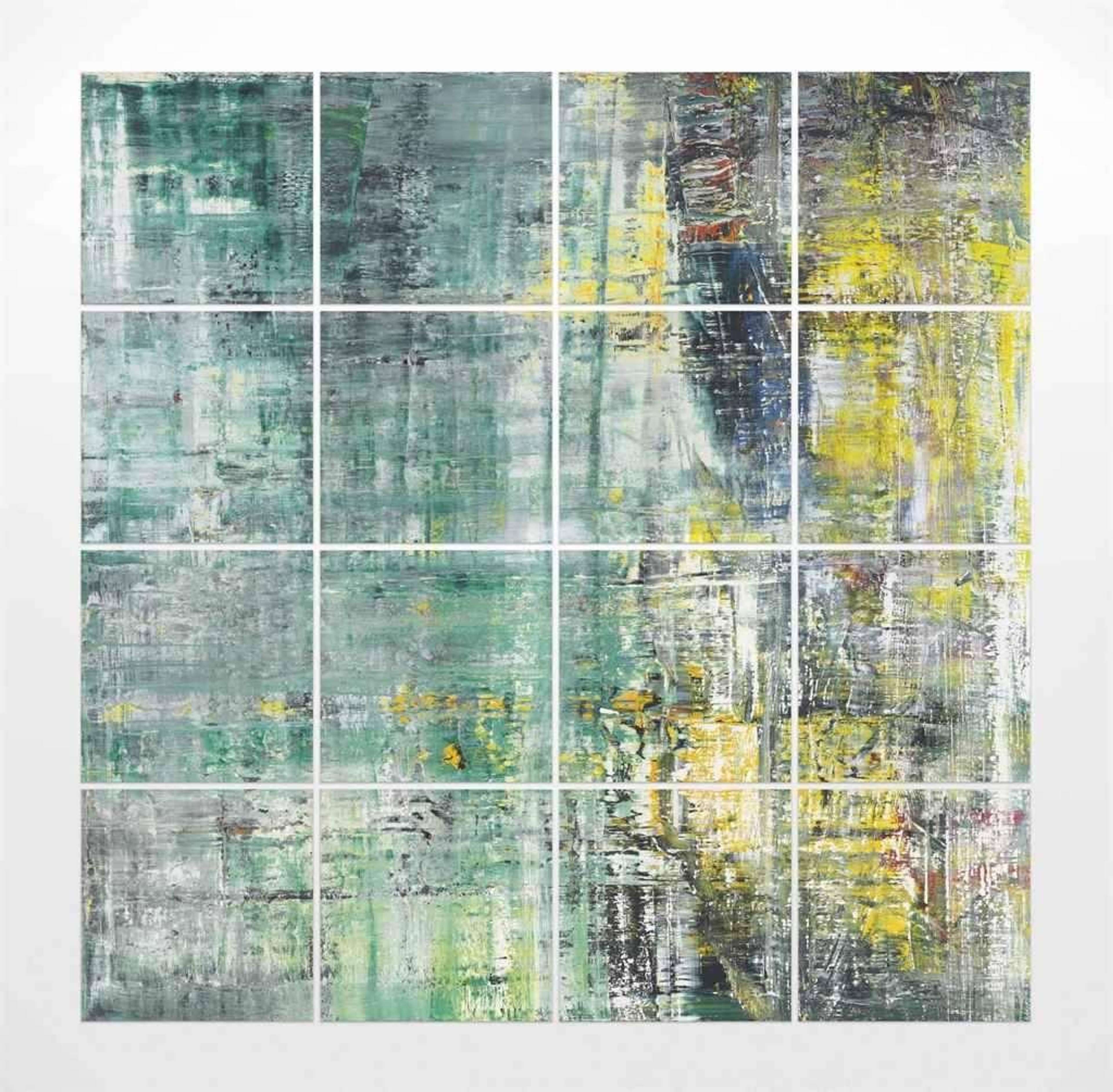
Cage Grid I (complete set)
Signed Print
Gerhard Richter
75 x 75cm, Edition of 16, Giclée print, 2011
£420,000-£630,000
$790,000-$1,190,000 Market Value Indicator
$790,000-$1,180,000 Market Value Indicator
¥3,800,000-¥5,710,000 Market Value Indicator
€490,000-€740,000 Market Value Indicator
$4,450,000-$6,670,000 Market Value Indicator
¥87,520,000-¥131,280,000 Market Value Indicator
$570,000-$850,000 Market Value Indicator
There aren't enough data points on this work for a comprehensive result. Please speak to a specialist by making an enquiry.
Track auction value trend
Meaning & Analysis
Cage Grid I (complete set) comprises sixteen giclée prints arranged in a 4×4 configuration, each panel reproducing a component of Richter's abstract squeegee paintings from the Cage series. Produced in 2011 in a signed edition of 16 complete sets, the work reads as a unified composition when hung together, shifting chromatically from cool greens at the left through to warmer yellows and grey-black tones at the right.
The Cage Grid series extends the visual language of Richter's Cage paintings (2006) into the print medium. Those six large canvases were produced in sustained response to John Cage's philosophical positions on chance, silence and the rejection of compositional intention, and represent one of the deepest single-artist intellectual engagements of Richter's late career. The squeegee method produces marks generated by a consistent physical procedure that are, nonetheless, not intentionally designed in any conventional sense.
Across the sixteen panels of the complete set, the grid functions as both structure and composition. The individual cells are each self-contained abstract works, but their arrangement within the 4×4 field establishes a larger chromatic arc: the greens of the left-hand columns – teal, sage, mint, lighter olive-grey – give way progressively to yellows and warm grey-blacks in the right-hand columns, with white cutting through the surface as a recurring bright note. The shift reads almost like a weather system moving across a field of vision, though no representation is intended. The complete set was produced in an edition of 16 – one set for each of the panels within it – making it among the most limited of Richter's multi-part print editions.