Pyramids
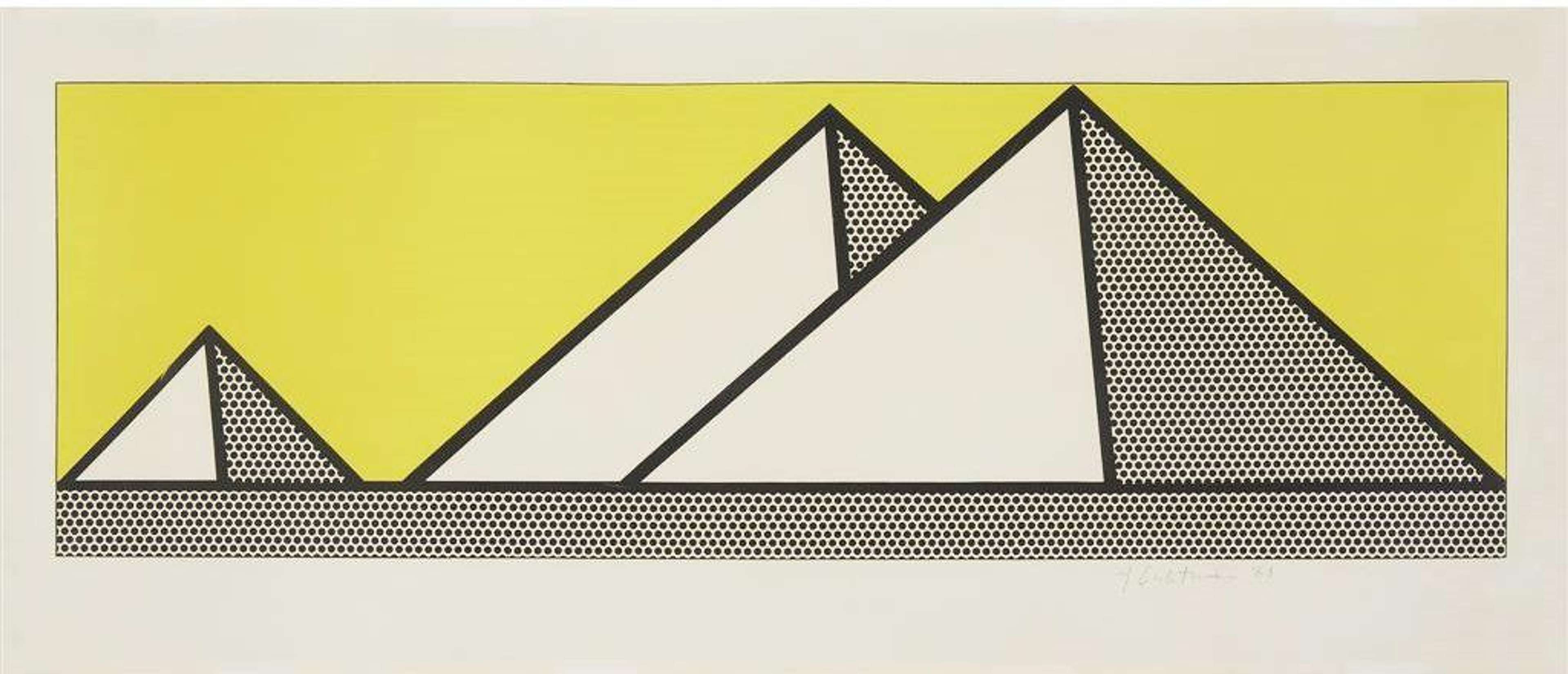
Pyramids
Signed Print
Roy Lichtenstein
29 x 89cm, Edition of 101, Lithograph, 1969
£11,500-£17,000
$22,000-$30,000 Market Value Indicator
$22,000-$30,000 Market Value Indicator
¥100,000-¥150,000 Market Value Indicator
€13,500-€20,000 Market Value Indicator
$120,000-$180,000 Market Value Indicator
¥2,420,000-¥3,570,000 Market Value Indicator
$15,000-$23,000 Market Value Indicator
There aren't enough data points on this work for a comprehensive result. Please speak to a specialist by making an enquiry.
Track auction value trend
Meaning & Analysis
Roy Lichtenstein’s Pyramids of 1969 was commissioned by the Print Collector’s Fund of the Friends of Art, associated with the Nelson-Atkins Museum of Art in Kansas City. As opposed to Pyramid, a sculptural piece created one year prior, Pyramids is a two-dimensional colour lithograph.
The print is minimalist in its execution, showing three basic triangles set in a flattened desertscape. Lichtenstein uses an unmodulated yellow, black, and white colour palette to create his shapes and delineated Ben Day dots to invoke volume and dimension.
The artist’s representational manner in Pyramids is comparable to his Cathedrals and Haystacks. The work has the same visual quality and eligibility as its source material, yet it is a highly mechanised structure; a true expression of the 20th century. However, Pyramids is more than just an exercise in abstraction and geometry. It is a clever graphic rendition of a historical and architectural landscape.
Lichtenstein’s print relies on the symbolic and cultural potency surrounding the original Egyptian Pyramids. The artist is especially indulged by the supernatural connotations of the masonry structure. Finally, it must be noted that Pyramids represents a dramatic progression within Lichtenstein’s style. It acts as the artist’s first official move towards a more indirect and philosophical approach to artistic form.