
Published on 8 October, the survey draws on responses from 3,100 active high-net-worth collectors across the markets. Participants had net wealth of more than $1 million and had spent more than $10,000 on fine and decorative art in each of 2024 and 2025, and more than $5,000 in the first half of 2026.
Below are five findings that matter for anyone who owns, inherits, buys or plans to sell prints and editions. Alongside the survey, MyArtBroker’s auction data and discussions during Frieze Week offer further context on what these findings mean for collectors.
The UK and US are highly inherited art markets
Across the survey, 72% of high-net-worth collectors had received art through a will, bequest or gift. That proportion rose to 92% among UK respondents – the highest of the ten markets – and 86% in the US (p.77). Among those who still held inherited works, they represented an average of 32% of their collection’s value (p.82).
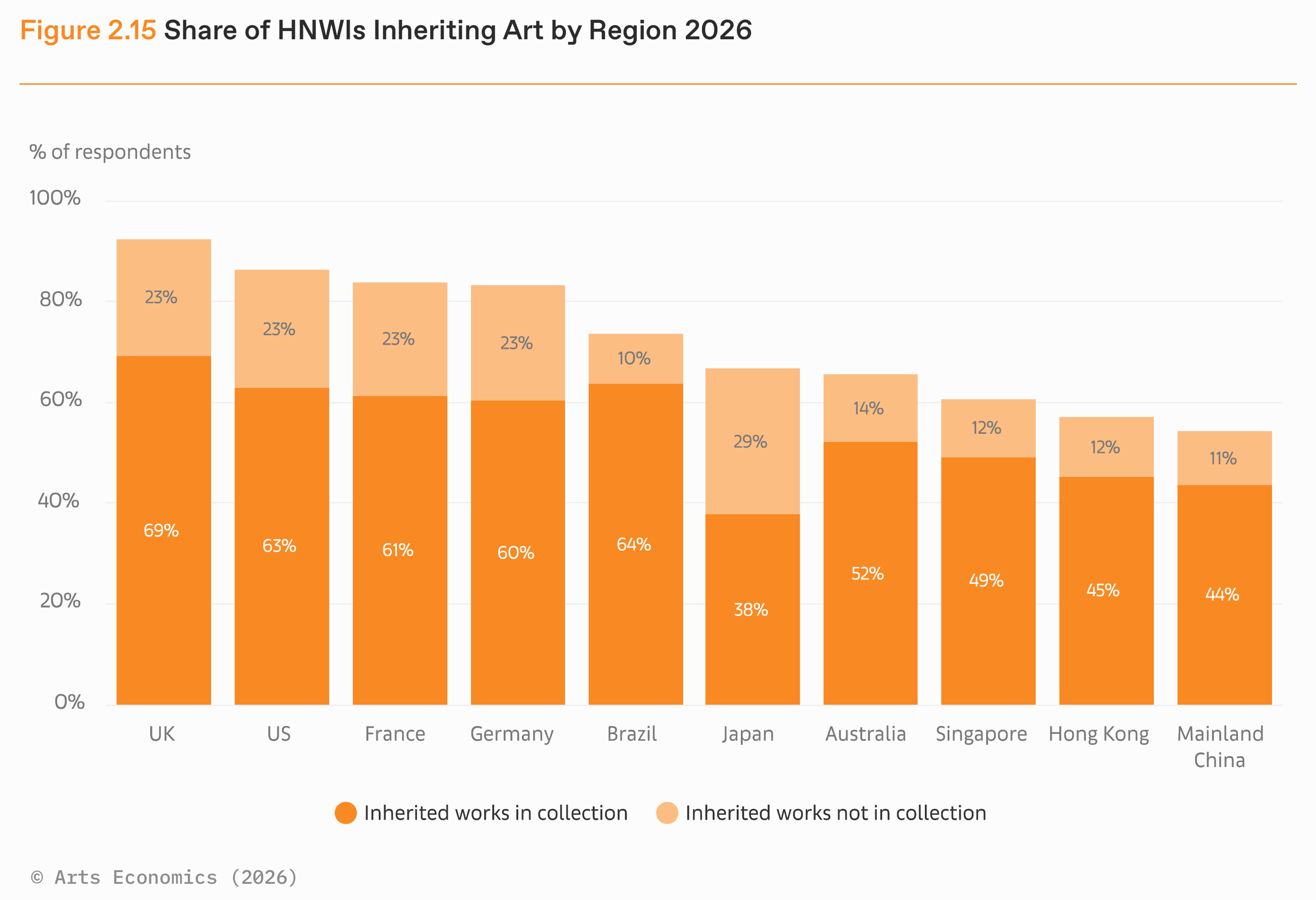
Much of this art has therefore changed owners without passing through the market. The recipient did not choose the work or negotiate its price and may have inherited little current information about its value. That gap becomes more important when markets move. For example, in MyArtBroker’s auction data for the 12 months to 8 October 2026, the median hammer price for David Hockney’s The Arrival of Spring prints reached £220,000 across 58 sales, 61% higher than in the preceding period.
For heirs, the first step is to establish exactly what they own. The title, edition, signature, condition and provenance determine where a print sits within an artist’s market; the artist’s name alone does not. Comparing those details with recent sales of the same edition creates a more credible basis for deciding whether to retain, insure, gift or sell the work.
The Great Wealth Transfer does not necessarily mean a rush to sell
Of those who had inherited art, 75% retained at least some of it (p.77). Almost 90% of Gen Z heirs still held their inherited works, compared with 64% of Gen X heirs. Wealth also influenced the decision: only 11% of heirs worth more than $50 million had kept none of their inherited art, compared with around one-third of heirs worth less than $5 million (pp.79–81).
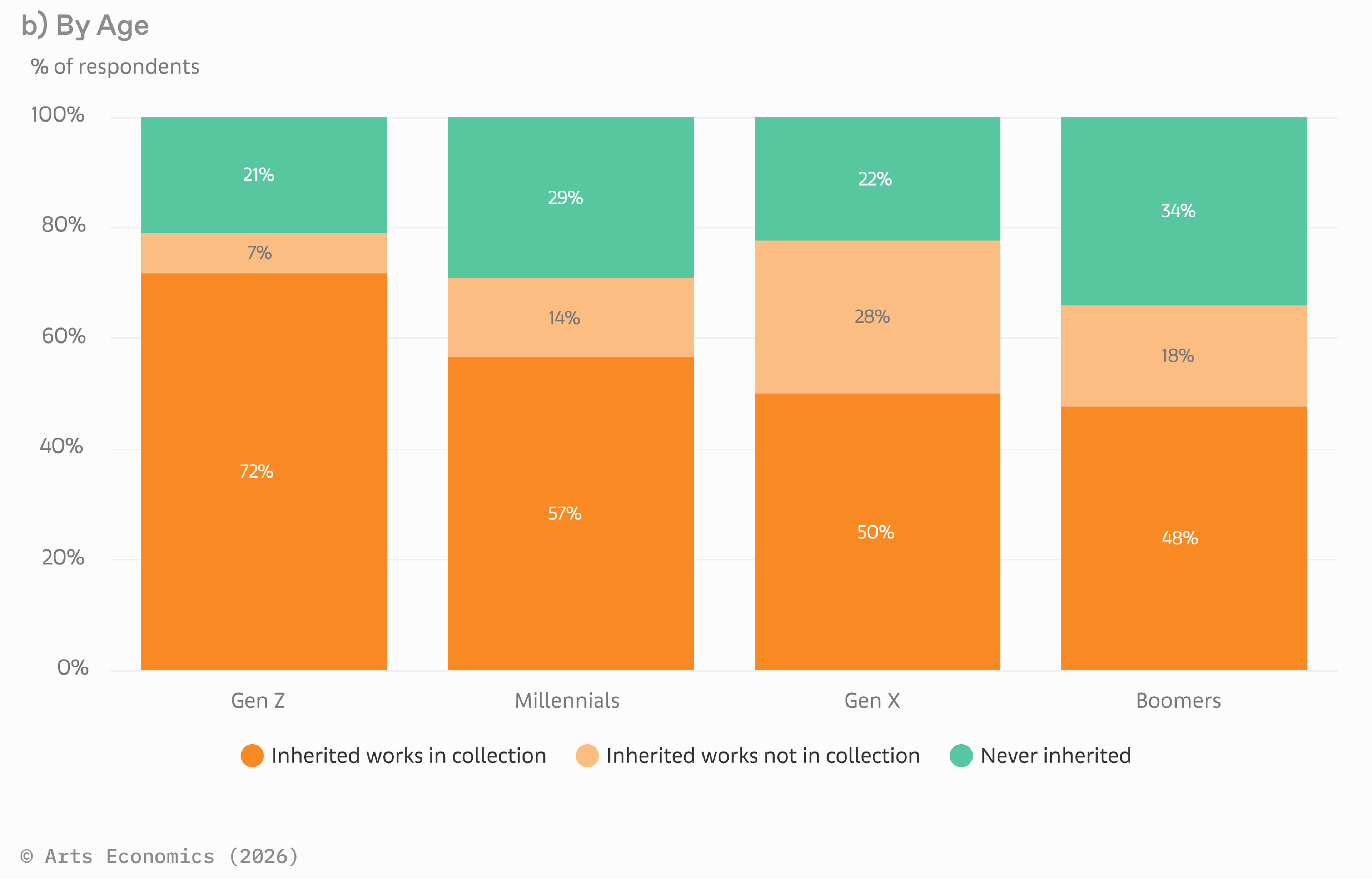
These figures challenge the assumption that inherited collections will quickly return to the market. Much of this art may remain within families. The greater tendency to sell among less wealthy heirs also suggests that the decision is shaped by what an owner can afford to keep, not only by personal taste. The report identifies tax bills associated with an estate as one reason inherited works may need to be sold.
At a next-generation collecting discussion at Niru Ratnam during Frieze Week, panellists challenged a related assumption arguing that the transfer of wealth will automatically produce a wave of new art spending. Assets may pass first to surviving spouses, while retirement, tax and other financial commitments affect how much eventually reaches younger beneficiaries. An inheritance is not necessarily a collecting budget.
Even when the art is kept, its new owner still needs to understand what they have inherited and how it should be protected. If a future sale may be necessary, seeking advice before a tax or financial deadline provides more time to establish value and decide whether auction or private sale is the better route.
UK and US collectors are preparing to sell – but not necessarily to leave the market
Across the ten markets, 23% of respondents planned to sell art during the next 12 months, while 39% intended to buy. Selling intent was highest in the UK at 32%, followed by the US at 30% and Australia at 29%. Mainland China presented the sharpest contrast, with only 15% planning to sell and 53% intending to buy (p.20).
The UK and US figures do not necessarily suggest that collectors are leaving the market. Buyers still outnumber sellers, and the UK, US and Australia also had the highest proportions of respondents planning to do both. This points to active collection management, proof that owners are selling works that no longer fit their collection, releasing funds or making room for new acquisitions. The report also allows for a more cautious reading, with some collectors choosing to realise value while market conditions remain uncertain.
More sellers nevertheless mean more choice for buyers, making the positioning of a work increasingly important. Recent sales of the same edition provide useful evidence, but they are only one part of an estimate. Condition, rarity, provenance, timing, venue and the depth of demand can all affect how a work is priced and where it is best offered.
Sellers should understand how an estimate has been reached, what reserve or pricing strategy is proposed and what they are likely to receive after commission and other charges before choosing between auction and private sale.
Prints are not a secondary collecting category
Some 54% of respondents owned at least one print or multiple – the same proportion as photography and digital art. Prints represented 10% of the works held across the survey, rising to 12% in both the UK and mainland China. Among respondents who bought fine art during 2025 or the first half of 2026, 47% bought a print, an increase on the previous year (pp.93 and 137).
Speaking at Niru Ratnam, Georgina Adam highlighted prints and multiples as an option for collectors unable or unwilling to commit the sums required for a major painting. It's an important distinction because choosing a print can reflect how much someone wants to spend, rather than simply how much they can afford.
This demand sits within a wider move towards familiarity. Only 45% of respondents bought work by an artist they had discovered for the first time, the lowest level in five years and down from 66% in the previous survey. Established artists accounted for 46% of works in the collections sampled in 2026, compared with 25% in the 2024 sample (pp.97 and 140).
Prints by established artists bring these preferences together through recognised names, a broad range of price points and comparable auction histories. Editions make repeat-sales analysis possible, although condition, signature, provenance and edition type can produce substantial differences between impressions. As collectors become more selective, understanding those differences becomes increasingly important.
The art market’s headlines are written at seven figures. Most collecting is not
Some 77% of respondents spent less than $50,000 in total on fine art during the first half of 2026, while 84% spent under $100,000. The proportion buying at least one work priced below $10,000 rose from 48% in 2025 to 59% in the first half of 2026 (pp.88–90).
MyArtBroker’s print-auction data shows a similar concentration below the prices that dominate market coverage. During the 12 months to 8 October 2026, 94% of priced print lots sold for £50,000 or less at hammer and 72% sold below £10,000. The median hammer price was £4,000, 7% higher than in the preceding period. At the other end of the market, lots exceeding £50,000 represented just 6% of sales but 64% of total hammer value.
What this shows is a market with two very different centres of gravity, one where most transactions take place at accessible price levels, and another where a small number of works account for most of the value. Record prices describe the second group, but offer limited guidance to the majority of buyers and sellers.
It is significant, then, that respondents named art-market transparency as their leading concern, citing opaque pricing, undisclosed fees and conflicts of interest (p.211). For most collectors, transparency begins with recent comparable sales and ends with the complete cost of the transaction. Buyers need to know what they will pay after premiums, VAT and shipping; sellers need to know what they will receive after commission and expenses. The headline price is only one part of either calculation.
What about Gen Z?
Gen Z provided the survey’s most prominent headline, reporting average fine-art expenditure of $347,460 in 2025 – 19% higher than the previous year and more than twice the average of any older generation. Average spending across the full sample was $124,265, up 13% (p.17).
The figure, however, needs context. Gen Z represented 9% of the sample, or approximately 280 respondents, and acquired around the same number of works as older generations. The higher average was driven partly by a smaller number purchasing at higher prices (pp.45 and 89). It demonstrates the presence of serious young buyers, but not necessarily the spending pattern of an entire generation.
The more revealing Gen Z finding may be that almost 90% of its heirs retained inherited art. This suggests younger collectors will shape the market not only through what they buy, but through the collections they assume responsibility for. The Great Wealth Transfer may therefore create a new generation of owners before it creates a new wave of sellers.
Ownership, however, does not imply continuity of taste. At Niru Ratnam, Adam argued that younger collectors may not only choose different art from their parents, but different ways of acquiring it as well. For galleries and advisers, this presents a forward looking task of not only identifying who will inherit collections, but understanding what those owners value, how they want to participate and what would encourage them to make purchases of their own.