Beethoven (complete set)
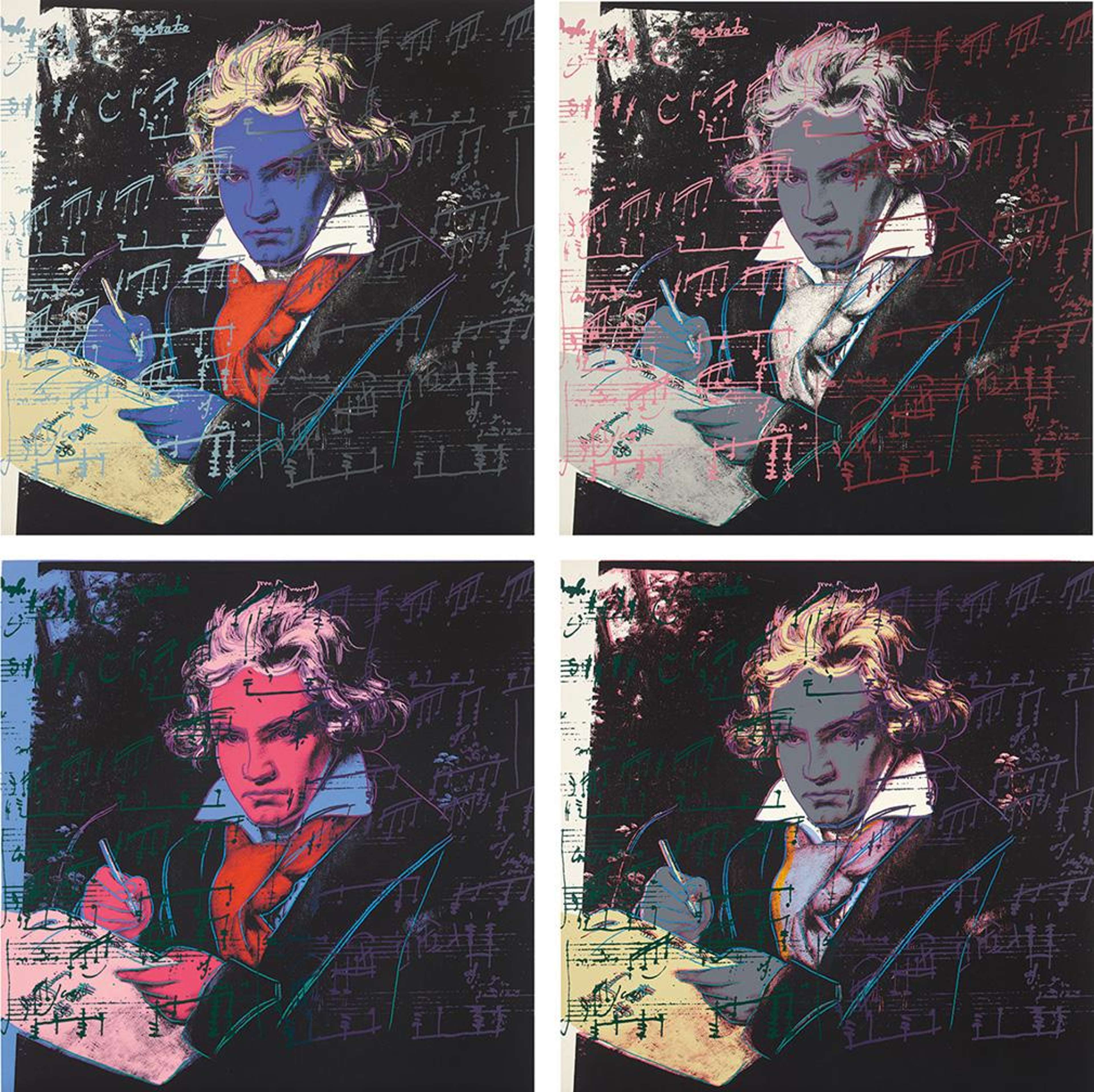
Beethoven (complete set)
Unsigned Print
Andy Warhol
102 x 102cm, Edition of 60, Screenprint, 1987
£260,000-£390,000
$490,000-$730,000 Market Value Indicator
$490,000-$730,000 Market Value Indicator
¥2,360,000-¥3,540,000 Market Value Indicator
€300,000-€450,000 Market Value Indicator
$2,760,000-$4,140,000 Market Value Indicator
¥54,360,000-¥81,540,000 Market Value Indicator
$350,000-$530,000 Market Value Indicator
There aren't enough data points on this work for a comprehensive result. Please speak to a specialist by making an enquiry.
Track auction value trend
Meaning & Analysis
Beethoven (complete set) is a set of four screenprints each presenting a canonical portrait of Ludwig van Beethoven in a different chromatic arrangement, set against a near-black ground scattered with fragments of musical notation. Produced in 1987 in an unsigned edition of 60 complete sets, it was among the last major series Warhol completed before his death in February of that year.
Warhol based the Beethoven series on a well-known nineteenth-century portrait – most likely derived from Joseph Karl Stieler's 1820 painting, which had become the standard image of the composer: dishevelled, intense, caught in the act of composition. In Warhol's hands, the portrait is reworked through the screenprint process and overlaid with scattered score fragments, the musical notation functioning simultaneously as contextual information and as graphic texture across the dense, near-black ground.
Across the four prints, the same figure – yellow-blonde hair, white cravat, pen in hand – appears in blue, grey-silver, pink and warm amber respectively, each colourway shifting the register from cold and monumental to more approachable. The musical notation printed into the backgrounds varies in intensity between prints, at times almost submerged in the ground and at others more clearly legible. The overall effect applies Warhol's serial logic – same source, multiple colour states – to an icon of canonical Western high culture rather than to consumer objects or contemporary celebrity. That this was among his final bodies of work gives it a retrospective resonance, though the prints themselves make no announcement of ending. They are, in formal terms, characteristic: methodical, chromatic and deliberately non-committal about what, if anything, the repetition is supposed to mean.