

Quelle est la valeur des estampes de Keith Haring en 2026 ?
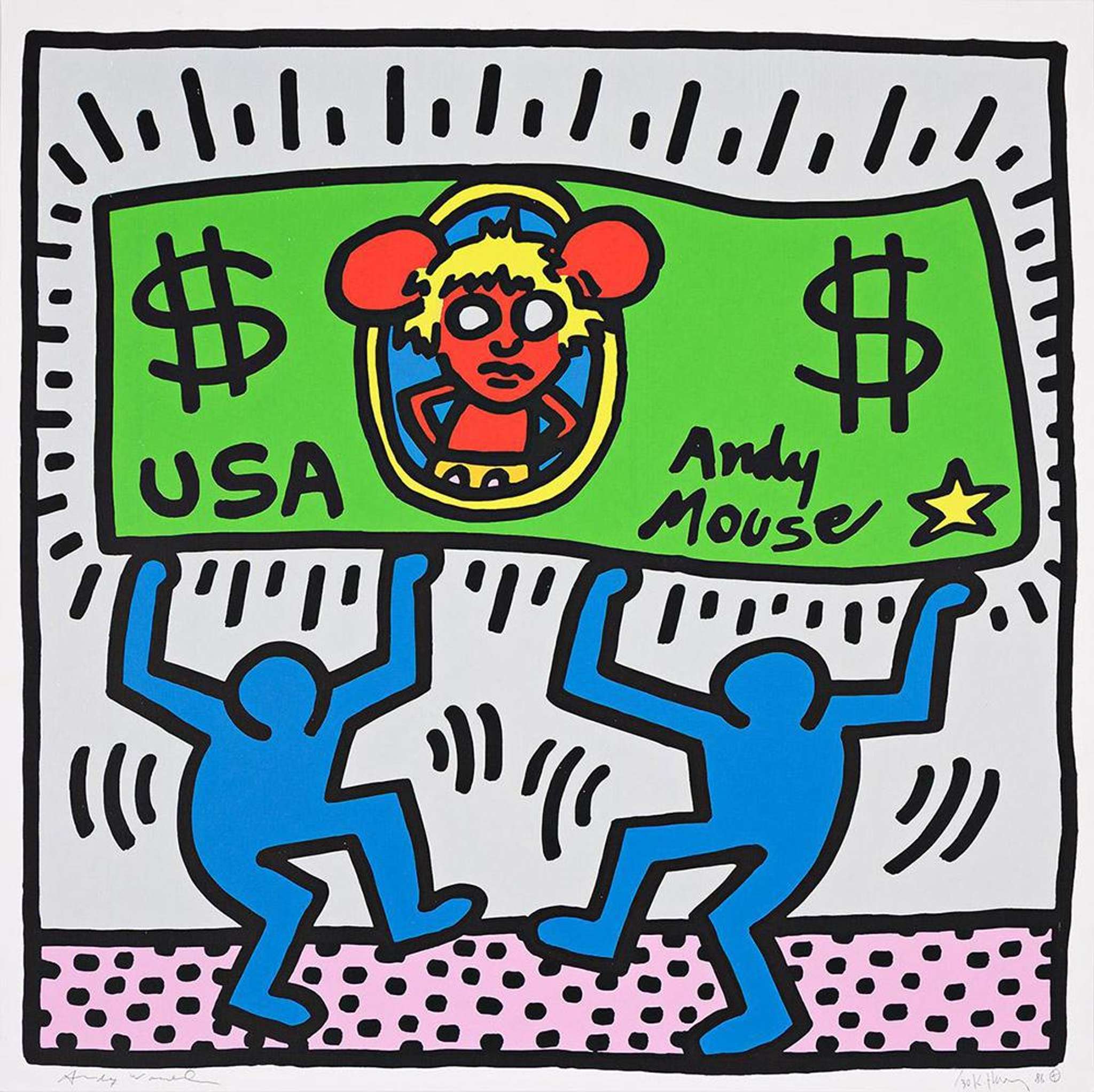
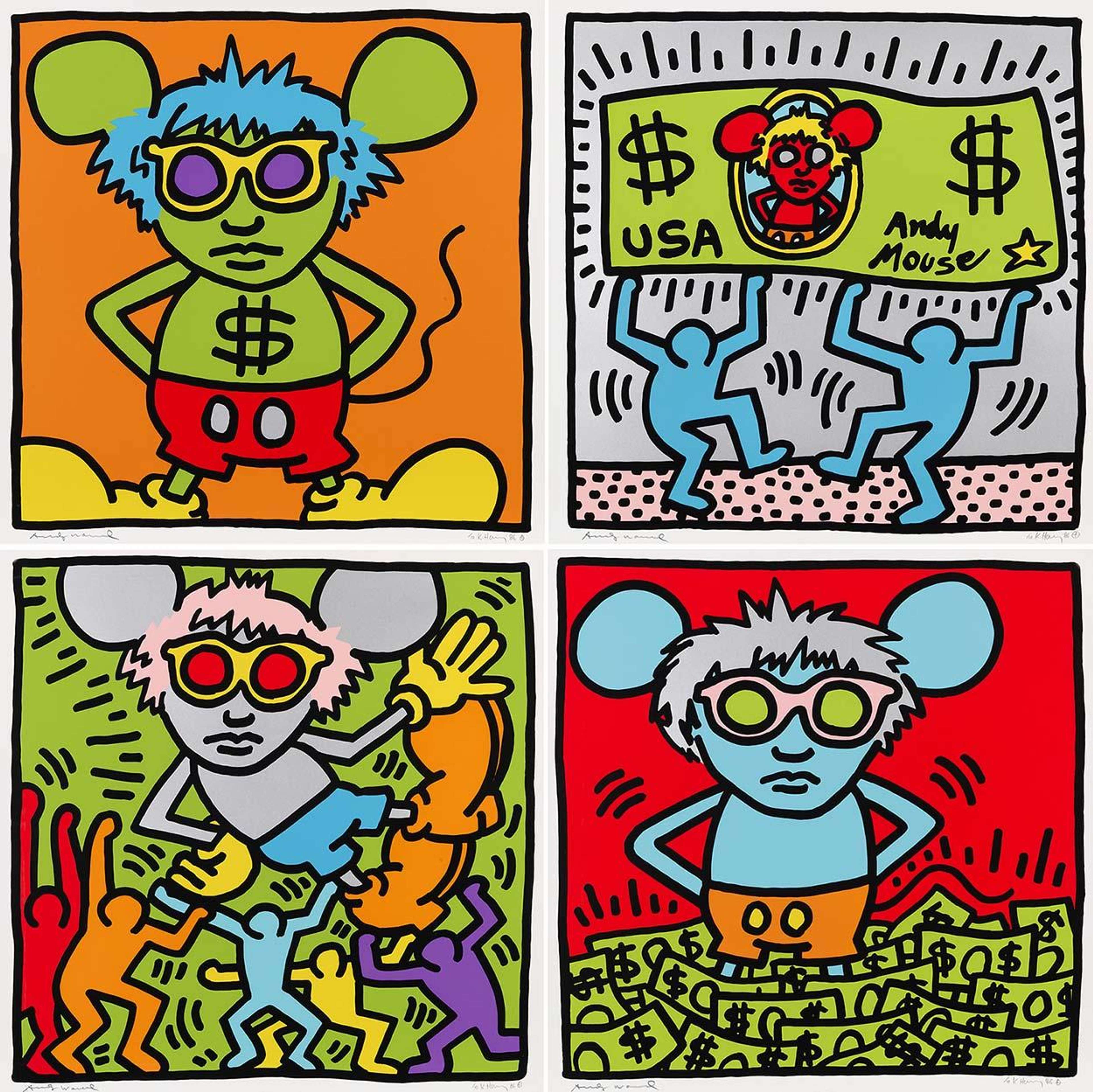
Le prix des estampes de Keith Haring oscille entre moins de 15 000 livres sterling et bien au-delà de 100 000 livres sterling, selon la signature, la rareté, la série et l'année de création. Le record d'adjudication pour une estampe de l'artiste s'établit à 991 182 livres sterling, atteint par une série complète d'estampes Andy Mouse en 2023.
Pour une première acquisition d'une estampe de Keith Haring, vous rencontrerez le plus souvent des œuvres situées entre 10 000 et 30 000 livres sterling. Il s'agit fréquemment d'éditions principales signées issues de séries reconnues, ou d'éditions signées par la succession et autorisées par la Keith Haring Estate. À ce niveau, l'impact visuel et l'état de conservation importent autant que le statut de la signature.
Les éditions signées de premier plan, les formats rares et l'imagerie très reconnaissable se négocient généralement entre 30 000 et 70 000 livres sterling. De nombreuses estampes de Keith Haring ne sont pas titrées ; dans ce cas, la valeur est souvent liée à l'année de création. Les œuvres du début des années 1980 – en particulier entre 1982 et 1985 – ont tendance à atteindre des prix plus élevés que les éditions ultérieures, reflétant la préférence des collectionneurs pour la période la plus formative et historiquement significative de l'artiste.
Les résultats à six chiffres sont réservés aux œuvres plus rares et ambitieuses sur le plan matériel : les estampes de la série Cut Out représentant des chiens, ainsi que certains portfolios complets. Ces pièces figurent au sommet de la hiérarchie des estampes de Keith Haring et apparaissent rarement sur le marché public.
Les acheteurs doivent également prendre en compte les points suivants :
- Une estampe signée à la main par Keith Haring bénéficie généralement d'une prime par rapport aux éditions signées par la succession.
- Les épreuves d'essai (TP) et les épreuves d'artiste (AP) peuvent atteindre des prix plus élevés lorsque leur rareté est dûment documentée.
- Les séries complètes peuvent se négocier avec une prime lorsqu'elles sont intactes, bien que certaines œuvres individuelles emblématiques atteignent souvent des résultats tout aussi compétitifs.
- L'état de conservation et l'intensité des couleurs influencent matériellement le prix, quel que soit le segment.
Le marché de Keith Haring comprenant des œuvres signées à la main, des éditions de la succession et des estampes non signées telles que des affiches d'exposition, les acheteurs doivent comparer les ventes au sein d'une même série et d'un même type d'édition plutôt que de se fier aux moyennes globales.
Les estampes de Keith Haring constituent-elles un bon investissement en 2026 ?
Le marché des estampes de Keith Haring demeure structurellement actif, soutenu par un volume de transactions annuel constant et une segmentation claire des prix. Contrairement aux marchés portés uniquement par une poignée d'œuvres trophées, la solidité de Keith Haring réside dans une répartition équilibrée sur plusieurs segments de valeur.
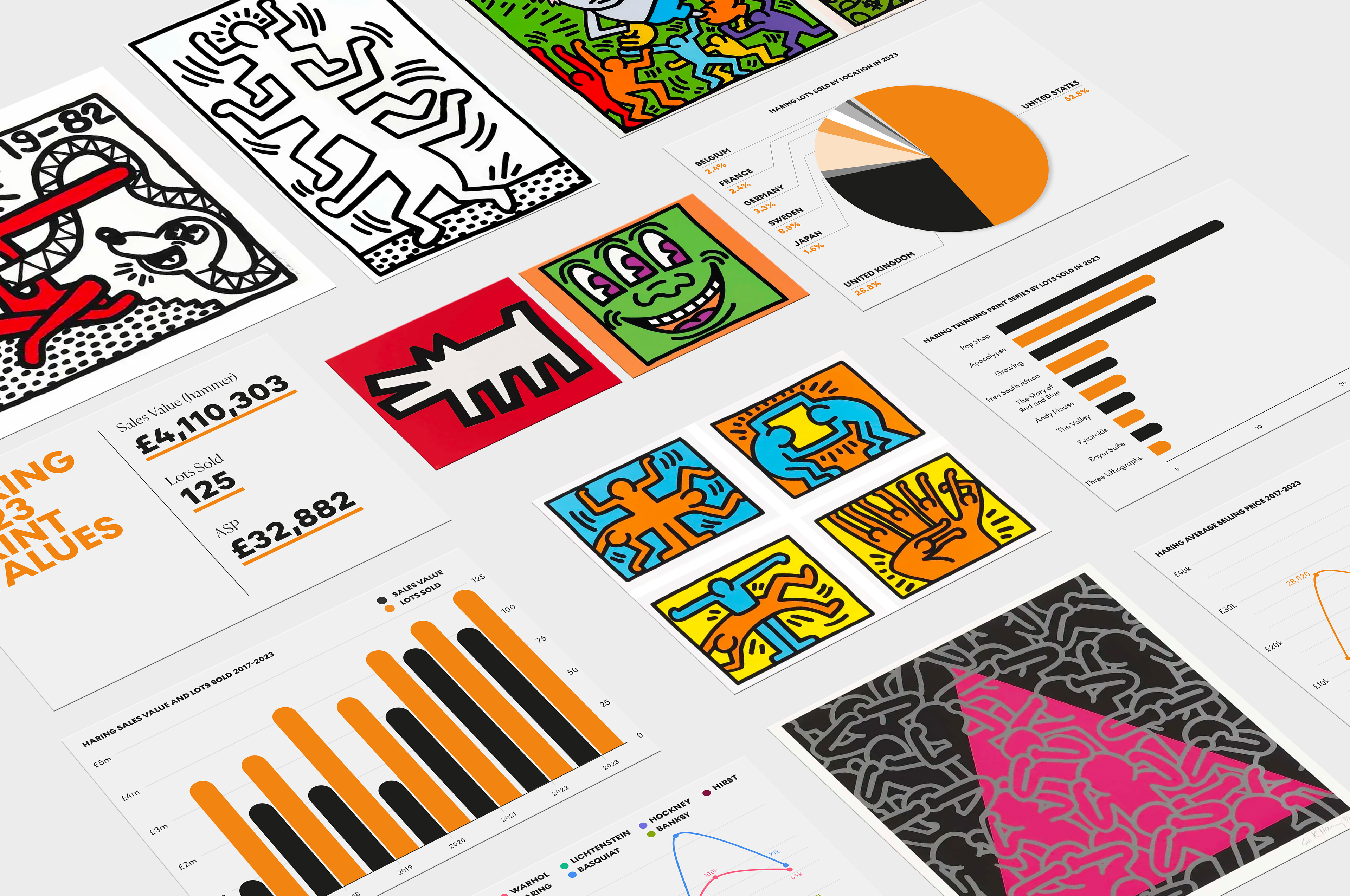
Entre 2021 et 2025, la plus grande part de la valeur totale des ventes a été générée par des œuvres estimées à plus de 90 000 livres sterling (36,1 %), confirmant que les éditions rares et très recherchées – dont celles de la série Andy Mouse, les estampes Cut Out, ainsi qu'une sélection d'œuvres issues de portfolios – continuent de constituer le socle du segment haut de gamme du marché. Parallèlement, 18,7 % de la valeur totale se concentre dans la fourchette de 15 000 à 30 000 livres sterling, et 14,1 % dans celle de 30 000 à 50 000 livres sterling. Cette étendue témoigne du fait que la liquidité ne se limite pas aux seuls résultats records.
Les éditions signées surpassent systématiquement les œuvres publiées par la succession ou à titre posthume sur le long terme, bien que l'écart puisse se réduire en fonction de la série et de l'offre. Les acquéreurs gagneraient à évaluer chaque œuvre individuellement plutôt que de se fier uniquement à la présence d'une signature.
Les ensembles complets et les épreuves d'artiste peuvent atteindre des résultats notables, mais le marché de Keith Haring ne dépend pas exclusivement des portfolios. Des œuvres isolées de qualité – en particulier les formats rares ou ceux présentant une imagerie culturellement marquante – sont souvent tout aussi compétitives. Pour une analyse plus approfondie de l'évolution des prix sur le long terme, des performances des éditions et des tendances de liquidité, consultez notre Guide d'investissement Keith Haring dédié.
Le moment est-il venu d'acquérir des estampes de Keith Haring ?
Le marché des estampes de Keith Haring associe une pertinence culturelle indéniable à une grande diversité de gammes de prix. Son imagerie – bébés rayonnants, chiens aboyeurs, silhouettes dansantes – demeure instantanément reconnaissable et largement soutenue par les institutions, tandis que ses œuvres en édition offrent des points d'entrée bien plus accessibles que ses peintures uniques.
Contrairement aux segments du marché portés exclusivement par la rareté des artistes blue chip, le marché de Keith Haring s'étend d'estampes accessibles à moins de 15 000 livres sterling jusqu'à des résultats approchant le million de livres sterling. Cette étendue garantit à la fois une liquidité certaine et des opportunités d'investissement sélectives. Pour les acheteurs, Keith Haring constitue l'un des points d'entrée les plus emblématiques sur le plan culturel dans le marché de l'art contemporain des années 1980, soutenu par un marché secondaire dont l'activité est démontrée sur plusieurs paliers de prix.
Éditions d'estampes de Keith Haring : œuvres signées à la main, signées par la succession, épreuves d'essai et éditions Pop Shop
Le marché des estampes de Haring se compose de plusieurs catégories distinctes, dont la compréhension est fondamentale avant toute acquisition.
Estampes de Keith Haring signées à la main
Nombre des œuvres les plus prisées de Haring sont signées au crayon par l'artiste. Elles atteignent les prix les plus élevés, en particulier celles datant du début des années 1980 et les portfolios majeurs tels que Andy Mouse, Flowers, Growing et Fertility. Andy Mouse présente une double signature, celle de Haring ainsi que celle d'Andy Warhol.
Estampes de Keith Haring signées par la succession : faut-il les acquérir ?
Certaines éditions autorisées ont été publiées après le décès de Haring et portent la signature de Julia Gruen, exécutrice testamentaire du Keith Haring Estate. Bien qu'il s'agisse d'éditions légitimes, leur valeur sur le marché est généralement inférieure à celle des exemplaires signés à la main par l'artiste. Les acheteurs s'interrogent souvent sur la valeur des estampes de Haring signées par la succession ; la tarification reflète l'absence de la signature autographe de l'artiste.
Épreuves d'essai et épreuves d'artiste de Keith Haring : atteignent-elles des prix plus élevés ?
Des épreuves d'essai (TP) et des épreuves d'artiste (AP) existent sur le marché de Haring et peuvent faire l'objet d'une prime lorsque leur rareté est dûment documentée. Une TP est imprimée en dehors de l'édition principale numérotée, souvent en petite quantité. Toutefois, la désignation d'« épreuve » ne garantit pas à elle seule une valeur supérieure sur le marché de Haring ; l'attrait dépend toujours de l'imagerie, de l'état de conservation et de la demande des collectionneurs pour la série spécifique.
Séries complètes de Keith Haring : quand surpassent-elles les œuvres individuelles ?
Parmi les portfolios complets vendus publiquement récemment figurent les collections Fertility, Flowers, Growing, Icons et Pop Shop. Cela étant dit, le marché de Haring n'est pas exclusivement axé sur les portfolios. De nombreux résultats d'enchères performants proviennent d'œuvres individuelles rares plutôt que de séries complètes ; les acheteurs doivent donc évaluer attentivement les deux formats.
Estampes, « quads » et affiches d'exposition Pop Shop
Les estampes Pop Shop de Haring ont été conçues pour rendre son travail largement accessible et ont été publiées en éditions plus importantes que nombre de ses œuvres antérieures. La taille des éditions peut varier selon le tirage et la variante de couleur, et le prix reflète à la fois le format et le statut de la signature. Les œuvres Pop Shop se déclinent en estampes sur feuille simple, incluant des compositions « quad » où quatre images sont présentées sur une seule feuille, ainsi qu'en séries complètes. « Retrospect » est une œuvre rare qui présente 24 des illustrations Pop Shop les plus reconnaissables de Haring sur une seule feuille et peut s'échanger entre 70 000 et 100 000 livres sterling sur le marché actuel.
Certaines œuvres Pop Shop sont signées à la main par Haring, d'autres sont signées par la succession, et certaines ne sont pas signées. Les acheteurs doivent vérifier la taille de l'édition, la numérotation et le type de signature avant d'estimer leur valeur. Des affiches d'exposition existent également et sont généralement non signées et non numérotées. Celles-ci se négocient à des prix inférieurs à ceux des estampes d'édition autorisées et ne doivent pas être confondues avec des éditions signées ou numérotées.
Les estampes les plus précieuses de Keith Haring : Andy Mouse, Cut Out et éditions rares
Lorsque les acquéreurs recherchent les estampes de Keith Haring les plus convoitées, l'attention se porte systématiquement sur un groupe restreint d'œuvres culturellement significatives et structurellement rares.
Andy Mouse (série complète) : La série Andy Mouse (série complète) se situe au sommet de la hiérarchie des estampes de Haring. Créées en collaboration avec Warhol, ces estampes atteignent les prix les plus élevés sur le marché de l'artiste. En 2023, la série a établi le record d'enchères pour une estampe de Haring, atteignant 991 182 livres sterling (frais inclus).
Éditions Dog Cut Out : Au cours des années 2024 et 2025, deux sculptures Dog Cut Out sont apparues aux enchères – une épreuve d'essai jaune en 2024 et une édition principale noire en 2025 – atteignant un prix marteau de 280 000 livres sterling et 241 386 livres sterling respectivement (frais inclus), renforçant ainsi leur position comme l'un des segments les plus recherchés et les plus prisés du marché des estampes de Haring.
Silence Equals Death : Silence Equals Death est l'une des œuvres de Haring les plus chargées politiquement et culturellement importantes. Créée au plus fort de la crise du sida, elle possède une résonance historique et sociale profonde. Les exemplaires signés sont particulièrement recherchés, les belles estampes se négociant généralement entre 30 000 et 70 000 livres sterling ; l'importance de cette œuvre dépasse largement sa valeur décorative. Pour les collectionneurs s'intéressant à l'activisme et à l'héritage de Haring, cette estampe demeure une acquisition déterminante.
Comment authentifier une estampe de Keith Haring avant tout achat ?
L'authentification d'une estampe de Keith Haring exige de confirmer que l'œuvre appartient à une édition autorisée, qu'elle est correctement signée et qu'elle concorde avec les archives des éditeurs ainsi qu'avec le catalogue raisonné. Le marché de Keith Haring incluant des œuvres signées à la main, des éditions signées par la succession de l'artiste, des affiches d'exposition et des contrefaçons connues, les acquéreurs doivent faire preuve d'une grande vigilance avant tout achat.
Catalogue raisonné de Keith Haring : comment vérifier une édition
Les estampes de Keith Haring sont répertoriées dans le catalogue raisonné officiel de l'artiste, publié par Rizzoli et supervisé par la Keith Haring Foundation. Avant tout achat, les acquéreurs doivent s'assurer que l'estampe correspond à l'année, au tirage, à l'éditeur et au format enregistrés. De nombreuses œuvres de Keith Haring étant dépourvues de titre, une datation exacte revêt une importance particulière. Si une estampe ne correspond à aucune entrée du catalogue, une expertise spécialisée supplémentaire est nécessaire.
Certificat d'authenticité (COA)
Certaines œuvres sont accompagnées d'un certificat d'authenticité délivré par le comité d'authentification de la succession de Keith Haring (Estate of Keith Haring). Un certificat d'authenticité émanant de la succession renforce considérablement la provenance et offre une garantie supplémentaire que l'œuvre a été examinée et approuvée selon le processus d'authentification de la fondation. Toutefois, l'absence de certificat ne signifie pas systématiquement qu'une estampe n'est pas authentique. De nombreuses œuvres légitimes circulent sans certificat mais sont vérifiées par le biais du catalogue raisonné, de la documentation de l'éditeur et de l'historique de provenance.
Types de signatures chez Keith Haring : signées à la main, signées par la succession ou non signées
Les estampes de Keith Haring se répartissent en trois catégories principales : signées à la main par Keith Haring (généralement au crayon), signées par la succession par Julia Gruen, exécutrice testamentaire de la succession de Keith Haring, et les œuvres non signées. Les œuvres signées à la main atteignent des prix plus élevés. Les éditions signées par la succession sont autorisées mais se vendent généralement à des prix inférieurs aux exemplaires signés à la main. Les acquéreurs doivent être conscients que les signatures au crayon contrefaites sont courantes sur le marché des œuvres de Keith Haring, en particulier pour les estampes plus accessibles. Pour « Andy Mouse », l'authentification doit également confirmer la présence et la cohérence de la double signature de Keith Haring et Warhol.
Vérification de l'éditeur et du timbre sec : Martin Lawrence et Iguana
De nombreuses estampes authentiques de Keith Haring ont été publiées par Martin Lawrence Limited Editions. Les détails concernant l'éditeur doivent concorder avec les documents enregistrés pour la série spécifique. Certaines estampes autorisées du « Pop Shop » portent le timbre sec Iguana. Les acquéreurs doivent vérifier que tout timbre sec correspond aux normes de production connues et qu'il n'a été ni ajouté ni altéré.
Pourquoi la provenance est essentielle lors de l'achat d'une estampe de Keith Haring
En raison de l'existence de contrefaçons sur le marché des œuvres de Keith Haring, la provenance réduit considérablement les risques. Avant de conclure une transaction, les acquéreurs doivent examiner les factures de galerie, les anciens prix d'adjudication, la documentation de l'éditeur ainsi que tout certificat émis par la succession. Les œuvres proposées à des prix nettement inférieurs à ceux du marché doivent être abordées avec prudence. Acquérir une œuvre via une plateforme spécialisée qui effectue des vérifications et des recoupements avec le catalogue raisonné constitue une protection supplémentaire.
Comment vérifier l'état d'une estampe de Keith Haring ?
L'état de conservation joue un rôle majeur dans la valeur d'une estampe de Keith Haring. Dans la mesure où la plupart de ses œuvres sont des sérigraphies audacieuses caractérisées par des aplats de couleurs saturées et un trait noir affirmé, même des défauts mineurs peuvent être visuellement évidents et avoir une incidence notable sur le prix.
Examen de la couleur et de l'état de surface des sérigraphies de Keith Haring
Les estampes de Keith Haring reposent sur la précision du trait et la vigueur des contrastes chromatiques. Les acquéreurs doivent être attentifs à tout signe de décoloration, d'irrégularité dans la saturation des couleurs, d'éraflures ou de craquelures de la couche d'encre. L'exposition aux rayons UV peut altérer la vivacité des pigments, particulièrement pour les rouges, les jaunes et les tons primaires éclatants. Cette perte d'intensité chromatique est plus perceptible sur les œuvres de Keith Haring que sur le marché d'autres estampes.
État du papier, marges et découpes des estampes de Keith Haring
Inspectez le papier pour déceler d'éventuels jaunissements, piqûres, plis, traces de charnières ou rognages. Des marges intactes et complètes sont essentielles sur le marché de Keith Haring, car le recadrage d'une estampe pour l'adapter à un cadre peut en réduire considérablement la valeur. Si les œuvres du début des années 1980 doivent présenter un vieillissement naturel, une décoloration prononcée ou des dégâts dus à l'humidité altèrent significativement leur attrait.
Considérations sur l'état des éditions découpées et des œuvres de forme, dont le Dog Cut-Out de Keith Haring
Pour les éditions découpées, telles que les œuvres « Dog » et les éditions « Pyramid », l'intégrité des bords est fondamentale. Les acquéreurs doivent examiner les contours pour repérer d'éventuels éclats, déchirures, marques de manipulation ou déformations. Ces œuvres brouillant la frontière entre l'estampe et l'objet, leur état physique revêt une importance accrue.
Encadrement, montage et restauration : ce que les acheteurs d'estampes de Keith Haring doivent savoir
Un encadrement inapproprié avec un fond acide ou un montage adhésif peut causer des dommages irréversibles. Il est recommandé d'encadrer les estampes avec un verre anti-UV et des matériaux sans acide. Une restauration excessive peut également déprécier l'œuvre. Un nettoyage agressif, une retouche des zones sérigraphiées ou une conservation non documentée peuvent impacter négativement la valorisation. Dans la plupart des cas, un vieillissement stable est préférable à une intervention intrusive. Avant l'acquisition d'une estampe de Keith Haring, les acheteurs doivent solliciter un rapport d'état détaillé, des images haute résolution de la surface et des marges, des photographies en lumière rasante pour révéler les irrégularités de surface, ainsi qu'une déclaration de tout historique de restauration. Sur le marché de Keith Haring – en particulier pour les œuvres précoces signées et les formats rares – un exemplaire présentant une meilleure conservation justifie souvent une prime substantielle.
Où acquérir une estampe de Keith Haring en 2026
Les estampes de Keith Haring sont disponibles auprès des grandes maisons de ventes aux enchères, des plateformes régionales, des galeries, des courtiers privés et des réseaux de spécialistes. Le marché de Keith Haring couvrant plusieurs segments de prix – des estampes accessibles aux œuvres avoisinant le million de livres sterling – l'offre est présente sur une grande variété de lieux de transaction.
Acquérir des estampes de Keith Haring en vente aux enchères
Les grandes maisons de ventes, notamment Christie's, Sotheby's et Phillips, traitent des œuvres très demandées telles qu'« Andy Mouse », les éditions « Dog Cut-Out » et des portfolios complets. Si les acheteurs bénéficient de la transparence des prix publics et de la compétitivité des enchères, ils doivent tenir compte des frais acheteurs de 25 % ou plus, des implications liées à la TVA, ainsi que du risque de surenchère lors de l'apparition d'œuvres rares. Les maisons de ventes régionales peuvent proposer des points de prix plus accessibles pour des œuvres de milieu de gamme.
Acquérir des estampes de Keith Haring via une vente privée
Les ventes privées offrent une souplesse de négociation, une discrétion accrue et l'accès à des œuvres qui ne seront peut-être jamais présentées aux enchères. De nombreuses œuvres anciennes signées ainsi que des exemplaires dans un état de conservation supérieur circulent dans le secteur privé, notamment lorsque les vendeurs souhaitent éviter de rendre les prix publics. Pour les collectionneurs ciblant des séries spécifiques, certains types d'éditions ou des estampes dans un état de conservation optimal, la vente privée constitue souvent une voie d'acquisition plus maîtrisée.
Enchères ou vente privée : quelle est la meilleure option pour les acquéreurs ?
Le marché de Keith Haring comprenant à la fois des œuvres de milieu de gamme largement échangées et des pièces de premier ordre très convoitées, combiner le suivi des enchères et le sourcing privé représente généralement la stratégie d'acquisition la plus efficace. Pour une comparaison détaillée de ces deux circuits, consultez notre guide sur les ventes aux enchères versus les ventes privées pour les estampes et multiples.
Pourquoi choisir MyArtBroker pour acquérir des estampes de Keith Haring ?
L'acquisition d'une estampe de Keith Haring exige bien plus qu'un simple suivi des prix d'adjudication ; elle requiert une expertise approfondie sur les types de signatures, l'alignement avec les éditeurs, la désignation des épreuves et les exigences liées au rapport d'état. MyArtBroker fournit l'infrastructure nécessaire pour accompagner ce processus. Notre Trading Floor met directement en relation les acquéreurs avec un réseau mondial de collectionneurs traitant activement des estampes de Keith Haring, permettant ainsi d'accéder à des œuvres qui n'atteignent parfois jamais le marché des enchères publiques. Notre outil d' évaluation instantanée compare chaque œuvre spécifique aux ventes récentes comparables et aux données de performance propres à chaque série. Chaque transaction est soumise à une vérification rigoureuse concernant la structure de l'édition, le type de signature, l'alignement avec l'éditeur, la cohérence du catalogue et l'état de conservation, réduisant ainsi considérablement les risques d'acquisition sur un marché où les signatures contrefaites et les erreurs de description subsistent.